


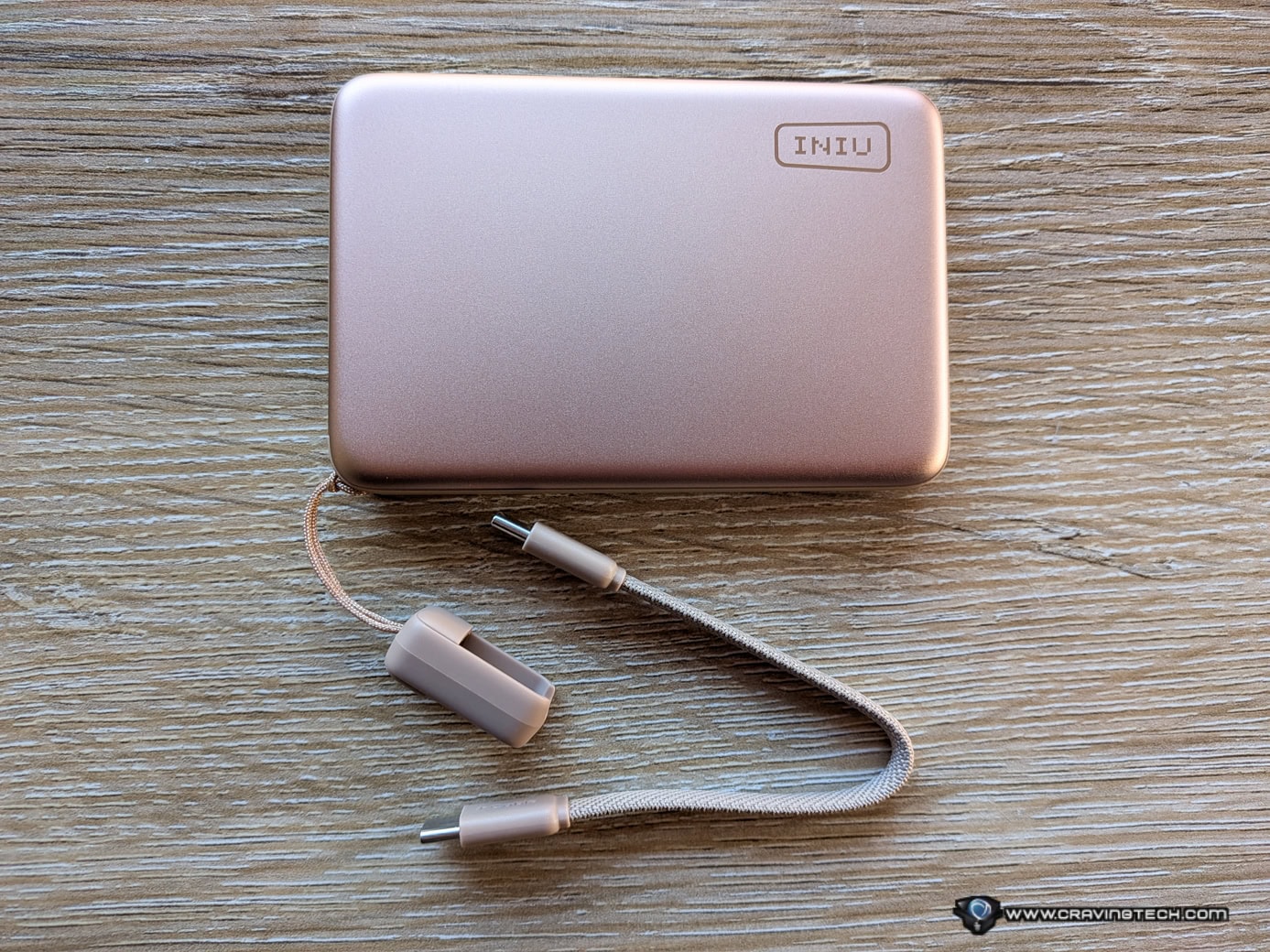
Power banks are one of those gadgets I never leave home without, but let’s be honest, most of them are chunky bricks that make my bag heavier than it needs to be. So when INIU sent over their SnapGo Air, a magnetic Qi2.2 power bank that’s only 1.37cm thin with 10,000mAh battery capacity, I was curious to see if it could actually replace the bulkier ones I’m used to carrying around.
The SnapGo Air is built around Apple’s MagSafe-style magnetic alignment, so it snaps onto an iPhone easily. I’m a Google Pixel man myself (a pink one, at that – check my Pixel 9a Review), so without a special magnetic case or ring attached to my Pixel, it won’t snap on and hold the way it would on an iPhone. I could still use it for wireless charging by simply resting it against the back of my phone, just without the magnetic lock — or when travelling, I’d just plug it in with the GoCord (more on that later). So this review comes from an Android/Pixel angle, with a few notes on why I can still see the appeal for iPhone owners.
I’ve had a few days to charge with it, drain it, recharge it, and generally live with it in my bag, on my desk, or in my pocket, so here’s how it went.
Packaging and Unboxing
Design and portability
The first thing you notice with the SnapGo Air is just how small and slick it is. At 10.5 x 7.1 x 1.37cm and only 195g, it’s pocketable in a way that a lot of 10,000mAh power banks simply aren’t. It comes in six colours (I got sent a fairly neutral one), and the anodised aluminium body with a soft-touch finish makes it feel a lot more premium than the price tag suggests.
One thing that I like is the USB-C cable design, or as INIU calls it, the GoCord. Instead of forcing you to carry a separate charging cable around, it’s built into the power bank itself and doubles as a little handle or a stand for the unit.
Most power banks in this price range just give you four little LED dots to guess your remaining battery from, but the SnapGo Air shows you an actual percentage. It makes a real difference when you’re trying to decide whether it has enough juice left to get your phone through the rest of the day, rather than doing some guess work.
Wireless and wired charging
Being a Qi2.2 certified power bank, the SnapGo Air can push up to 25W wirelessly, but that top speed is currently locked to newer iPhones (16 Plus/Pro Max and later, running iOS 26+) that support the full Qi2.2 spec. On my Pixel 9a, wireless charging still worked perfectly fine, since the Pixel supports standard Qi charging, but I wasn’t getting anywhere near that 25W ceiling.
The bigger limitation for me as a Pixel user is the magnetic snap. The SnapGo Air’s magnets are designed to align with Apple’s MagSafe magnet ring, which is built into iPhone 12 and later. My Pixel 9a doesn’t have that magnet array, so the power bank won’t lock on by itself. I could still rest it against the back of the phone and it would charge wirelessly, but I had to hold it in place or be careful not to bump it, rather than just snapping it on and forgetting about it. If you’re on Android, you’d need a magnetic ring case or a phone with built-in magnets (like some of the newer Qi2-ready Android devices) to get that same snap-and-go experience.
That said, I can absolutely see the appeal for iPhone owners. Snapping the power bank onto the back of your phone and having it lock in with a satisfying click, strong enough to survive a run for the train, is a genuinely nice way to charge wirelessly without cables getting in the way. It’s just not an experience I could fully replicate on my Pixel without buying extra accessories.
Putting the wireless charging speed to the test
I set the Pixel 9a on top of the SnapGo Air with the power bank sitting at 84%, and tracked both percentages as the wireless charging session went on:
TimePhoneCharger1:24 PM10%84%1:44 PM16%78%1:58 PM21%75%2:19 PM29%68%2:31 PM33%65%3:06 PM46%54%3:14 PM49%51%3:35 PM57%45%4:03 PM65%35%4:23 PM73%28%4:40 PM78%22%5:09 PM87%12%5:32 PM91%0%
Over 4 hours and 8 minutes, the power bank drained itself completely, from 84% down to 0%, while my Pixel 9a only climbed from 10% to 91%. That gap is expected rather than disappointing. Wireless charging has to convert power twice, once going out of the power bank’s own battery and across the coil, and again as the phone’s receiver turns that into a current its battery can accept, and each step bleeds off energy as heat. Working through the numbers, the phone was only receiving roughly half the energy the power bank was actually spending, which lines up with the kind of real-world efficiency you typically see from Qi wireless charging.
It’s also a good demonstration of why the Pixel’s 7.5W wireless ceiling matters here. Even setting efficiency losses aside, the phone was never going to pull anywhere near the SnapGo Air’s 25W Qi2.2 maximum, since that top speed is reserved for the newer Qi2.2-compatible iPhones. For Android users, the more realistic takeaway is that wireless charging on this power bank is convenient, but noticeably slower and less efficient than just plugging in, and it’ll eat through the power bank’s own capacity a lot faster than a wired session would.
Putting the wired charging speed to the test
If you do need speed, the wired side is where this thing flexes a bit more muscle. The built-in GoCord supports up to 45W PD fast charging. To actually put that to the test, I used my other phone, an OPPO Reno 12F 5G, since its 5,000mAh battery and 45W-rated charging make it a better match for seeing what the GoCord can really do than the Pixel’s more modest 23W wired ceiling.
I plugged the Oppo Reno 12F 5G into the SnapGo Air’s GoCord from completely flat and tracked the percentage as it charged:
TimeBattery9:40 AM0%9:52 AM13%10:11 AM31%10:32 AM53%10:53 AM73%11:16 AM90%11:38 AM98%11:53 AM100%
That’s a full charge in around 2 hours and 13 minutes. For context, Oppo’s own lab figures claim a 1–100% charge in about 71 minutes when the phone is paired with its proprietary 45W SuperVOOC charger. So the SnapGo Air was noticeably slower than that official number, and there’s a straightforward reason why: SuperVOOC is a proprietary fast-charging protocol that needs a specific handshake between the charger and the phone to unlock its full speed. A standard USB-PD power bank like the SnapGo Air can’t trigger that handshake, so the Reno 12F 5G falls back to a more generic charging profile instead, well short of its rated peak.
It’s a good reminder that a “45W” rating on a power bank doesn’t automatically mean 45W on every phone. Brands like Oppo, OnePlus, and Xiaomi gate their fastest speeds behind their own proprietary protocols, so if you’re coming from one of those ecosystems, don’t expect the box-advertised wattage. On phones that stick to standard USB-PD, like the Pixel, you’ll get a much truer picture of what the GoCord can actually deliver.
So should you get the INIU SnapGo Air?
For a device this thin, the SnapGo Air packs in a surprising amount: fast Qi2.2 wireless charging, 45W wired output, a useful percentage display, and a built-in cable that saves you from digging around your bag. As a Pixel 9a user, I still got plenty of use out of it as a slim, well-built wireless and wired power bank. I just didn’t get the full magnetic snap-on experience or the 25W wireless ceiling, since both of those are really designed around the iPhone’s MagSafe ecosystem.
If you’re on iPhone 12 or later, this is an easy recommendation. The magnetic snap and full wireless speed make it feel purpose-built for your phone. If you’re on Android like me, it’s still a solid, ultra-slim power bank with fast wired charging and decent wireless support, but you’ll want to go in knowing the magnetic party trick needs an iPhone (or a magnetic case/ring) to really shine.
Disclosure: INIU SnapGo Air review sample was supplied for reviewing
INIU SnapGo Air Review
Summary
A compact and stylish 10,000mAh power bank with fast wired charging, convenient magnetic wireless charging, a useful battery display, and a cleverly integrated cable.
Pros
- Small, slim, and pocketable
- Slick, premium-feeling design
- Percentage display beats the usual LED dots
- Fast Qi2.2 wireless charging (on supported iPhones)
- 45W wired fast charging
- Strong magnetic snap onto iPhone
- Built-in USB-C GoCord doubles as a cable and a stand
Cons
- Magnetic snap and full 25W wireless speed are effectively iPhone-only features
- Android users need a magnetic case or ring to get the snap-on experience
- 10,000mAh capacity means it’s good for a top-up, not multiple full charges
- Proprietary fast-charging protocols (like Oppo’s SuperVOOC) won’t be triggered, so wired speed can fall short of a phone’s advertised peak on some Android brands
About Yohan Setiawan
An avid gamer and footballer, also passionate in technology and software development. His writing effortlessly blends their love for gaming and technology, creating captivating narratives that resonate with readers across various interests.
–>
Source link