
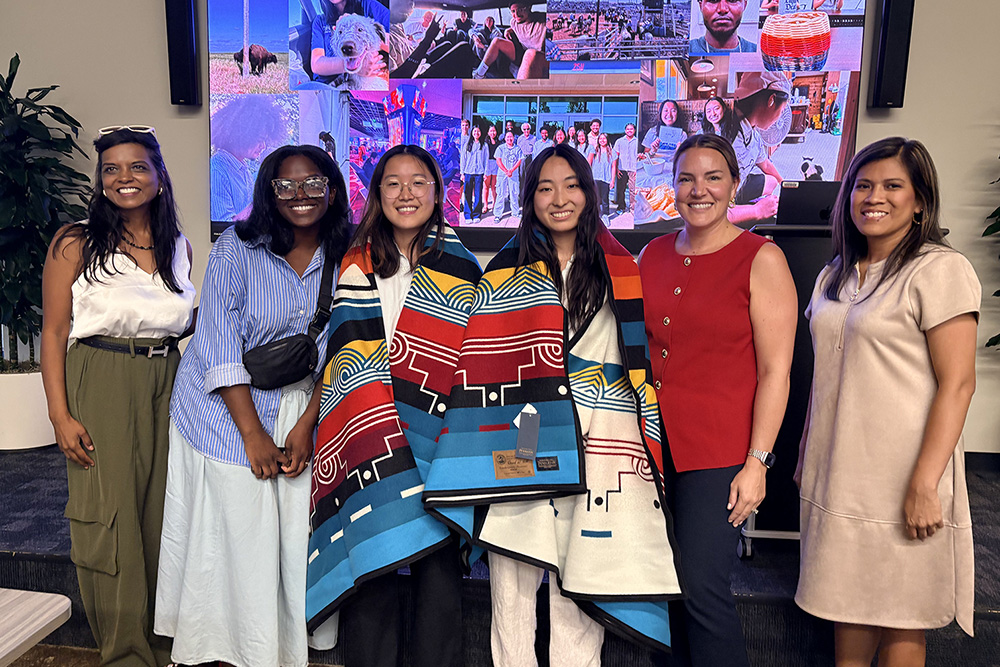
When MIT mechanical engineering student Daphne Wang arrived for her internship at the Muscogee Creek Nation Department of Health in Tulsa, Oklahoma last summer, she expected to be writing code. To her surprise, she found herself analyzing tribal history and the implications for technical innovation.
“I learned so much that I think should be required curriculum for every single person in this country,” says Wang. “I think tech for good is genuinely getting out into communities and learning about people who aren’t you, creating worldly perspectives that you ultimately can take into everything else that you do.”
Wang and fellow intern Lucy Sun, who is majoring in artificial intelligence and decision making, spent the summer supporting the development of the Muscogee Nation’s first Pregnancy Risk Assessment Monitoring System (PRAMS) survey to capture maternal health data specific to Muscogee women. The project required completing literature reviews, analyzing datasets, and drafting survey questions, while considering issues of data sovereignty and governance structures specific to the Muscogee.
“It was this change of pace — 180 [degrees] from MIT, completely,” Wang reflects. At MIT, she says, course instructors routinely prepare students for big technical challenges, but there are fewer opportunities to “work with communities, [learn] how to think about the cultural and historical dimensions of the work, or how to consider the people who will be affected.”
Wang’s supervisor, epidemiologist Breanna McNaughton-Long, was effusive about Wang and Sun’s engagement. “They were instrumental. They did so much work that I don’t think we would have been able to do as quickly,” she says. “And they brought this sense that we were doing something that mattered.”
Experiential learning at the confluence of humanities and engineering
Wang was one of 10 MIT undergraduates to participate in the PKG Center for Social Impact’s 2026 Code.Tulsa program. Now in its second year, Code.Tulsa is made possible by support from the Patrick J. McGovern Foundation and the George Kaiser Family Foundation.
Students live at the University of Tulsa for the summer. They intern with the Muscogee and Cherokee nations, as well as local nonprofits Black Tech Street and Urban Coders Guild, completing AI, data science, and other technical projects.
The PKG Center’s assistant dean for community-based programs, Vippy Yee, complements students’ professional experience with education on the historical and cultural significance of tech-based development in the Tulsa region from the perspective of local leaders.
“As with all PKG Center programming, our aim is to help students integrate an engineer’s approach to problem-solving with a humanist lens on the nature of social challenges, and by extension interventions,” says Alison Badgett, the PKG Center’s director.
“Getting to speak to people who were either very educated on the issues or have experienced them has been a massive help in reshaping the way that I think about social issues,” says Chenise Harper, an electrical engineering with computing major who interned with the Urban Coders Guild.
Harper puts this dynamic candidly: “I hated history, but I learned a lot about why it is useful for making social change and how to go about researching it. I now feel a lot more confident that I can make an impact.”
A student’s vision for increasing STEM access
Code.Tulsa was the brainchild of sophomore Jack Carson, an electrical engineering and computer science (EECS) student who approached the PKG Center with the idea for Code.Tulsa as an incoming first-year student. Carson, who is from Tulsa and a member of the Cherokee Nation, saw firsthand that rural Native students who could benefit greatly from STEM education were unlikely to have access to it. Carson proposed developing a weeklong STEM camp for members of federally recognized tribes held at the University of Tulsa, with he and Code.Tulsa interns serving as instructors.
Carson devised a nomination system to attract promising high school students, selecting 25 campers from 10 tribes out of 160 applications representing 25 Native nations.
To develop the curriculum, Carson enlisted Harvard University student Allie Zong, whom he had met at Campus Preview Weekend. The Tulsa Advanced Sciences Camp (TASC) offers intensive, interactive track time in AI engineering, DNA technology, physics, and chemistry and energy. This is complemented by philosophical workshops to help students think more ambitiously and deliberately about what they can and should achieve in the near and long term. As Zong explains, “We teach them not knowledge, but curiosity, and the skills to teach themselves.”
The TASC experience “kind of propelled me to self-study calculus,” says Alyssa Theofanidis, a rising high school senior from Houston who is a citizen of the Cherokee Nation. Theofanidis participated in the camp’s first year, returning this summer as a teaching assistant. Like many TASC campers, Theofanidis is eager to use her developing STEM expertise to benefit her Native community.
TASC “got us to think 1,000 times more ambitiously about the impact we could have,” said another camper, who was inspired by guest speakers “like the nuclear fusion person at the top of their field,” referring to physicist Alexandra LeViness of MIT spinout Commonwealth Fusion Systems, who helped develop TASC’s chemistry and energy track. Campers were also inspired by “the different worldviews” of MIT interns. “I thought, maybe this is what MIT looks like,” said one camper, with several expressing the intent to apply to MIT as a result of the camp.
Cherokee Nation Principal Chief Chuck Hoskin Jr. also delivered remarks at TASC, encouraging students as future leaders to take a public interest in technology.
“Technology can be used for good, or it can be used for harm. Your generation has the opportunity to bend that arc toward something good,” Hoskin said. “It’s a very special relationship that the Cherokee Nation has with MIT. As we reach out a hand in friendship, we have a hand reaching back. We are thankful for Cherokee citizen Jack Carson, a former secretary for the Cherokee Nation tribal youth council, for his leadership role in organizing this effort.”
Making a positive long-term social impact
Like TASC campers, Code.Tulsa interns came away from the experience motivated to make a positive impact. While most MIT students won’t go on to full-time professional roles traditionally associated with social impact, PKG Center programming like Code.Tulsa helps students recognize they can promote the public interest no matter their career. As Elvis Chipiro, a junior in computer science and engineering, reflected after interning with the Cherokee Nation, “Social impact is not separate from mainstream technology; rather, it is embedded in the choices engineers make every day … Ultimately, meaningful social change is not driven by technology alone, but by people willing to design systems with empathy, responsibility, and inclusion at the center.”
For others, Code.Tulsa helps them reconnect with a sense of public purpose. “Remembering that … I could use my MIT education to help others was a big reason I applied to MIT in the first place,” says Harper. “But I forgot my own mission in the stress of school. Code.Tulsa really re-opened my eyes to why I am here.”