

As time ran out on the fifth-generation of video game consoles, an even more exciting lineup of hardware was poised to bring the industry into an entirely new, seemingly unpredictable era. The 2000s were already shaping up to be phenomenal, and that was especially true if you were waiting patiently for the launch of the PlayStation 2.
Growing up during the era of the original PlayStation was something truly special, as you saw a mix of well-established franchises getting next-gen upgrades, as well as new, original IPs coming to fruition. That trend continued well into the PS2 era, but while Sony’s first console was home to some incredible sequels, a few games opted to skip the current generation of PlayStation and go right to the sixth-generation to produce a sequel.
RELATED
10 PS2 Games That Shaped Modern Gaming More Than Players Realized
The sixth generation spearheaded many gaming revolutions.
Many PS1 games, including several Sony-developed first-party exclusives, saw the next entry bypass the original hardware altogether. The allure of higher polygon counts and larger, more detailed environments was just too tantalizing to pass up, so there were quite a few PS1 games that had sequels go directly to Sony’s next-gen powerhouse.
8
Klonoa: Door to Phantomile
The Other Nostalgic 90s Platformer
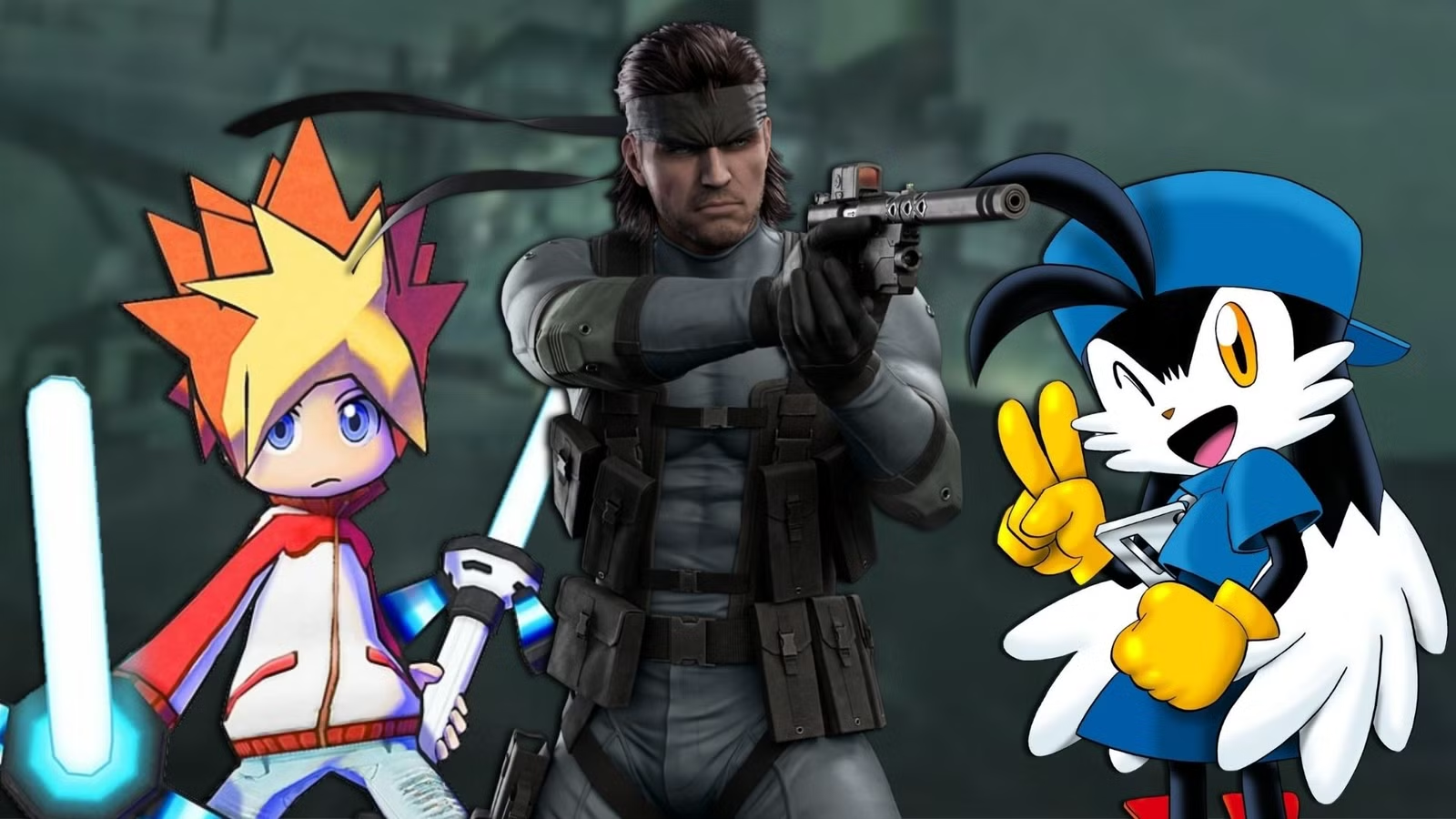
When you think of platformers that made an impact in the 1990s, a few obvious ones spring to mind. The likes of Super Mario 64 and Banjo-Kazooie are well documented, but Klonoa: Door to Phantomile was able to compete with the heavy hitters, cultivating its own dedicated fanbase.
It wasn’t as groundbreaking or innovative as those titles, but it’s still one of the absolute best platformers of the 1990s. The first Klonoa game launched on PS1 in 1998, but a full-fledged sequel wouldn’t come to fruition until three years later.
Klonoa 2: Lunatea’s Veil hit the PS2 in July 2001, and was even better than the original. The environments were far more detailed, Klonoa’s animations were incredible, and the team really found a way to hone in on the first game’s impeccable art style. It was also an early entry in the PS2 library, and was just a sample of what was possible with the new hardware.
7
Ape Escape
Escaping to the PS2
Sony’s outright refusal to do a new Ape Escape game is genuinely baffling. There’s clearly a market for this type of experience, and that was never more true than when the original Ape Escape launched on the PS1 in 1999.
It was a joyful, remarkably fun game that is easily one of my favorites of all time. It also launched near the end of the PS1’s life cycle, as Sony was already a year away from launching the PS2. As a result, Ape Escape 2 became a PS2 game, launching in 2002.
Ape Escape 2 felt like such a huge leap, in part due to how much of an improvement the PS2 hardware was, but also as a showcase of how talented the team at Sony Computer Entertainment Japan was. The rich, vibrant colors, increased speed and even more satisfying catching systems elevated Ape Escape 2 into one of the PS2’s most brilliant experiences.
6
Parappa the Rapper
Got the Funky Flow
The original Parappa the Rapper was legitimately one of the coolest video games of the 1990s. It introduced me to rhythm games, and I suspect that it did the same for a lot of other people. I would not have fallen in love with the likes of Gitaroo Man without Parappa.
It helped make the genre more mainstream worldwide, and would go on to influence countless rhythm games moving forward. A sequel wouldn’t see the light of day until 2002, emerging on the PS2 as one of its most fabulous experiences.
The songs in the original game are absolutely amazing, but I firmly believe the songs in Parappa the Rapper 2 are even better. There’s so much variety, and it has some of the most infinitely re-playable songs I’ve ever heard in a rhythm game.
5
Valkyrie Profile
Take Me to Valhalla
I often look back on Valkyrie Profile with a level of nostalgia that feels inherently different from other games during this decade. It was one of the first games I remember getting for the original PlayStation, and I still have memories of my dad buying it for me at Circuit City.
It was one of those games that I would just pour untold hours into, and I would very easily put it up against any contemporary JRPG. It’s genuinely that good, and despite the sequel taking almost seven years to develop, it was well worth the wait.
Everything about the original game’s spectacular combat system and world was kept intact, only now operating at an insanely high level. Valkyrie Profile 2: Silmeria was deeper, more complex and featured one of the best stories I’ve ever witnessed in a JRPG.
4
Armored Core
Big Budget Upgrade
The 1990s were a pretty good decade for the mech genre, as it produced some of the best anime, manga and video games imaginable. Among the increasingly crowded genre of giant mechs shooting at each other, one game managed to stand out in the crowd in the form of FromSoftware’s Armored Core.
Though they are mostly known for their Soulsborne games these days, FromSoft’s Armored Core franchise has been producing some of the best mech games of all time since the original game launched on the PS1 in 1997. Three years later, Armored Core 2 launched on the PS2, and was one of the console’s most endlessly entertaining games.
RELATED
8 Settings FromSoftware Should Explore in its Next Soulsborne Title
What setting should FromSoft go for next?
Hideo Kojima’s Zone of the Enders, was still a year away, so it didn’t have much competition in the genre. Armored Core 2 managed to completely demolish the original game in every single way, from the mission design to the visuals, and the soundtrack is also stupendous. As far as retro mech games go, Armored Core 2 is one of the best to ever do it.
3
Silent Hill
A Masterful Follow-Up
Playing the original Silent Hill on PS1 was quite an experience. It was one of those games I could never play by myself, and I played through it with my dad watching, which made it even more special looking back.
So, when Silent Hill 2 made a splashy debut on the cover of PlayStation Magazine, I devoured every bit of it. It became one of my most anticipated games of the year, and a key reason for me to get a PS2. The first game was a late-gen PS1 title, which prompted Team Silent to embrace the next-generation of PlayStation hardware to tell the next chapter.
That made it even more compelling when Silent Hill 2 took something of a departure from the first game, avoiding the cult storyline from SH1, and forging a bold, daring look at the human condition. Silent Hill 2 took a big swing, but absolutely knocked it out of the park in nearly every way.
2
Legacy of Kain: Soul Reaver
An Ambitious Sequel
There aren’t many franchises that I have a deeper, more personal connection with than Legacy of Kain. I have something of an obsession with this series, and for me, it started with Legacy of Kain: Soul Reaver on PS1. I didn’t play Blood Omen until years later, not until long after the sequel to Soul Reaver hit the PS2 in 2001.
The original Soul Reaver was one of the PS1’s most impressive games. It was among the first games to solve the issue of 3D characters running around an open environment in a truly satisfactory way, and it still feels genuinely brilliant to play today.
As you might expect, it was a long 2-year wait for Soul Reaver 2 for me. I read every magazine and scoured the early days of the internet to find as much as I could, but it was worth it. Soul Reaver 2 is one of the most incredible games I’ve ever played, with a story powered by some career performances by its spectacular voice cast.
Kept Us Waiting Until the PS2 Generation
The legacy of Metal Gear Solid is one of the most documented in the entire history of video games. I can’t tell you anything about this game that you probably haven’t heard already, as it is truly that ubiquitous. As far as important, iconic games go, Metal Gear Solid is at the top of the list nearly every time.
One of the most interesting, perhaps less discussed elements of MGS, however, is the way it used the PS1 hardware to create its world. Hideo Kojima’s team did the impossible, creating a fully playable action film with cutting-edge visuals and technology. Metal Gear Solid 2: Sons of Liberty, then, is the epitome of a great sequel, in that it attempts to make everything bigger and more expensive.
Kojima’s team went all out for MGS2. It’s one of the most visually stunning games of its generation, and a lot of that comes down to the way the finer details accentuate the larger ones. The way that the characters’ eyes dart around subtly is so impressive, and the level of detail in the effects, particles and systems is just breathtaking. It’s a one-of-a-kind experience that hasn’t been duplicated.
NEXT
10 Great PS1 Games that are Fun from the Start
No tutorials, just vibes.