


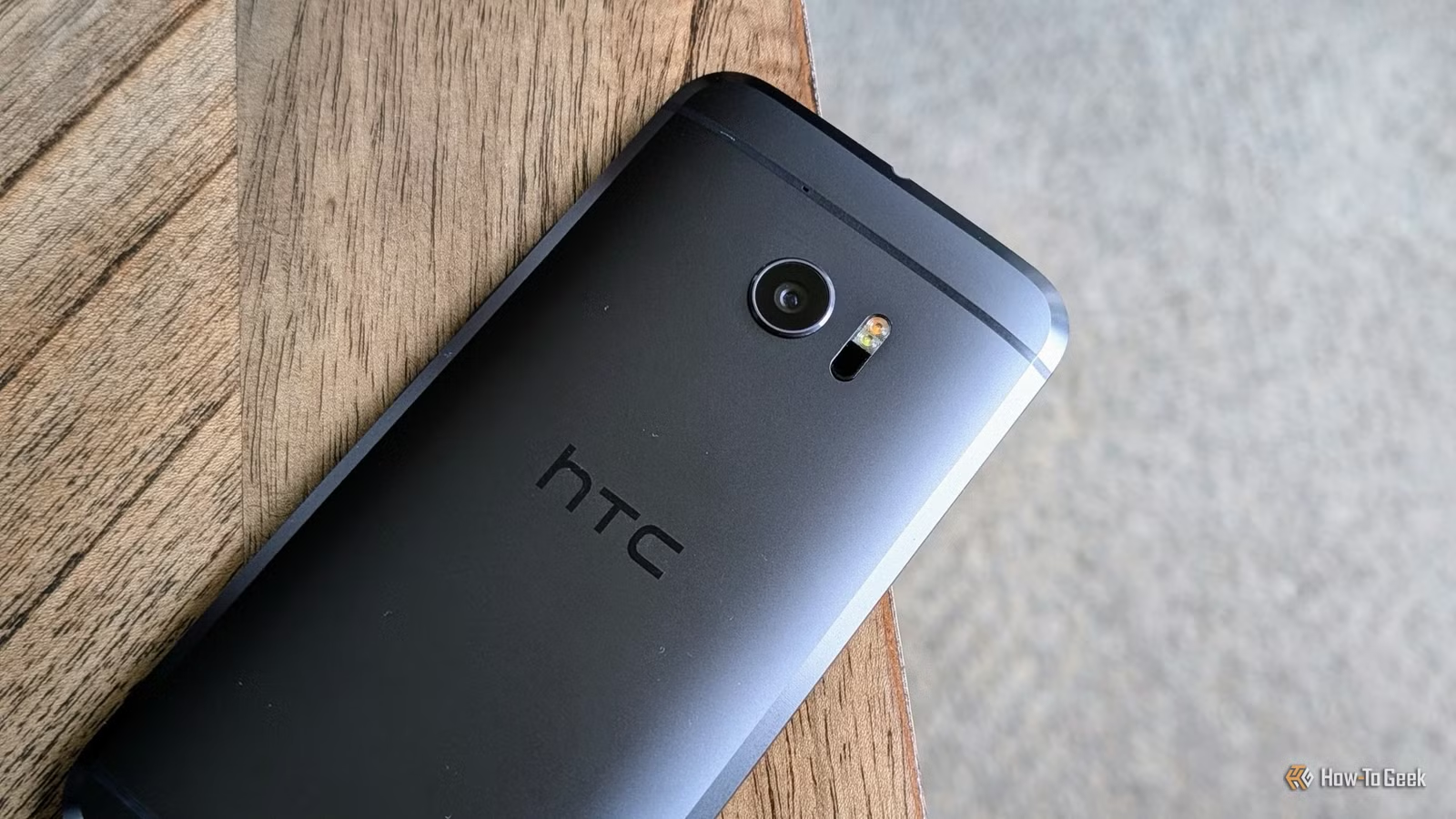
During the early days of Android, even flagship phones were fully plastic. But then manufacturers started introducing metal backs and frames, with HTC leading the pack. I remember that even my budget-focused HTC One V had a body mostly made of metal, while HTC’s premium offerings, like the legendary HTC One, had premium aluminum unibodies, with metal being the preferred material for Apple as well back then.
But something changed in the intervening years, and you’ll be hard-pressed to find a modern Android phone made entirely of metal. Yes, phone frames are still made of it, but the glass sandwich design, featuring a thin metal frame in the middle that increases rigidity, has become the dominant choice across the mid-range and high-end Android phone markets, with Apple doing the same with iPhones. So why did phones move from metal to glass, and why aren’t we seeing phones boasting all-metal cases anymore?
Wireless charging was the main reason for the shift
But not the only one
Back when the Wireless Power Consortium introduced the first generation of the Qi wireless charging standard, wireless charging was essentially impossible to implement in phones with metal backs.
Qualcomm did create wireless charging tech called WiPower that worked with metal devices, but the technology ultimately lost the market battle to Qi, which became the dominant wireless charging standard in phones and which isn’t designed to work with metal-backed phones. Technically, Qi charging can work with metal, but metal can interfere with the charging process and generate enough heat to potentially damage components inside the phone.
The Pixel 5 is a great example of Qi’s dominance and how manufacturers worked around the limitations of Qi charging. Instead of opting for Qualcomm’s technology, Google decided to cut a hole in the aluminum chassis of the Pixel 5 to make room for the wireless charging coil. It then covered the hole, and the rest of the body, with a very thin layer of highly durable bio-resin (just a fancy name for a plastic material), all to allow the phone to use Qi charging.
Credit: Joe Fedewa / How-To Geek
But phone brands moved on from metal for other reasons as well. Having a glass back allows phones to achieve and maintain better connectivity, which is very important in today’s world covered with ultra-fast 5G networks and 5GHz and 6GHz Wi-Fi signals, all of which suffer from high attenuation, especially the 6GHz Wi-Fi band and 5G mmWave.
If modern phones had metal backs, it would be much more complex to design antenna systems capable of achieving strong signal strength and high data speeds on 5G networks and the 5GHz and 6GHz Wi-Fi bands because metal acts as an RF (radio-frequency) shield that stops RF signals in their tracks.
One of the major reasons why Samsung chose glass instead of metal for the back of its Galaxy S6, a watershed moment for glass phones, was that glass “solved a cell phone signal blockage issue.” In fact, metal can interfere with cellular and Wi-Fi signals enough that even modern glass-sandwich phones have multiple plastic strips in their metal frames to allow the phone’s antenna signals to break through the frame. My Pixel 10 Pro, for instance, has six of them placed all around its metal frame. Conversely, one of the early glass-sandwich phones, the iPhone 4, had only a few antenna breaks in its frame, and covering one of them with your hand could significantly weaken the cellular signal.
Lastly, the glass used to cover phone screens and backs has become increasingly tough and resistant to drops over the years. Corning has made strides with its Gorilla Glass, and while glass backs are still much easier to damage than metal, they’re surprisingly sturdy and can survive drops onto hard surfaces that would likely shatter older generations of phone glass available when all-metal phones ruled supreme.
Metal has too many drawbacks—and costs more
Credit: Cory Gunther / How-To Geek
Aside from being a better choice than metal when it comes to signal interference and wireless charging support, glass makes high-end phones look more attractive and premium, according to a 2018 Counterpoint report. A study from 2022 showed that, when all things are equal, glass is perceived as by far the most “current” material, with plastic and metal being perceived as obsolete, at least when compared with glass.
I, and perhaps you, would vote differently. Personally, I’d always pick a cold, brushed-metal unibody over the glass-sandwich design, which was also the majority vote in an Android Authority poll that placed metal ahead of glass as the favorite material for the back of a smartphone. Phone manufacturers, on the other hand, prefer glass for the reasons I’ve already stated and others.
On top of the aforementioned advantages, glass also gives phone brands more creative freedom when designing phones. On the flip side, metal is harder to work with and offers fewer options when it comes to finishes, colors, and visual effects, especially ones that won’t get scuffed or worn over years of use. Last but not least, let’s also not forget that all-metal unibodies are more expensive to manufacture than glass-back designs.
Plastic is still fantastic
But not on high-end phones
Credit: Joe Fedewa / How-To Geek
Now, there’s another material out there that plays just as nicely with wireless charging and wireless signals as glass, can be made in any imaginable color, is tough and won’t shatter when dropped, and is cheap to produce: plastic.
Plastic was the dominant phone material back in the day. Early smartphones, including Nokia’s Symbian devices, Android phones, and the iPhone 3G and 3GS, were all made largely of plastic, and no one batted an eye. But in a bout of irony, the rise of metal-laden phones shifted public perception of plastic, and by the mid-2010s, plastic was deemed unacceptable on high-end phones.
I still remember the number of complaints—both from reviewers and fans—Samsung was getting about the plastic Galaxy S phones (especially the Galaxy S5) in an era when other big brands, such as Apple and HTC, had shifted to premium-feeling handsets boasting all-aluminum unibodies.
The outcry resulted in plastic being labeled as a no-go for premium phones, and while I and others wouldn’t mind rocking a phone made of quality polycarbonate, the public sentiment toward plastic in high-end phones had become so negative back in the day that I doubt we’ll see a mainstream flagship rocking a plastic case anytime soon.
I love metal phones, but can’t deny the versatility of glass
At the end of the day, glass is not superior to metal, but it is much more versatile, at least when it comes to phone housings, as well as cheaper to source. Despite my preference for metal as the main material for phone backs and my longing for the days when metal unibody flagships reigned supreme, those days are gone, with metal now relegated to the thin, sturdy frame sandwiched between two glass panels.