


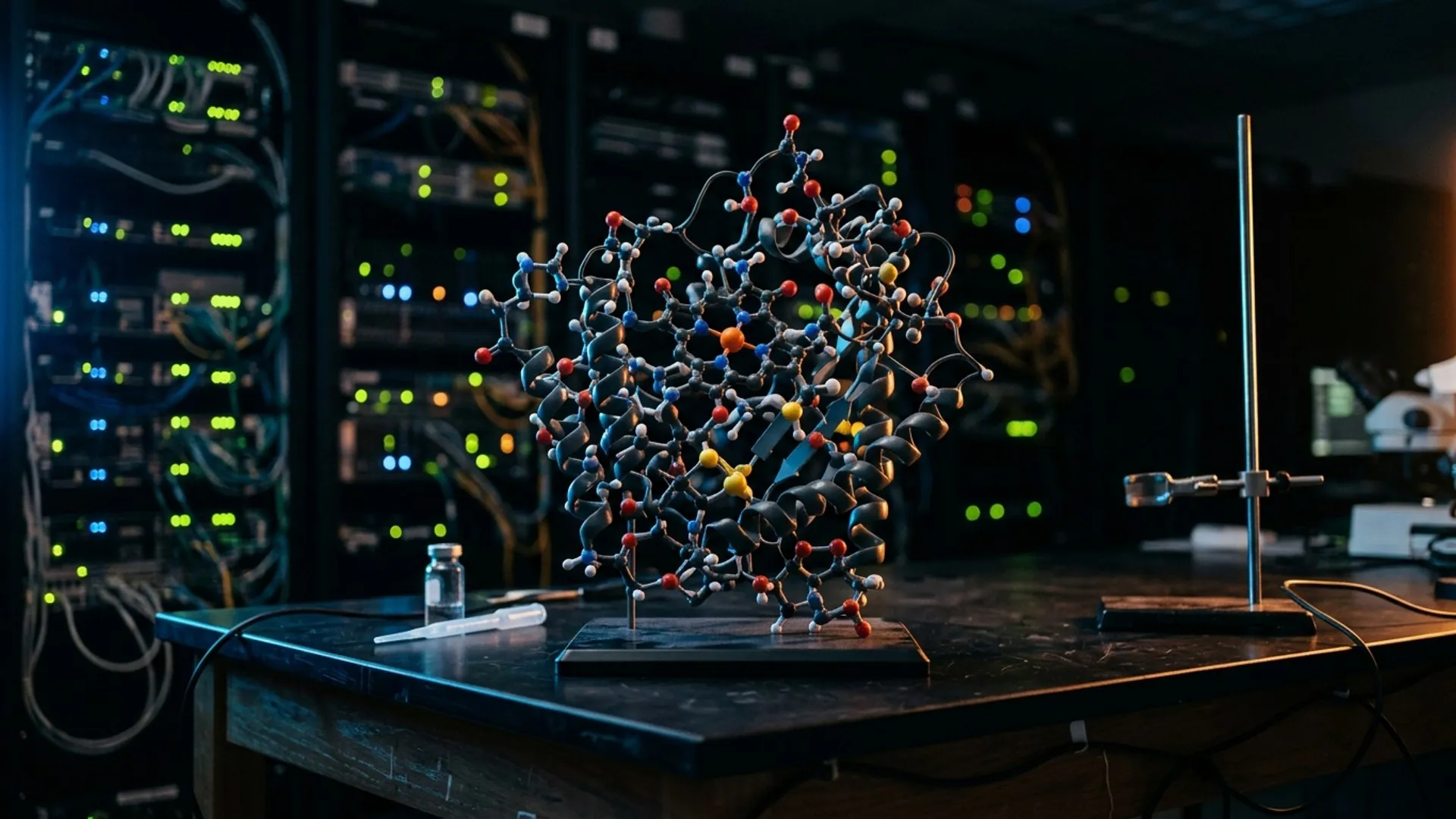
ai& and Tenstorrent launched JapanFold on September 3, 2026, a drug discovery platform serving open-source structural biology models entirely on infrastructure inside Japan. The platform runs on ai&’s sovereign infrastructure powered by Tenstorrent Galaxy superclusters, and the companies say every computation executes within the country.
Japanese researchers, pharmaceutical companies, and biotech firms can access the models at what the companies describe as a fraction of the cost of conventional cloud infrastructure. ai& said it carries the cost of inference, so researchers, universities, and institutes in Japan can use every model free of charge. The company described JapanFold as its first substantial effort in AI for Science.
Models and Access
JapanFold serves models across three categories. For structure and binding affinity prediction, the platform offers Boltz-2, OpenFold3, ESMFold-2, OpenDDE, Protenix-v2, RoseTTAFold3, OpenBind-0, and Nesso-1. For de novo drug design, it serves BoltzGen, RFdiffusion 3, and PXDesign, which together cover the workflow from protein folding through drug candidate generation. ESMC and SaProt provide protein embeddings for downstream tasks.
Users can reach the platform three ways: a browser-based Workbench that requires no install or sign-up, a single HTTP API endpoint shared by every model, and an agent skill for tools including Claude Code, Cursor, and Codex. The API is asynchronous (jobs are submitted, polled, and downloaded once complete) and keyless by default, with an optional Bearer key that scopes jobs to an individual caller.
Because the public service is a free demo running on shared compute, inputs and concurrency are capped, with per-model ceilings such as 1,024 residues for Boltz-2 and 576 for OpenFold3, plus rate limits and a results budget. The documentation notes the full platform carries no such limits. Results are not durable storage: the service retains the 1,000 most recent jobs and evicts the busiest caller’s oldest job first once that cap or a storage ceiling is reached.
Accuracy and Model Limitations
ai& said it optimizes and serves every JapanFold model on Tenstorrent processors at 1:1 accuracy, without the cost premium, because the models scale nearly linearly on the hardware — doubling the number of processors doubles output. Before each release, the platform’s output is checked for parity against each model’s official reference implementation, and a comparison leg passes when the device sits inside the reference’s own seed-to-seed noise floor, according to the accuracy documentation.
That documentation also carries stated caveats. The parity checks measure the port rather than the underlying science, comparing the device against the reference implementation on the same input rather than against experimental structures. OpenFold3’s weights are a preview checkpoint trained well short of the full AlphaFold3 schedule, so its confidence scores should be read before trusting a prediction. The OpenDDE checkpoints match their reference implementation, including that implementation’s weakness on some hard antibody-antigen targets.
In a companion post, ai& co-founders Shimpei Hara and David Bennett explained the compute economics behind the launch. Folding models are compute-bound rather than memory-bandwidth-bound like language models, they wrote, so the workload favors chips shaped around arithmetic and on-chip memory. They reported that one Blackhole Galaxy reaches the throughput of an NVIDIA DGX B200 on a 512-residue protein at roughly a fifth of the purchase price — about five times the throughput per dollar, holding workload and accuracy fixed — citing the project’s published benchmark measurements.
Hardware and the Two Companies
The platform’s Tenstorrent Galaxy Blackhole server carries 32 Blackhole ASICs rated at 23 petaFLOPS of block FP8 compute, with 6.2 GB of accelerator SRAM and 1 TB of GDDR6 memory, according to Tenstorrent’s hardware specifications. The 6U air-cooled system lists at $160,000, and a supercluster configuration of four Galaxy Blackhole systems starts at $640,000.
“Japan’s research community should never have to choose between world-class AI and keeping their data sovereign,” said David Bennett, CEO and co-founder of ai&, in the launch announcement. He said JapanFold removes that trade-off.
“Tenstorrent delivers fast, scalable compute, and ai& owns the full stack in Japan,” said Jim Keller, CEO of Tenstorrent. “Together, we’ve turned it into a platform researchers can actually use with JapanFold.”
ai& is a vertically integrated AI technology company founded in March 2026 and headquartered in Yokohama, integrating data center infrastructure, heterogeneous compute, and model services into a single platform. Tenstorrent, led by Keller, builds RISC-V-based AI processors and systems for developers, enterprises, and sovereign infrastructure, and has raised over $1 billion from backers including Bezos Expeditions, Samsung, LG Electronics, Hyundai Motor Group, and Fidelity. The companies described the JapanFold launch as the first step in a broader effort to make sovereign, open-source AI infrastructure available to scientific research communities across the region.