


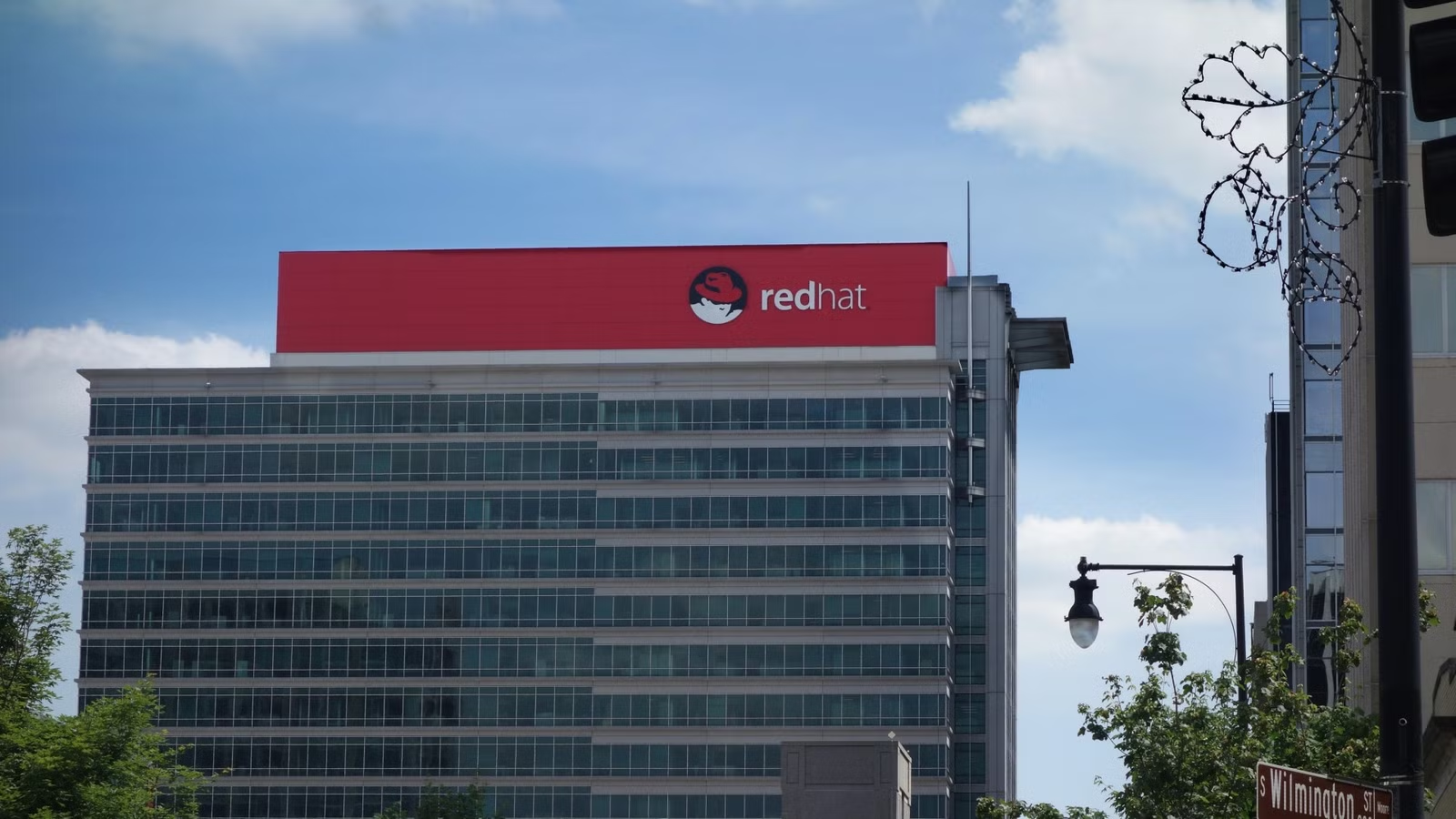
It’s easy to think that big, unilateral, seemingly bone-headed (Apple would say “brave”) decisions are only made by big closed-source OS vendors like Microsoft and Apple. If only!
In 2026, CERN announced (as reported in It’s FOSS) that it would start using Debian on over 2,200 control systems. Up to this point, CERN’s accelerator infrastructure had been deeply tied to the Red Hat ecosystem, but the custodians of RHEL and CentOS had effectively forced CERN’s hand to start looking elsewhere.
CentOS used to make Red Hat the center of professional Linux
It made perfect sense
CentOS Linux has now faded into history, but for a while it was an amazing way to benefit from all that development work that’s gone into Red Hat Enterprise Linux. That’s great for an organization like CERN, because it can apply paid copies of RHEL where it needs them, and deploy CentOS where it doesn’t need that same level of support, but you can be sure that since CentOS is downstream of RHEL, it should all interoperate without issue.
This is why CERN was happy to base its in-house Linux on RHEL and CentOS. Then, in 2020, the CentOS blog dropped a bombshell. “The future of the CentOS Project is CentOS Stream”, it proudly proclaimed, but what does that mean?
It effectively flipped the script by making CentOS Stream into an OS “serving as the upstream (development) branch of Red Hat Enterprise Linux.” There was still Fedora Linux, of course, but that was aimed at a completely different crowd who don’t need the stability and rigorous testing that happens between Fedora and the (downstream) RHEL.
Red Hat broke the model that made its ecosystem so attractive
There goes the neighborhood
Credit: Michael Vi/Shutterstock.com
The change from CentOS Linux to CentOS Stream had a pretty strong ripple effect on how the ecosystem worked. In May 2021, Linux@CERN posted news highlighting that the changes to CentOS were going to be a problem:
“We are evaluating a number of scenarios for future Linux distributions, such as community editions or academic license options over the next 12 months as the shorter Stream lifecycle is not compatible with a number of use cases for the scientific program of the worldwide particle physics community.”
CentOS Linux 7 still had support until June 2024, although CentOS Linux 8 was cut short at the end of 2021. So, there was still some runway left, but institutions like these need loads of warning to make big changes, and honestly, this was probably cutting it close.
CERN didn’t drop RHEL completely. In fact, if you look at its current distro guidelines, RHEL is still at the center of it. But it is a key sign that big organizations like CERN were looking at other options. Not because they wanted to, but because Red Hat made decisions that threw them for a loop.
Another example would be the RHEL source code changes after IBM acquired it in 2019. To be clear, IBM said it would preserve Red Hat’s independence and neutrality. There’s no solid evidence that IBM directly ordered the later CentOS or source-code changes, so those should be attributed to Red Hat as far as anyone knows.
But, what happened was that two years after CentOS Stream, the Red Hat Blog posted an announcement that “CentOS Stream will now be the sole repository for public RHEL-related source code releases.”
This led to AlmaLinux, which had been aiming to provide a 1:1 RHEL-compatible rebuild, announcing that it was changing tack, because the new setup made it impossible for “downstream clones to continue to be 1:1 binary copies of Red Hat Enterprise Linux (RHEL).” The whole project changed its aim to be “binary compatible” with RHEL instead. In other words, to ensure that they could run the same software.
The exact RHEL sources were no longer being published through the old public CentOS Git repository; Red Hat directed the public to CentOS Stream while customers and partners could obtain RHEL sources through its portals. There’s a great blog post at Rocky Linux arguing why the path Red Hat has been on is problematic.
CERN’s Debian switch shows why organizations are looking elsewhere
There are just too many conCERNs
Credit: NASA/GSFC/METI/ERSDAC/JAROS, and U.S./Japan ASTER Science Team
So, the CERN switch to Debian for certain machines should not be seen as an isolated thing. In this case, it was triggered by RHEL dropping support for hardware inside CERN scientific equipment that’s still perfectly fine. Upgrading these machines just to work with the latest (and future) version of RHEL would amount to serious monetary wastage.
Instead, switching to Debian is by far the cheaper (but far from cheap!) solution. The problem for customers with unusually long hardware life cycles is that Red Hat’s definition of a reasonable enterprise hardware baseline may no longer line up with theirs. For an operating system sold partly on long-term stability, that’s exactly the sort of incompatibility that can push customers toward alternatives.
RHEL isn’t dying, but “enterprise Linux” no longer automatically means Red Hat
The story here isn’t that RHEL has lost its grip on its niche, but that it’s losing its grip. That doesn’t mean RHEL is going anywhere, but organizations now have credible enterprise alternatives that don’t require staying inside Red Hat’s ecosystem.
Considering that major well-funded distros like Ubuntu LTS have up to a decade of support through the paid Ubuntu Pro program, those who wear the red hats should feel a little discomfort before making any decisions without really consulting with the clients who keep them afloat, perhaps.