


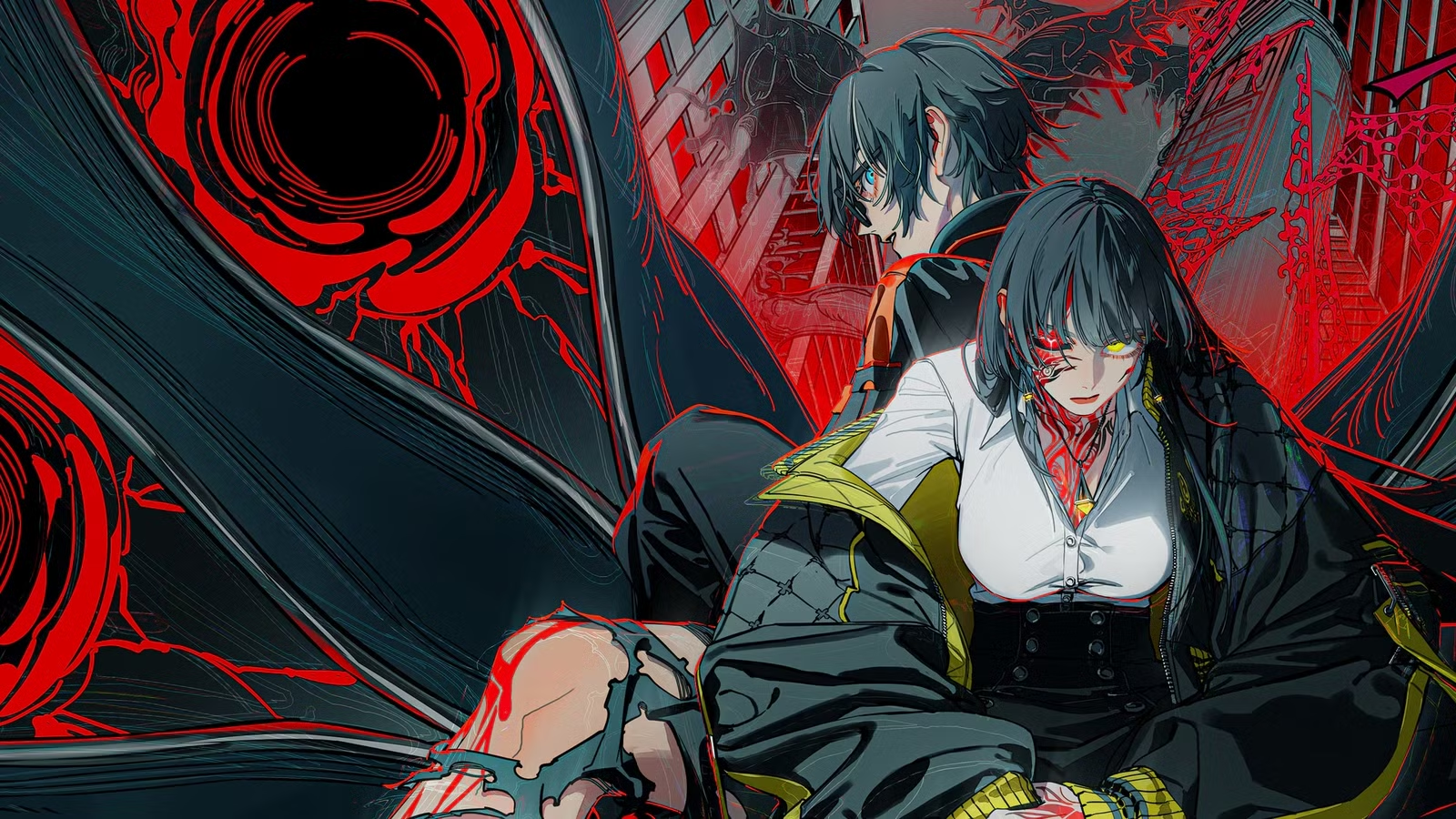
The power of a brand is something magical. I’d heard of Qliphah in Providence’s Shadow, but I never paid it much attention until I saw the Arc System Works logo flashing before me. I like style, and if there’s something Arc System is good at, it’s making stylish, captivating games. Ok, now I am paying attention to Qliphah in Providence’s Shadow.
Related
10 Most Ambitious PS2 JRPGs
The PS2’s improved hardware allowed developers to create incredibly ambitious titles.
The game’s press releases constantly flaunted its unique battle system: tactical, fast-paced, and high-stakes, where unleashing devastating counters was the answer. I like high-stakes, counters, and all the buzzwords, so I knew I had to try this JRPG. And so I did. After reaching the credits with 10 hours of gameplay, I have some things to say, though they aren’t very praiseful.
A Collapse Has Struck Tokyo
As soon as I started Qliphah in Providence’s Shadow, I was simultaneously impressed and a bit frightened. Right off the bat, the game introduced me to the protagonist in a great cel-shaded visual fashion, followed by a grotesque monster and a macabre soundtrack, and I even considered passing the review to another writer because I am a scaredy-cat. But I persevered and pushed forward, starting the combat tutorial for a game that calls itself a “Tactical Counter Timeline RPG” featuring stylish battles. And it plays out just like it says on the tin.
Before delving into the gameplay, let me talk about the setting and story. I started the game as Rena Hizuki, a peacekeeper for the Public Anomaly Squad, essentially a detective who deals with creatures called Aberrations. She reaches an area oozing with corruption and finds an unconscious young man named Soma Hoshigami. It’s soon revealed that Soma somehow resisted transforming into one of those horrifying creatures and stopped halfway through, maintaining his human form while still managing to use that power for himself, which makes him an ally in this fight.
The entire narrative boils down to Rena and Soma wandering around, analyzing corrupted places, defeating monsters, and uncovering why they keep appearing in increasing numbers. Qliphah in Providence’s Shadow has no exploration, as everything is done by clicking points on the map and watching the story unfold in a visual novel style. Sometimes there are full-screen illustrations, but they are rare and often reused, even though they are gorgeous.
From the get-go, I was confused. At first, I thought these creatures were something entirely unprecedented in Japan, and that they had just started attacking the public as soon as I booted up the game. This was partly because everything seemed way too chaotic and nobody was prepared to deal with them, and partly because of Soma’s own dialogue, as he was stunned by everything. Whenever something unusual happened, Rena explained it to Soma, and I discovered alongside the boy that these occurrences started long ago, and daily life in this world already involved avoiding corrupted areas.
Then Rena taught Soma about another piece of lore, then another, and then yet another, until I began to notice that the narrative was more concerned with dumping lore piece after lore piece than actually telling a story. Everything boiled down to finding these monsters, or a location suddenly infested with them, where I would be ambushed, fight, and then defeat them. It was always the same result. Look, I don’t mind predictable plots, but at least they become predictable because I am paying attention to their development. If I skipped all the cutscenes in Qliphah in Providence’s Shadow, I would still know how the game ends, because the outcome for every story beat is always the same.
Too Much Lore Building, Too Little Story Development
I understand that some JRPGs rely on a visual novel format to tell a story due to budget constraints, author style, or something in between, and I don’t mind that. However, if you commit to that format, you had better refine and polish the script to the max, because the words carry the most weight in that kind of narrative, but unfortunately, the game didn’t meet that standard. Qliphah in Providence’s Shadow is packed with lore, perhaps a bit too much. After exploring a corner, I would sometimes pick up a piece of evidence that further explained certain terms. When investing Research Points in these pieces of evidence, I could learn a skill. I love supplementary materials in JRPGs as much as the next nerd, and at first, I was reading everything.
The game features a social media system where various users report on events happening around the region, intimately tying it to my investigations. I consumed everything, stayed informed, and tried to engage with the game’s world. Yet, once I realized this wasn’t supplementary material but a crutch for the narrative, I lost all interest. If HQ asked me to explore a church, the protagonists would have a superficial discussion about the location and what’s happening, and then all the nitty-gritty details would appear in evidence files written in a technical, formal, and bland style.
The best comparison I can give is this: have you ever played a sci-fi RPG? Something like Mass Effect. If you explore the menus thoroughly, you can read all about a ship’s thrusters, perhaps the material used to build its motor, and other cool engineering talk. Those details are welcome, but they shouldn’t be mandatory for understanding the story. It’s geek talk. Qliphah in Providence’s Shadow tries to explain scientific, philosophical, and religious terms at every moment in these extra documents, forgetting it needs to tell a story along the way.
Qliphah in Providence’s Shadow tries to explain scientific, philosophical, and religious terms at every moment in these extra documents, forgetting it needs to tell a story along the way.
After Chapter 3 (out of 5), I stopped reading these optional bits and felt like I no longer understood anything; missing pieces were everywhere, and everything became tedious and flat. Besides, do you know what happens when a game leans too heavily on lore building? It neglects the characters. I have nothing to say about Rena or Soma because they simply aren’t interesting. They don’t grow, don’t captivate, and exist only because the game needed an agent to move the needle forward.
I was genuinely disappointed with the story in Qliphah in Providence’s Shadow. To make matters worse, I kept running into several grammatical errors in the localization, which made my entire experience even more jarring. At least my full playthrough only lasted 10 hours (and I promise I didn’t skip a single cutscene or main dialogue).
Related
7 Upcoming JRPGs to Play If You’re Skipping GTA 6
If your only crime is an insatiable urge to grind, then I recommend these JRPGs for anyone skipping GTA 6.
Tactical Counter Timeline RPG Indeed
To be fair, the game seemed more keen to showcase its gameplay than its story, so let’s talk about that. The combat seemed intriguing at first, and it’s genuinely unlike anything I’ve seen in all my JRPG years. It happens in real time, but it gives you breathing room to think about your actions before executing them. Everything truly hinges on counters, on trying to pair the same color attack as the enemy at the exact right moment. Look, I won’t even try to explain how it works in detail because it is exceptionally complex, but it somehow works. At least initially.
At the start of the game, there is an immediate tutorial. Both characters can equip 3 attacks, 3 skills, and 4 passives. The controlled character’s attacks are assigned to the face buttons, the non-controlled character’s attacks are on the d-pad, and skills can be triggered by holding the trigger button. When you select an attack, ideally one of three colors: blue, red, or yellow, the character executes the move fully. The ideal approach, however, is to wait for the enemy to attack and match its attack color with yours at the right moment, triggering a counter and eventually downing the target before unleashing hell.
The game teaches that paying attention to the enemy’s attack circle is an effective strategy to counter, and that once the circles overlap, you should counter. However, I found the battle timeline a much more effective guide. It was far easier to focus on the timeline to watch the enemy’s attack approach and time the counter, and strangely enough, the game never explicitly mentioned that. I’m crazy about tutorials because, as a guide writer, I need to dissect a game from top to bottom. And trust me, Qliphah in Providence’s Shadow desperately needs a tutorial for all its systems.
Yet it fails so heavily to explain its mechanics, even the most basic ones, that I was left dumbfounded. The game clarifies that some boss attacks can only be countered using a Duo Counter, meaning you must pair both allies’ attacks at the same time. Neat, a great mechanic that demands precision and responsiveness. More often than not, though, the Duo Counter simply didn’t trigger, and I couldn’t understand why, even when I knew I was timing it correctly. Then, I discovered on my own that the attacks couldn’t be on cooldown. Before you give me a funny look, you can spam attacks whenever, but they get stronger once their cooldown finishes. In short, I needed to save a matching-colored attack specifically to use this Duo Counter, or else it was lights out. Why did the game never mention that?
Don’t even get me started on skill effects. Many have descriptions like Clone +1, Bonus DMG, or Increase EVA… okay, what does that mean?! What is Clone? How much bonus is that damage? And what does an evasion increase entail when I thought dodging was done manually? There’s no explanation whatsoever, and it was driving me crazy, so I just stuck with the same old increase ATK or DEF skills and called it a day.
If an enemy attack is white, it means I should sidestep or block, easy enough. The problem is that if you don’t have an action queued up, the game automatically enters slow motion, and you cannot exit this slow motion until you select an action. I can’t express how frustrating this was. Sometimes all I wanted was to play it cool and wait for the enemy to prepare an attack so I could counter, but I had to wait an eternity for anything to happen due to the slow motion. So what would I do? I would spam sidestep just to pass the time quickly. Yet more than once, these unnecessary sidesteps ruined my timing and made me miss the counter. Gals and guys, I just wanted a toggle to disable the slow-motion effect and let my character stand still to prepare for a devastating counter.
Great Battle Concept Marred by Wasted Potential
The combat system felt like the biggest wasted potential in Qliphah in Providence’s Shadow because when it works, it’s really amusing and gripping. I fought the first boss on Dread difficulty (the hardest) about 50 times because I wanted an A Rank. Not kidding, I spent 4 hours on that single battle, and I was genuinely having fun trying to optimize my strategy, analyze the exact timing of the boss’s attacks, use counters at the most opportune moments, and string together extra attacks whenever possible. I was on the verge of a no-damage run. The best I managed was a B Rank, so I reset the battle. Ironically, I couldn’t beat it anymore, so I dropped the difficulty to Normal just to move on.
On Normal, the battle became stupidly easy. Not just because I had memorized the boss’s skill set with my eyes closed, but because on Dread it has more attacks. During downtime between counterable attacks, it unleashed white attacks that kept me constantly moving. On Normal, the downtime between the boss’s attacks was humongous, and I defeated it after downing it only twice. But do you know what was worse and caught my attention the most? In the middle of that Normal-difficulty battle, I earned a trophy for completing all the tutorials. I mean, what? I had done that battle dozens of times and never earned that trophy before. Either the tutorials weren’t appearing on Dread difficulty, or the trophy wasn’t tracking properly, but either way, it was a bizarre oversight.
The combat system felt like the biggest wasted potential in Qliphah in Providence’s Shadow because when it works, it’s really amusing and gripping.
Upon reaching Chapter 2, I noticed the regular monsters were identical to those in the first chapter. Then it happened again in subsequent chapters, with maybe one or two variations, and they kept repeating until the end: the same enemies, the same design, the same attacks, and yes, the same way to kill them, since it’s Counter City after all. The real highlight of Qliphah in Providence’s Shadow was the boss fights. Still, since everything during the intermissions leading up to them was wildly uninspiring, I grew increasingly demotivated to play. That’s a shame, because I was genuinely invested in mastering the system during the first boss, until I realized I was trying way too hard to make my own fun.
Related
9 PS1 JRPGs Most Haven’t Played, But Definitely Should
The PS1 JRPG catalog is even better than many think.
Don’t even get me started on facing multiple enemies. Attacks came from every side, and I had to pause the system to figure out who to counter, when to sidestep, what attack to use, and so on. It was mildly challenging and impressive, but once I learned that duo-countering the fastest attacker downed every single enemy, it banalized every multi-fight. Not to mention the repetitiveness again.
If I had to assign a single descriptor to Qliphah in Providence’s Shadow, it would be half-baked. The game and its systems needed more development time, whether to refine details or even for QA. I ran a series of back-and-forth tests between Normal and Hard difficulties because something felt off. The first battle on Hard was unbearable, taking me over 10 minutes to finish. I had to deal 40 times more damage to regular fodder monsters compared to Normal. Subsequent fights improved slightly and balanced out my experience, but it was still a slog due to the monsters’ sponginess. It felt, again, like a major oversight and a balancing issue.
When I saw that Arc System Works was involved with Qliphah in Providence’s Shadow, I was excited because I liked the premise, the screenshots, and the trailer. I longed for a unique battle system. I did receive something distinct, but the JRPG failed to capitalize on it and turn it into something engaging from start to finish, even for a brief 10-hour playthrough. Unfortunately, the game was a letdown, and I find it difficult to recommend to others, especially at a time when we are being bombarded with heavy hitters, including many incredible JRPGs.
Qliphah in Providence’s Shadow focused all its promotion around its Tactical Counter Timeline RPG battle system, and it certainly wasn’t lying, as the game presents a gameplay design unlike anything I have seen before. However, what felt interesting during the first few hours quickly became highly repetitive, poorly explained, and eventually unengaging. Pair that up with a script that cares far more about explaining technical terms and lore than actually telling a story, and the result is a half-baked experience that never finds its footing.
Next
Two Major JRPG Titles Will Return to Modern Platforms
Nihon Falcom is really focusing its efforts on bringing its entire lineup to modern platforms.