


The 30th annual Tokyo Game Show just wrapped this week, unfortunately cut short due to Typhoon Dujuan sweeping through Japan on Monday. Still, the event was a major triumph, bringing together some of gaming’s biggest names to promote their upcoming titles on the show floor. Sega was a major standout this year, who are gearing up to release the highly anticipated Persona 4 Revival, Crazy Taxi World Tour, and of course, an all-new standalone entry in the Yakuza series, Stranger Than Heaven.
The booths on the ground were grandiose, placing standing rows of players to try out a generous demo focused on the game’s combat. Given the developers’ pivot into the RPG playstyle with Like A Dragon, and their most recent remake of Yakuza 3 stirring plenty of controversy, I think it’s fair to say that there’s a lot riding on Stranger Than Heaven.
Related
Stranger Than Heaven Brings Retro Yakuza Action To 1943
New footage of Stranger Than Heaven was shown at Summer Games Fest, revealing a fresh look at 1943 in Japan and the Yakuza of the recent past.
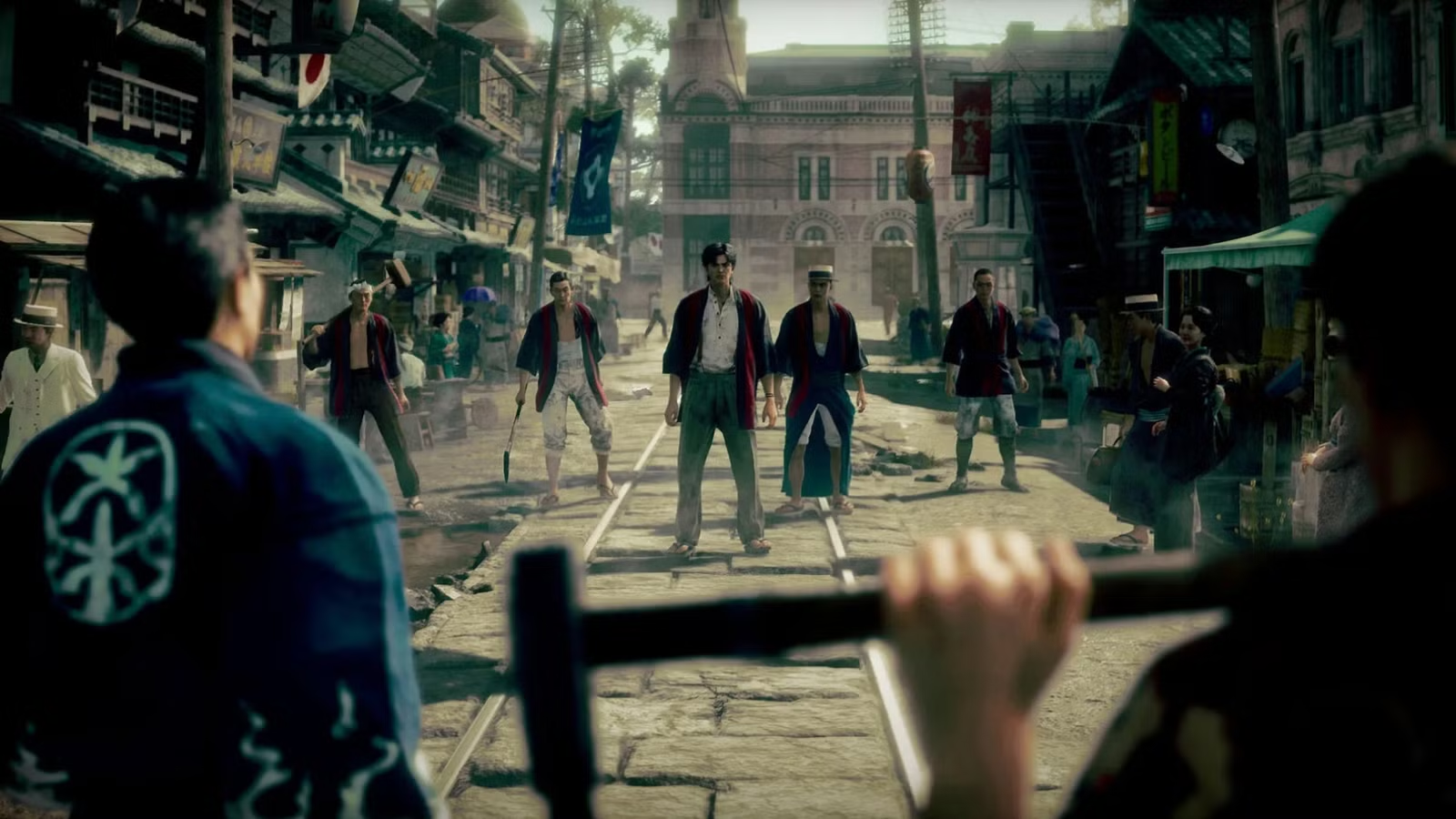
It’s a big step for the developer, who have been biding their time to take the next graphical leap their series needs, and I think it pays off. Stranger Than Heaven looks and feels gorgeous even in the small slice shown in the demo. Bustling crowds fill the streets, and colorful, resplendent lighting soaks the city, giving the setting a slick and next-gen look.
While it was a fairly restricted demo, there’s still a lot to talk about, especially if some of your favorite parts of the Yakuza franchise have been its combat.
Phase 1: The Beginner’s Fight
Tokyo Games Show’s demo kicked things off by throwing us into a casual street fight against a mob of generic enemies you’d find wandering the streets in any Yakuza game.
In this fight, you start off as a younger Makato Daito, who, at this stage, has no other weapons besides his fists and a few trusty street chairs to throw at people. One of the biggest changes to combat, as opposed to the Yakuza games, is that your left and right triggers are now your attack buttons, freeing up the face buttons for blocking and dodging. R1 and R2 are light and heavy attacks using your right side, and L1 and L2 covering your left. That’s right, it’s like QWOP.
Weaving attacks from both sides seems to be the most ideal way to execute combos, and choosing where to execute your heavy attack without leaving yourself open is the trickiest part of understanding combat. I won’t lie, despite being positioned as the easiest fight, this one was pretty close for me. Adjusting to the new combat style while getting swarmed by a mob of enemies took me a minute to readjust, but after getting punched around a bit, things started to click.
Related
10 Best Games With Satisfying Parry Mechanics
Games like Sekiro and Sifu have parrying and counter mechanics that strike the perfect balance between entertainment and skill.
There’s also a stagger meter this time around, visible on the bottom left of the screen. If you block too many attacks, you’ll get staggered and will need a few seconds to recover. You can also get knocked down to the floor and will need to push enemies back before they strike or dodge before their attacks land. In some cases, you won’t be able to get up right away, which makes for a pretty tense moment in a crowded fight. Thankfully, the same can happen to enemies, and you’ll be able to finish off most lesser mobs after a single stagger break.
Unlike in Yakuza, which had a faster action-style combat, Stranger Than Heaven feels heavier and slower. Attacks need to be more calculated, and errors in your combo are far more punishing. This wasn’t really an issue for this fight outside of the main leader having a chunkier health bar, but it becomes a matter of life or death in the final fight.
Phase 2: A Steel Beam To the Face
After the learning curve of the first fight, the second fight was a bit of a breeze, if I’m honest. Like before, you’re thrown into a fight with a mix of generic lesser enemies and a heavy, who will charge at you and throw you around if you’re not careful.
Unlike the previous fight, you get a massive crowbar to hit enemies with. The downside of this is that your attacks become even slower, meaning you’ll need to be more calculated with your hits because recovery windows are less forgiving. Thankfully, for lesser mobs, a hit or two is enough to stagger them, leading to a brutal takedown attack.
Something I haven’t mentioned yet is how brutal the fights are in this game. The trailers weren’t shy about telling audiences Stranger Than Heaven would be a grittier and more serious experience compared to Yakuza, but you can really feel that tonal shift in combat. There are some silly elements, though. Pulling out a rice ball mid-combat to munch on and recover health still looks pretty silly in an endearing way. It goes without saying that slamming enemies with a massive steel crowbar is also pretty ridiculous, but I’m all for it.
There isn’t much else to say about this fight if I’m honest. I appreciate the train yard setting, and it’s another showcase of how gorgeous and distinct the locations are in this game. But with limited opportunity to roam around, there isn’t too much to highlight here.
Phase 3: A Humbling Experience
After getting over the learning curve of the first two fights, it’s fair to think you could wander into the last fight and push through it, right? Oh, you couldn’t be more wrong. The third fight takes place later in the game and pits you against an old sword master who would put Kingdom Hearts 1 Sephiroth to shame. Thankfully, there are more options for weapons here to help take him down.
The fight starts you off with a knife, which offers up a more agile playstyle, blending stabs with kicks. This lets you weave in several attacks, allowing for some pretty nifty combos. Kicks will also hit through the enemies’ own blocks, which was pretty nice in the first phase of the fight, although it started showing some obvious weaknesses later. Among other weapons on hand are also a hammer, your trusty steel crowbar from the previous fight, and a katana.
Related
Netflix and Sega Strike Deal on Crazy Taxi, Stranger than Heaven, and More
Live-action films and animated series based on Sega IPs are entering the Netflix pipeline.
I tried a number of different approaches to the fight with all of these weapons and found that the Katana was the best weapon on offer.
The first half takes a bit of trial and error, but it isn’t too hard. The sword master will parry your attacks, sending your own stagger meter into red if you’re not careful, meaning dodging is a fair approach here. In saying that, I found that some moves can’t be dodged reliably, meaning you’ll either need to block or predict which move he’ll make and space carefully in the fight to have that extra reaction time.
One aspect of the combat that takes a bit of getting used to is how slow your character moves in battle. He’ll pace around, meaning that to run after an enemy who’s made a lot of distance results in opening yourself up by closing that gap; something this boss loves to do. He’ll do this twirly jump to make space, moving out of your attack range, and will use that to launch into a deadly flurry which will chunk your health or delete your stagger meter. This move changes throughout the different phases in the fight as well, making it pretty tough to read what he’s about to do and how to react to it.
Stranger Than Heaven looks and feels gorgeous even in the small slice shown in the demo. Bustling crowds fill the streets, and colorful, resplendent lighting soaks the city, giving the setting a slick and next-gen look.
If you use any other weapon besides the katana, I found that there was nearly no way to reliably react to this move. If you block with the knife or hammer, you’ll still get damaged and have your stagger bar deleted. The katana was the best bet as it’s actually able to comfortably block the full attack.
After getting the boss down to half health, he’ll also heal himself, and then noticeably become much tougher. After getting him back down to half health again, he’ll change his moves to now feature a grab, which always caught me off guard so late into such a tense fight.
Sadly, I ran out of time in the demo before I got to take down this boss, and I could see on the other screens next to me that everyone else was struggling with the fight. I can only hope that this was a superboss placed here to catch people off guard, and isn’t a generic enemy you face off with, because I can totally see people just quitting the game after having to fight this monster more than once.
Overall Thoughts: Strange is Good
I won’t lie, I was less than impressed with Stranger Than Heaven’s trailer when it was shown off at Summer Games Fest in June. Admittedly, the Tupac inclusion was such “jump the shark” moment that I couldn’t take the game seriously. Add in a bit of disappointment with Yakuza Kiwami 3 & Dark Ties, and I was starting to wonder if maybe the studio was running out of steam.
After playing the demo, I think I was being a bit too reactionary. The team still has the juice, and it’s clear that Stranger Than Heaven is a big step forward for them in terms of technical prowess and in refining combat into something new and rewarding to play; especially given the sea of action games that are either Sekiro or God of War clones.
I think getting to have a hands-on experience with the game has squashed some of those concerns. I’ll also admit, I’m actually excited to play the game when it releases now. Although, part of that hype is also to have a rematch against that old man and exact some much-needed revenge.
Stranger Than Heaven releases on January 15, 2027 for PlayStation 5, Xbox Series S|X, and PC.
Next
Stranger Than Heaven Boss Clarifies Tupac Situation After Legal Concerns
Snoop Dogg and Tupac Shakur reunite in upcoming action-adventure game, Stranger Than Heaven.
Released
January 15, 2027
ESRB
Mature 17+ / Blood and Gore, Intense Violence, Strong Language, Suggestive Themes, Use of Drugs, In-Game Purchases