


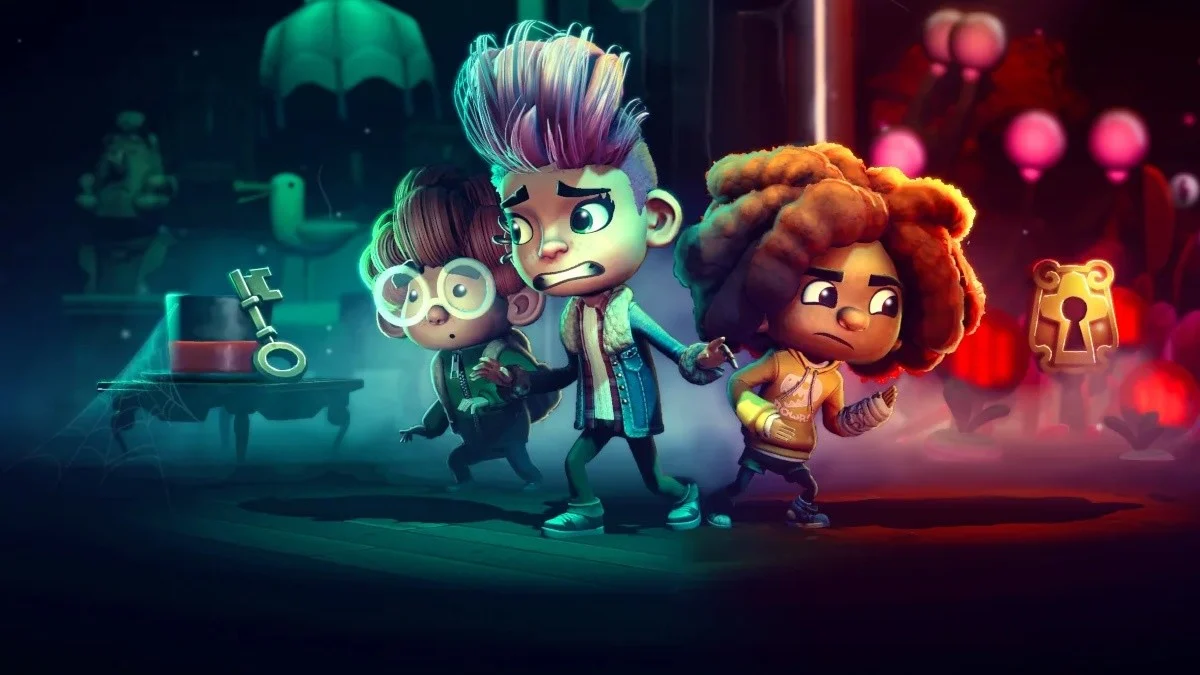
We’ve all experienced a game-induced argument over the years, and for most of us here at Nintendo Life Towers, Ghost Town Games is to thank.
This is the developer that brought us Overcooked and subsequently awakened a Michelin-star chef in each of us, barking out orders at our friends and significant others as if Anton Ego himself was waiting at the door, demanding to be fed.
We’ve poured so many hours into the two Overcooked games and their expansions over the years that our ears pricked up when we first heard about the studio’s next project, Stage Fright, at The Game Awards 2024.
This one takes the co-op chaos out of the kitchen, instead plonking us in a spooky playground, filled with puzzles to solve and challenges to overcome. With an appearance in the recent September Direct confirming a 2027 release, we were keen to sit down with the team to work out whether this one was going to test our relationships once again.
So we did exactly that. We recently got the chance to catch up with two of the studio’s three founders, Oli De-Vine and Phil Duncan, to talk all things Stage Fright. Our conversation covered Overcooked’s success, flipping the script for this new project, and a certain spooky Nintendo series that may have provided some inspiration.
Nintendo Life (Jim Norman): Before we get into Stage Fright, let’s talk a bit about Overcooked, because the game has grown into quite the beast, hasn’t it? At what point did you know that you were onto a hit?
Oli De-Vine, Ghost Town Games: It wasn’t immediately after it came out, I don’t think.
Phil Duncan, Ghost Town Games: No, no! I think because our experience of trying to get it published was so fraught…We met with absolutely everyone, got turned down by absolutely everyone. Team17 were the only people who said, “Yes, it would be fantastic to work with you,” but I think even they were having the conversations of, “Oh, we’ll see how it goes.”
We were certainly of the opinion that we’ll get it out, and we’ll get it published, and hopefully it’ll make enough that we can make another game or at least a prototype for another game.
Oli: I also think we were in a weird post-release space of just being quite drained. It’s a weird, surreal experience of it slowly picking up, and I still think it took a long time before I started running into people in my real life who had played it, where I’m out at a restaurant or something and the waiter had played it.
Phil: I distinctly remember describing it to someone, “Oh, I worked on this cooperative cooking game,” and they’re like, “Oh, so kind of like Overcooked?” And I was like, “Oh yeah, kind of.” [Laughs]
Oli: Yeah, that was weird, when it started to be random people just in the world. It was amazing!
Images: Hello Games
There are certainly some similarities, but Stage Fright also looks very different. What inspired the shift to puzzle-focused gameplay this time?
Phil: It was a case of looking at the kind of things that we enjoyed, and one of the things that inspired us was escape rooms. It’s sort of analogous to Overcooked in some ways: a group of people who all have a common goal, working together. There’s a lot of communication against the clock. So that was our starting point, I guess.
We were talking about how we loved the fact that we’d managed to make a game which encouraged communication, maybe sometimes a bit too aggressively, but yes. So we thought, ‘Why don’t we try and take the people that enjoyed Overcooked, enjoyed communicating, and also enjoyed playing a game for the first time, and take them out on a bigger adventure together?’
Oli: Initially, when we were developing Overcooked, I don’t think we realised we were making a game that was for people who play games a lot and for people who don’t play games very often. That became clear over the development as we did more playtesting with people.
A lot of the game takes place outside of the game
And with this, we were like, ‘Okay, so we’ve got those people for an arcade experience; what would it be like to do something that’s more of an adventure with a narrative through it?’ More of a linear progression game, but still have it where you can be someone who plays games a lot playing someone who doesn’t play games very often. Because communication is the key to what makes it difficult, it still feels like an equal level of play between you and the other person.
We wanted to focus on two-player specifically, to focus on what worked particularly well in the communication aspect and really dig into that. We were looking at escape room-type mechanics a lot as aspects of gameplay that rely on a lot of communication but aren’t necessarily very dense in terms of inventory management or anything like that. Everything is still very physical in a way that Overcooked was. You’re still carrying these items around and moving them around in a real environment. We prototyped a lot of mechanics that were communication-based two-player mechanics that we peppered in amongst all of this to break that up.
So it’s not entirely a puzzle game. It’s more of an escape room with these more physical gauntlet-type things, but without ever becoming a full skills-based platformer. The difficulty still comes from communication rather than from controls.
Image: Hello Games
Two-player couch and, indeed, online co-op seems to be going through a bit of a moment at the minute, with the likes of Split Fiction, Orbitals, and Big Walk. What is it that you think sets Stage Fright apart from the other games in this little subgenre?
Oli: It’s a particular focus on the communication aspect of it and on it not being platformer-style. It’s much more about trying to simulate the experience of going into an escape room, getting all the stuff out on the table, and going, ‘Okay, what do we do?’ We did a lot of testing to try and make the arc of that work.
Phil: When we were making Overcooked, we had this watershed moment where we realised that the way the game became fun was by keeping people playing. In a lot of early prototypes, we found that people would split up, take their individual roles, and they would stick to it. They would just sit there in silence, do their job, and get through it. So we introduced mechanics such as the sliding boat, which would force players to realise there’s no one role you can do forever.
So that was at the core of our thinking when we were coming into this: How do we keep people talking? A lot of the game takes place outside of the game, so it’s about the conversation that you’re having in the living room, not necessarily what’s happening on the screen.
Oli: We do a lot with separating the players in the environment so you’re on one side of the screen and maybe there’s stuff you can see that they can’t see. Maybe you’re in a part of the level they can’t access, and there’s information you have that they don’t, but you’re both so occupied that one person can’t solve the whole game for the other player. You’ve got a lot to explore and find, and then you have to communicate that with the other player because they’ve been spending their time exploring and finding things.
Has your development process changed in recent years? What was it like coming to something completely new again?
Phil: The process is fairly similar, in a lot of ways. We still have a big focus on prototyping and playtesting. We try and get people to play the game as much as possible. We took Overcooked to a million conventions, and that was a great way of just getting loads of people through the game, seeing what resonated, seeing what didn’t, seeing where the jagged edges were. That’s definitely something that we’ve brought forward to this.
We started prototyping ideas for this almost immediately after ‘Overcooked 1’
I’d say the other thing we also do is try to get a balance of people who play games and who don’t play games together. A lot of our playtesting is with people who are like, ‘Okay, I’m the gamer in this relationship, but I’m playing with my partner who doesn’t play anything’. Sometimes they’re not quite accurate with it!
Oli: Our process has been similar. It’s slightly different in that we’re not making a party game now, it’s more of an evening thing. It’s still in chunks, but it’s not three-minute chunks. You’d be expected to play for more like 20 minutes or longer than that.
Phil: And the other thing is that we’re working with a lot more outside contractors. Friends and family have now joined us. It’s hard to say because people come in and off the project, but I think at our height, like 24-ish people were involved.
Oli: And the way we’ve been testing it has been different because we’ve been doing less of taking it to a convention and letting everyone play it because it doesn’t have the same vibe.
Phil: Yeah, exactly. You want people to sit down and play it for hours, and you can’t convince people to do that.
Oli: And it’s got a narrative to it. We’ve got a fully voice-acted, fully cinematic story going through it as well, so you want to really get a sense of what a lot of playthroughs would look like. It’s a case of working over the whole experience. That’s been more difficult to test.
It’s taken us a lot longer, though we’ve had the luxury of time. Overcooked had to be made in like 18 months, whereas this has been… I don’t even know how long now!
Phil: I don’t want to know! [Laughs]
Oli: We started prototyping ideas for this almost immediately after Overcooked 1, and it became a bigger project after Overcooked 2 came out. So it’s a long time.
Images: Hello Games
Let’s talk a little bit about that narrative. How long, roughly, do you think a playthrough would be from start to finish?
Phil: We have got this question before, and I still don’t know! We’re talking a good few evening sessions, I’d say.
Oli: I think so. It’s days — well, not days like 24 hours! If you’re playing in the evening, I think it should take you about a week.
Phil: We’re hoping that it becomes a thing that people sit and play for a couple of hours in the evening. We have this image in our head of making the ultimate game where you can sit with a person that you always play these games with, get under a blanket, get a big pile of snacks, and draw the curtains. It’s like your Friday night in. That’s the dream.
Oli: There’s variety over the course of the whole game, so you can play it, go away and come back, and it isn’t completely alien to you. Which I think is a problem with a lot of games.
Phil: I have lots of games where I’m like, ‘I’m never gonna go back to that game [because] I’ll have to learn how to play it again.’
One of the great things about Overcooked was that sense of replayability. Did that carry over to Stage Fright?
Phil: I’m hoping it’s like if you really enjoy a good film, you might go back and it becomes your comfort play. That’s my dream of it. I don’t think it is an arcade game in the same sense that you’ll be replaying levels. I certainly think there’s a lot to explore and discover on subsequent playthroughs, but it’s not designed in the same sort of way. I think it’s more of an adventure that you play from start to finish, and then hopefully it’s the kind of thing that we might come back and play every Halloween.
Oli: I think you could get a unique experience out of playing it again, but it does have the one linear story that goes through, so you’d know that.
Phil: Yeah, but that doesn’t always have to be a dealbreaker. I’m very much looking forward to playing through Ocarina of Time again, you know?
Image: Hello Games
I’m always fascinated by intentional co-op games like this, because they have puzzles that can only exist in this subgenre, made for two people who are looking at things differently. What is it like to make a puzzle that’s designed for people to work on cooperatively?
Phil: A lot of the time we work backwards in some ways. We like to think about the player experience and the kind of conversations we want the players to be having. How do we make that happen? How do we make sure the person finds something interesting and it draws their attention enough that they have to pass it on to the other player?
So I guess from a design philosophy point of view, we talk a lot about silence in the room — is that still there? How do we encourage players to actively engage with one another? How do we make sure that one player isn’t just being like, “Oh, I know the answer. Follow me, I’ll lead you through it.” We want to avoid what we call ‘First to Fun’, which is when one player takes charge and they’re like, ‘Okay, I’m going to run ahead, and I’m going to be the first to get to the enemy, and I’m going to be the first to get to the chest and open it.’
We’ve tried to keep it very comedic, whimsical and light
Oli: It feels bad from both sides, right? You don’t want to be the player who feels like they have to pull the other player along, and you don’t want to be the player who is being pulled along. So we’re trying to avoid that. It’s about what information they’re passing from one side to the other.
I also think the narrative informs a lot of the puzzle design as well. We’ll do a pass after the story starts to come into place where we’re, ‘Oh, actually, this could tie into the story that way.”
It’s been a very slow process of moving things around the game and putting it in front of players and [asking], “Okay, how did that go?” It’s sort of a psychology test environment, working out if it looked like they were both engaged.
Phil: It’s quite fraught in some ways making this kind of game because you can make a build and then you accidentally forget to turn a light on, and it means players suddenly can’t see a clue that they could before and the whole thing unravels. So we’ve had a lot of nightmare moments like that.
Oli: We’ve had fun dialogue that players will latch onto as a clue, even though it was intended just as a joke. Or we’d change the name of an item, and it drastically changes things. It’s very fiddly. There’s a long process of iteration to get that right.
Images: Hello Games
And you’ve got proper characters this time — Drew, Blake, and Charlie. How did it feel writing characters with stories and personalities? That must have been a nice change.
Phil: Well, we didn’t have to do a lot of the writing, thankfully. We have Gemma [Langford], who handled a lot of the story side of things. We obviously worked extremely closely — we’re all working together on the game — but she has a lot of experience with writing plays, and she wrote a lot of the narrative and bits and pieces that we had in Overcooked 2 and the subsequent DLCs.
But for us, it was just very exciting getting a chance to actually add something with a bit of real character and mystery to it. Because we knew we were making an escape room-inspired game, we wanted there to be this narrative thread. Given that escape rooms are all about solving a mystery, it was nice to make that part of the larger story as well.
The dream is that every single level introduces something new and just keeps you playing
Oli: This was also our first time working with voice actors. Everything is voiced, except for clue text and things. So we’ve got obviously our fully animated, more cinematic moments, but also a lot of dialogue that’s just interacting with NPCs in the world. That makes a huge difference for making a world feel alive. We’ve tried to keep it very comedic, whimsical and light — it’s not going to be a really lore-heavy game — but it really helps flesh out a world.
Phil: We were quite resistant to doing it originally, but we did the first tests with just some scratch audio that we’d recorded ourselves, and you could instantly see how quickly people took to it. It was like, ‘Oh, okay. That’s going to be a lot of work.’ [Laughs]
Oli: It’s the patience of a cooperative player as well, right? Because you’ve got two people playing a game together, they’re not going to sit there and read a lot of text to dialogue. So some parts have to be voiced, because otherwise they’re just not going to interact with it. So, that was really rich fun.
Phil: Also, shoutout to friends of ours that run an animation studio called Paper Snake, who have been handling all the animation. They’ve done an amazing job. They’ve been fantastic.
Games like this always bring Nintendo consoles to mind. And, of course, Overcooked had a huge following on Switch. How much of a priority was Switch, and indeed Switch 2, this time around?
Oli: Extremely high priority! Switch is, in some ways, a console built for co-op from the ground up. The fact that you can detach the controllers and it’s like you’ve got two controllers out of the box, particularly for a game like ours where the controls are deliberately simplistic — you could take one Joy-Con and fully control our game. So we knew that we would try to bring this game to Nintendo from the start.
Phil: I also think of the fan base that we’ve got on Nintendo consoles. We got so many comments and emails from people that played [Overcooked] on the Switch and really enjoyed it. This was the game that got them back into gaming, or whatever. So from our point of view, this is the audience we want to give back to in some ways.
Oli: With making a game that is trying to be, in some ways, an onboarding experience for people who don’t play games all the time, it’s a very accessible console. It’s a console that gets played a lot by families, so it really makes sense for us.
Image: Hello Games
On that Nintendo note, I detected some Luigi’s Mansion in your first trailer. Was that an intentional touchstone, and if so, what is it that you love about the series?
Phil: I absolutely love Luigi’s Mansion! I think it [strikes] a really good balance of keeping things spooky but also accessible. There’s a really nice quality to the art style in that you can instantly read things and understand what they are without having to have text to describe things or lots of context. There’s a lot of instantly accessible things in that way.
I also think it’s a really nice playground. That’s something we wanted to do with Stage Fright as well: to create a playground into which we can throw all sorts of bizarro co-op mechanics that we can think of.
When we were making the game, we prototyped just endlessly, everything we could think of that would encourage people to play together and communicate. Those went in, and we’d pick the best ones and see what worked well. What’s quite nice about the spooky town setting that we have — and we’ve got this stage magic element to it as well — is that it really opens the door for just creating variety in terms of gameplay. The dream is that every single level introduces something new and just keeps you playing.
Finally, Overcooked obviously grew into a bit of a franchise, with a sequel and DLC. Do you see a similar future for Stage Fright? Is it something that you’d be interested in revisiting?
Oli: That’s a very ‘count your chickens before they’ve hatched’ situation for us! What we’re focused on at the moment is trying to make this the most polished version of the game that it can be, and getting it out as a fully complete unit without needing to have extra things. And then, when you’ve put your best foot forward, who knows?
Phil: Really, we just make games that we want to play, and we just hope that people want to play it too.
Oli: We’re making something that we think is unique and interesting and then we’ll see if people respond to that.
Our thanks to Oli and Phil for taking the time to talk to us, and to Tim at Hello Games for setting up our chat.
Stage Fright launches on Switch 1 & 2 in 2027.
Jim came to Nintendo Life in 2022 and, despite his insistence that The Minish Cap is the best Zelda game and his unwavering love for the Star Wars prequels (yes, really), he has continued to write news and features on the site ever since.