


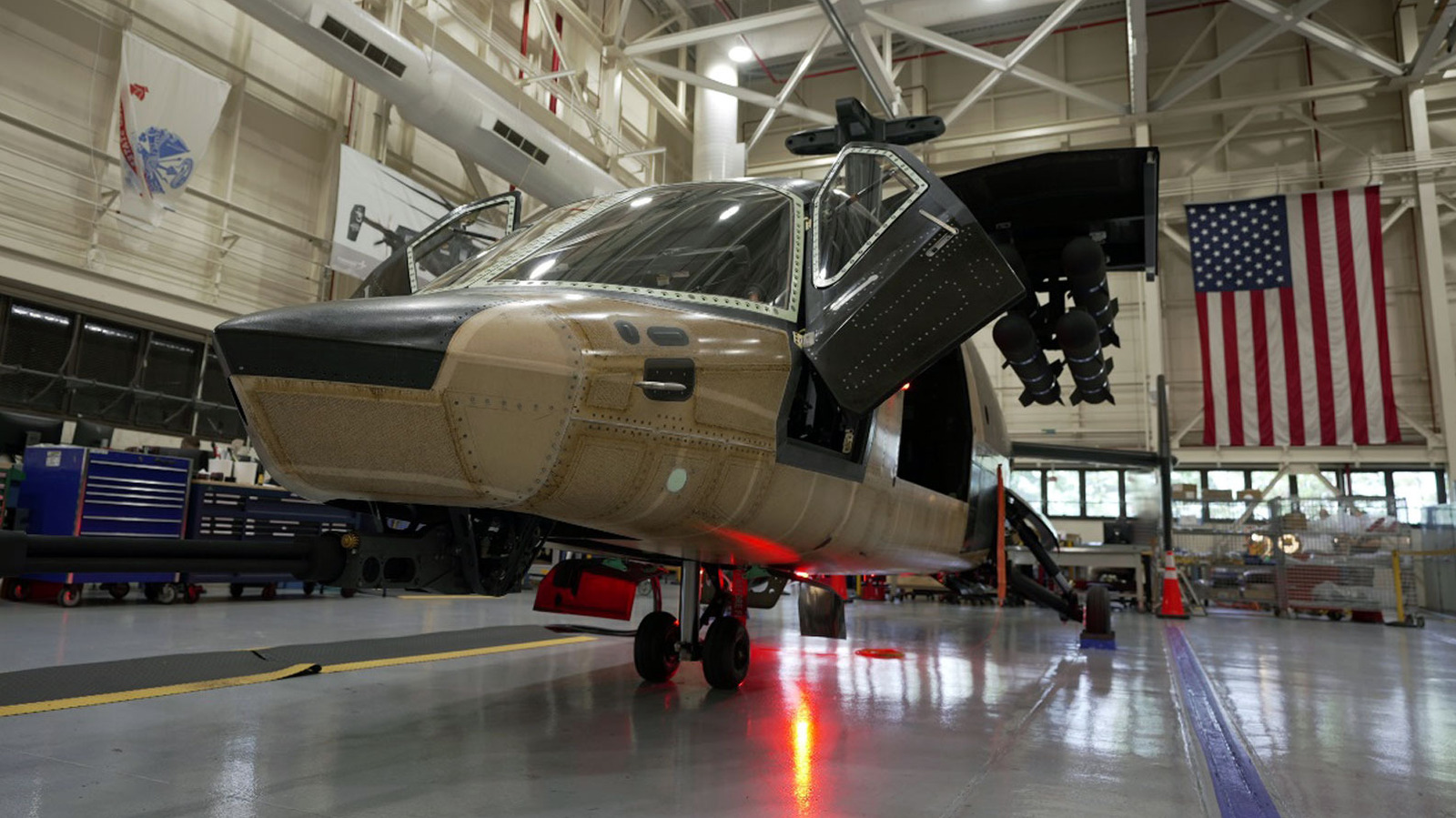
While they may not generate as much hype as the latest sleek, fixed-wing fighters or bombers, helicopters are a big part of America’s military arsenal, especially for the U.S. Army. Many of the helicopters in the Army aren’t too dissimilar from those that served in the ’80s and ’90s, with the venerable Black Hawk still one of the most commonly flown choppers in the fleet.
Though the Black Hawk platform has been heavily upgraded over the years, it’s still based on a helicopter design that first entered service back in the late 1970s. It’s much the same with the legendary AH-64 Apache attack helicopter, which first flew more than 50 years ago. It’s not surprising, then, that the Army has sought to modernize its fleet, with some attempts more successful than others.
One helicopter that could have brought the Army’s fleet into the future was the Sikorsky Raider X — a high-tech, armed scout helicopter being developed as part of the Future Attack Reconnaissance Aircraft (FARA) program. The program was announced in 2018, with the Raider X serving as Sikorsky’s entry. Though Sikorsky made significant progress on the Raider X, it was shelved when the Army cancelled the FARA program in 2024. Instead of a next-gen chopper, the Army switched its focus to drones and powerplant upgrades for its existing helicopter models.
The FARA story
Before talking about the high-tech Sikorsky Raider X, we have to go back to one of America’s more established military choppers, the Army’s OH-58D Kiowa Warrior. The Kiowa Warrior was an armed scout helicopter developed in the 1980s, based on the even older, 1960s-era OH-58A Kiowa. More a dual-purpose aircraft than a dedicated attack chopper, the Kiowa Warrior served in numerous conflicts, including Iraq and Afghanistan, and was retired from service in 2016.
The FARA program, initiated in 2018, sought to develop a new, state-of-the-art, armed recon chopper to replace the Kiowa Warrior. The two aircraft that made it to the second phase were the Bell 360 Invictus and the Sikorsky Raider X. Announced in 2019, Raider X was based on the Sikorsky S-97 Raider and built around Lockheed Martin’s X2 rotor system. The Raider X was designed to excel at low-level, low-speed reconnaissance, but Sikorsky also touted the X2 platform’s ability to climb as high as 9,000 feet and reach speeds over 250 knots.
The Raider X also planned to offer plug-and-play compatibility with several already-existing weapons and computer systems, improving its adaptability. By fall 2022, Lockheed Martin reported that the Raider X prototype was 92% complete and well on the way to begin flight testing.
Shifting priorities
Even though the Raider X was well on its way to completion, the Russian invasion of Ukraine in 2022 and the war that followed prompted a change in U.S. Army policy. The conflict gave U.S. Army leaders a look at the changing face of aerial reconnaissance and attack warfare, with unmanned drones doing many of the jobs formerly done by helicopters like the Kiowa Warrior. This reality, along with ongoing budget concerns, led to the termination of the FARA program in February 2024.
This pivot also meant that the GE T901 engine, developed as part of the Army’s Improved Turbine Engine Program and intended for the FARA helicopters, would instead be retrofitted to existing Black Hawk and Apache helicopters. The Apache, for its part, had already taken on some of the Kiowa Warrior’s reconnaissance roles while the Army waited on a proper replacement.
While the ambitious Raider X doesn’t look like it’ll enter service with the United States Army, X2-based Sikorsky choppers could still find future roles as next-gen helicopters for other NATO countries. Ultimately, time will tell what’s in store for the S-97 Raider and Raider X and their place in the long line of military helicopters Sikorsky has produced over the years.