


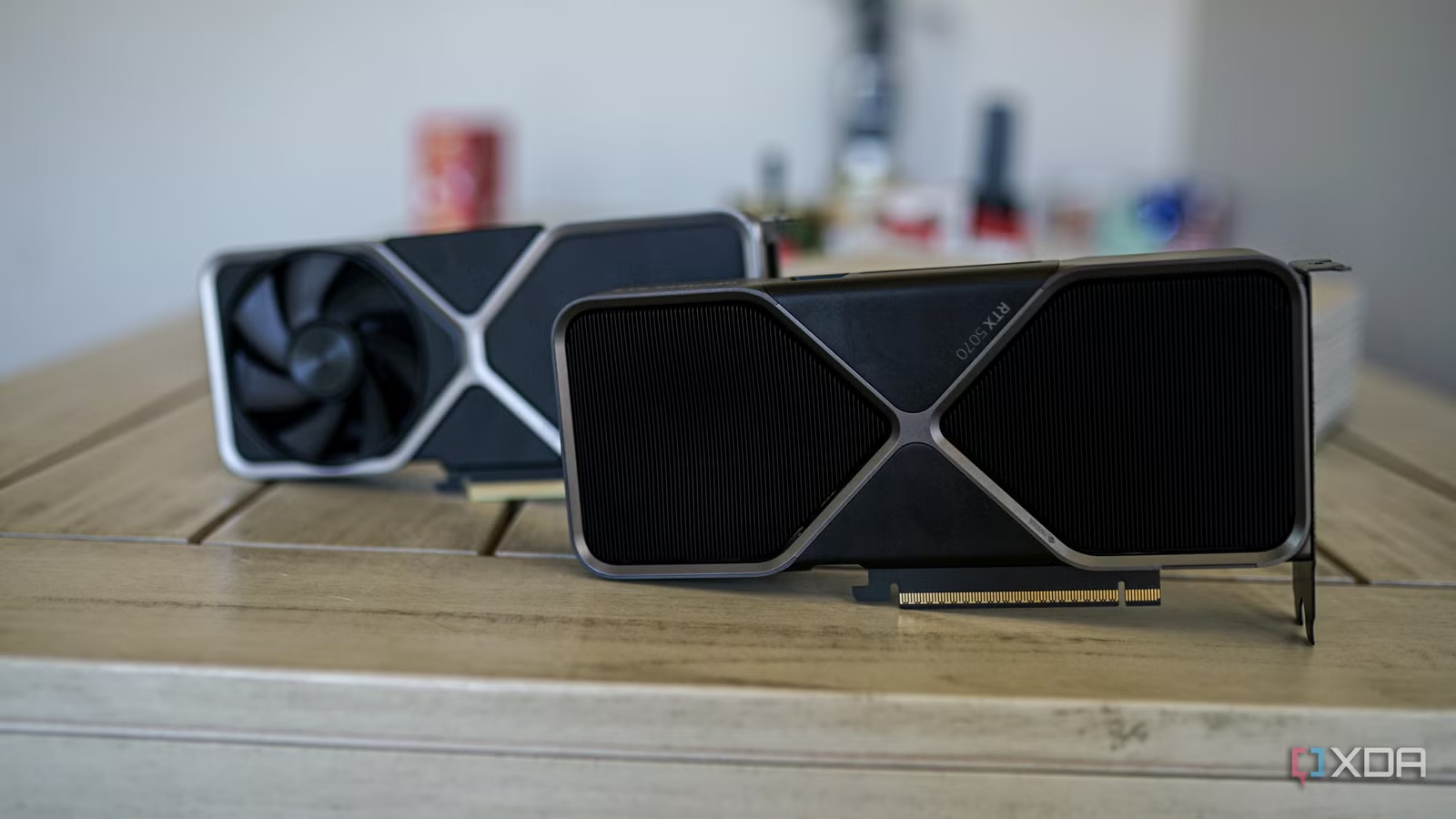
When Nvidia announced DLSS 5 earlier this year, I thought this might finally be the feature that would make me regret not upgrading to the RTX 5090 sooner when prices were reasonable. I was already pretty happy with my RTX 4090, so paying $2,000+ for a GPU that improved my frame rates by nearly 30% always felt like a tough pill to swallow. But Nvidia’s decision to call a neural rendering feature that has nothing to do with upscaling “DLSS 5” made it seem like a much bigger deal, especially with how it transformed lighting, skin texture, and other surface details in its demos.
Now that DLSS 5 is actually available in NBA 2K27, though, I don’t have that FOMO anymore. In fact, after looking at independent testing and seeing just how much performance it eats up for a result that has stability issues in motion, I don’t even want to try the unofficial DLSS 5 mod on my RTX 4090. If anything, this seems like an early adopter feature that likely needs years to mature before I’d consider upgrading my GPU for it. And since Nvidia has already confirmed that DLSS 5 is coming to the RTX 40-series, I’m not really missing out.
Related
DLSS 5 is further proof that rasterization’s days are numbered
For better or worse, rasterization continues to be buried, and it won’t be long until games are unrecognizable
The performance hit is worse than ray tracing
Upscaling won’t save your frame rates this time
Credit: Hardware Unboxed
What immediately killed my excitement was seeing what DLSS 5 does to frame rates without Nvidia’s Multi Frame Generation covering it up. Hardware Unboxed measured the RTX 5090 dropping from 192FPS to 76FPS at 4K in NBA 2K27 and from 220FPS to 134FPS at 1440p. That’s a 60% performance hit at 4K and a 40% hit at 1440p. At 1080p, the performance hit is far more tolerable, but who’s trying to game at 1080p with a high-end GPU in 2026? Sure, 76FPS is playable, but we’re talking about a sports game here.
You could argue path tracing has a similar impact on performance, but at least you can use DLSS upscaling to offset some of that FPS hit. DLSS 5, though, doesn’t give you that same luxury because it processes the frame after upscaling, not before it. So, you could use DLSS 4.5 Performance and render the game internally at 1080p, but that will have little to no impact on your FPS with DLSS 5. Even lowering in-game graphics settings barely moves the needle. Your only crutch is frame generation, but that’s the last thing I’d recommend using if your base frame rate isn’t at least 60FPS.
The screenshots are more convincing than the gameplay
Motion stability is one of its biggest weaknesses
DLSS 5 looks its best when you pause the frame and compare screenshots side by side. And if you look closely at Nvidia’s demos, you’ll see a pattern: they’re mostly close-up shots where you can clearly see the improvements to skin texture, hair, clothing, and lighting. But when you zoom out and look at things in the distance, which is how you’d normally play a game, you’ll quickly see that it’s not as impressive. From what I’ve seen, the neural rendering simply exaggerates the image to the point that it looks unnatural.
More importantly, those extra details don’t hold up perfectly when you start moving around in the game, which is what matters most. Even though DLSS 5 uses motion vectors to maintain consistency between frames, it processes each frame individually. So, it’s still prone to artifacts in motion. You’ll see some of the lighting flickering as you pan the camera around, while finer details can have a noisy look. When you actually play the game, that’s something you tend to notice more than things like skin texture and hair detail.
DLSS 5 has all the time in the world to improve
But right now, it’s just a tech demo; I don’t need an RTX 5090 for
Credit: Nvidia
I don’t want to sound like I’m hating on DLSS 5 for no reason. To Nvidia’s credit, DLSS 5 has already come a long way since its introduction in March. Nvidia’s initial demos were running on two RTX 5090 GPUs, but since then, it has somehow managed to improve DLSS 5’s performance by 5x in just six months. That’s exactly why I’m excited to see where this feature stands a year from now. If it becomes remotely viable on more demanding AAA titles, that’s a win in my books (and Nvidia’s).
But as it stands, it’s just a good tech demo at best. I wouldn’t call DLSS 5 transformative because it really needs favorable scenes to show off what it can do. Put a character close to the camera, and it’s impressive. But zoom out and play the game, and it looks like a high-contrast version of the same game. For the FPS hit, I want a transformative experience like path tracing. Right now, I feel like it makes more sense for reliving older classics that aren’t demanding for modern GPUs. And considering I know it’s coming to my RTX 4090 anyway, I’d rather hold out for the next-generation GPUs that are likely to be better equipped for DLSS 5.
I still don’t get why Nvidia calls it “DLSS”
For the longest time, DLSS has always been something gamers associated with getting more performance out of their GPUs. But DLSS 5 does the complete opposite, which is why I’m baffled by Nvidia’s decision to market it as DLSS 5 instead of something else entirely. Either way, I’m glad Nvidia is experimenting with neural rendering because there’s clearly a lot of potential here. It’s way too soon to call it a failure because, if you remember, early implementations of ray tracing and DLSS weren’t great either. DLSS 5 could very well follow the same path, but judging by what we have right now, it’s clearly not something you upgrade your GPU for.
Related
I tested Nvidia’s leaked DLSS 5 build on my RTX 40-series across 3 games, and it changed what I thought about neural rendering
Is this the future of rendering?