


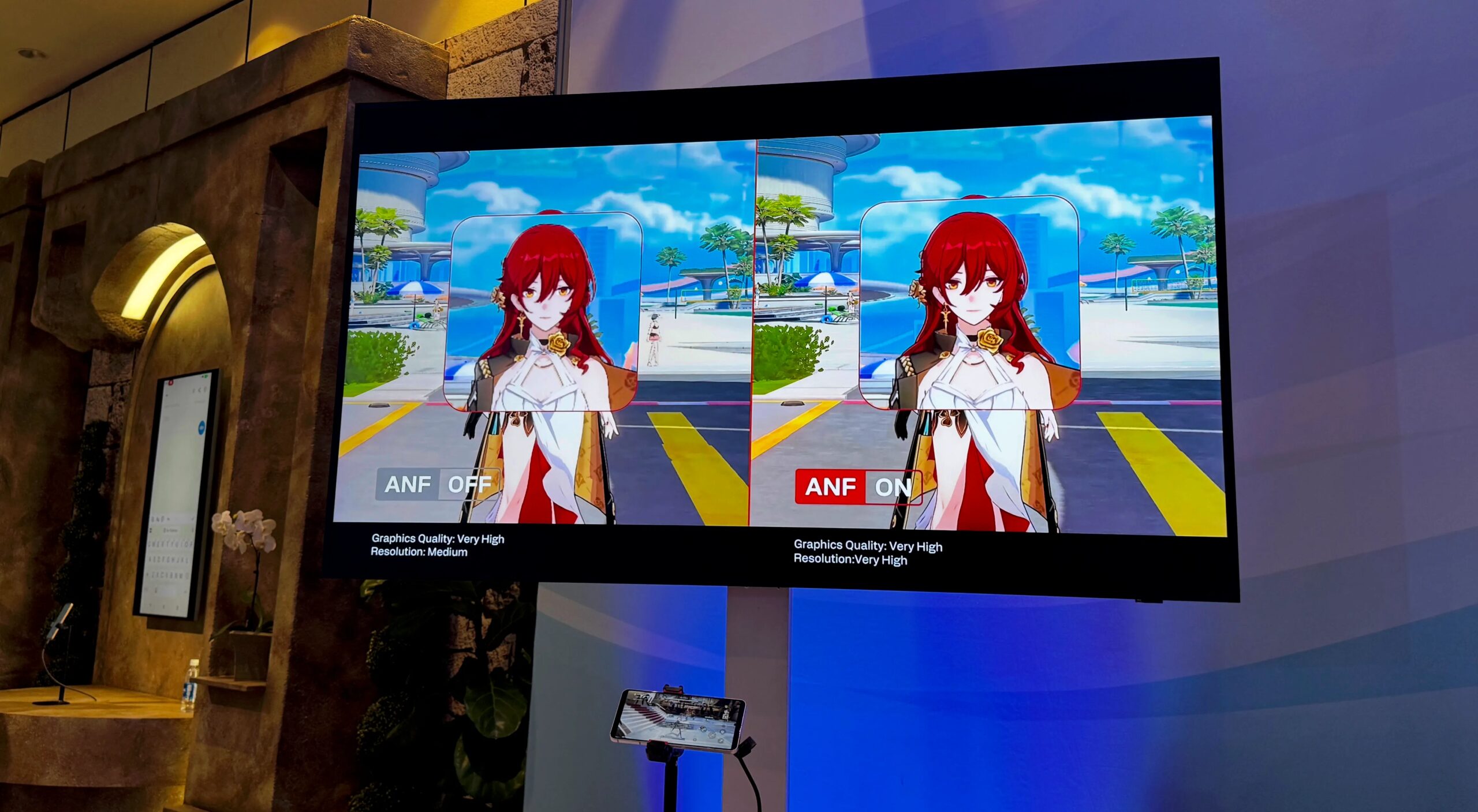
Gaming on phones has gotten good enough that graphics and gameplay are beginning to approach what players expect on PC and console. Those more established platforms maintain the edge, with massive GPUs and energy budgets that power AI enhancements that render smoother experiences. While there will never be enough room on a smartphone to fit a full-size graphics card, next year’s top handsets will finally get those AI boosts — and mobile gaming will never be the same.
It’s all because of technology making its debut on the latest phone chips. At its Snapdragon Summit 2026 recently, Qualcomm debuted the new Snapdragon 8 Elite Extreme Gen 6, which comes with GPU upgrades, including new Adreno Neural Fusion tech that uses AI to upscale resolution, generate frames to increase frame rate and extend battery life while gaming.
On stage at the Snapdragon Summit, Chris Patrick, Qualcomm’s SVP and general manager of handsets, shows off the Snapdragon 8 Elite Extreme Gen 6’s graphics gains with Adreno Neural Fusion.David Lumb/CNET
How AI gameplay improvements can come to mobile
Not every Android phone uses Snapdragon chips, but AI graphics boosts could come to them as well — the first time this tech will reach mainstream phones. In early September, chip designer Arm debuted its Mali G2-Ultra NX GPU, which has similar technology that upscales resolution and inserts frames, as well as a denoiser to improve image quality when rendering complex effects like ray-tracing reflections and lighting. Arm GPUs are used in top-end chips from companies like MediaTek.
This tech has been used in high-end PC and console hardware for years in the form of Nvidia’s DLSS and AMD’s FSR, which uses AI to bolster graphics in more affordable GPUs and boost frame rates for smoother gameplay. In beefy PC rigs and consoles that plug into wall outlets, or even laptops or handhelds like the Asus ROG Ally, this tech mostly eases complex workloads and makes good graphics better.
But the challenge in adapting this modern graphics tech to phones lies in one word: thermals. PCs have a constant flow of power, laptops have giant batteries, and gaming-specific computers are cooled with massive fans. But phones are so small that their batteries are measured in milliamp-hours, often running on a handful of watts of power per day, and increasingly rely on thermal paste and cooling chambers to vent heat.
The big challenge was getting even better graphics out of the latest generation of Snapdragon chips and even boosting battery life, said Qualcomm Director of Product Management Amandeep Dhaliwal, who leads Snapdragon’s GPU strategy.
“That was the main thing when we were building this Adreno Neural Fusion model,” Dhaliwal said. “How do I factor in thermals as I’m building this upscaling model so that eventually, if in my game, let’s say the power I was consuming was 1 watt, how do I then save 20% on that and come out ahead?”
On phones, AI boosts can eke out more battery life while gaming. With the Snapdragon 8 Elite Extreme Gen 6’s tech, rather than render graphics in full resolution, they’re dialed down to 540p and then AI upscales it to 1080p — it’s much more efficient for AI to make up that difference. Likewise, they can run at 30 frames per second and AI can insert more frames to boost the count up to 60 or even 90fps. This could result in noticeably better energy efficiency while gaming on phones using Snapdragon’s top chip, Dhaliwal said.
“Improving your battery life in a gaming session — people will [cheer] if you do it for 1 to 2%, and here we are talking about 20 to 30%, right?” Dhaliwal said. “Which is huge.”
Both of the new Snapdragon chips have improvements to their Hexagon GPUs, with the 8 Elite Extreme Gen 6 getting 44% improved GPU performance over the Hexagon in last year’s chip, while the 8 Elite Gen 6 has 37%. General battery efficiency for GPU tasks has improved 40% across both chips, too. But the Elite Extreme’s graphics processor has extra hardware that puts it above its Gen 6 sibling, like matrix GPU cores that enable Neural Fusion, AI enhancements that plug directly into the graphics pipeline rather than needing to tap traditional memory and other top-of-the-top-end boosts.
Lekha Motiwala, director of product management at Qualcomm, debuted the benchmark gains in the Snapdragon 8 Elite Extreme Gen 6’s Adreno GPU.David Lumb/CNET
Tech coming to today’s phones, but only the best of the best
In Snapdragon’s case, this new technology is only coming to the Snapdragon 8 Elite Extreme Gen 6, the most top-of-the-line chip in the company’s newly revised lineup.
Neural Fusion isn’t available on the Snapdragon 8 Elite Gen 6, which is still a premium chip at the same level as last year’s Snapdragon 8 Elite Gen 5 — that is, it’s silicon that is already slated to power the Xiaomi 18 Pro and will almost certainly come in many of next year’s upper-tier phones. The Extreme version is a cut above even that, and will only be used in the highest-end Android devices, like the Motorola Signature 27 and Xiaomi 18 Pro Max revealed at this year’s Snapdragon Summit alongside the new chips.
Neural Fusion could, in theory, be used in the Snapdragon 8 Elite Gen 6, but it wouldn’t be efficient and the gains wouldn’t be as substantial, Dhaliwal said. “Technically, it’s possible to have [Adreno Neural Fusion] on a nonmatrix core GPU, but it’s not advised because you are not going to see a good experience,” he said.
It comes down to the cores: Since the 8 Elite Gen 6 lacks its more premium sibling’s matrix cores, it’s heavily using all its existing cores to render scenes already, and Neural Fusion would tax them even further, requiring a compromise somewhere that would worsen the player experience. Decreasing frame rate to compensate could lead to players noticing dropped frames and choppy visuals, degrading quality for limited benefit.
To further clarify the graphical rendering difference between these chips, Dhaliwal put it in terms that PC gamers can understand: a parallel comparison between Nvidia’s latest 50-series PC GPUs.
“It’s like buying an Nvidia 5090 RTX versus buying a 5040TK or buying a laptop with an integrated GPU in it,” Dhaliwal said. “That’s basically like you have a mainstream GPU and then you have an extreme GPU.”
Qualcomm’s Chris Patrick introduced a list of game titles that will support improvements from the Snapdragon 8 Elite Extreme Gen 6’s Adreno Neural Fusion tech.David Lumb/CNET
What’s coming in tomorrow’s mobile gaming
Rendering graphics at lower resolutions and frame rates to upscale them to rates that gamers expect (1080p at 60fps) is an impressive way to extend battery life and offset some of the computational load from the CPU to neural processing. But there are even greater heights for the technology to reach.
For this generation of phone chip tech, Neural Fusion generates a frame for every one traditionally rendered — so going from 30 frames per second to 60, or 60 to 120. But the big trend in China is for even higher frame rate gaming, Dhaliwal said, with games natively rendered to 120, 144 or even 165fps. Since rendering those rates is power-taxing, which leads to swift battery drain on mobile gaming, Qualcomm’s next frontier is looking to generate more frames for each one rendered — boosting a native 30 frames up to 120, for instance.
But with Snapdragon and Arm introducing these PC gaming AI boosts and Apple adding neural accelerators to GPUs on its A-series chips, the mobile industry is heading toward harnessing this tech in phone gaming on a greater scale. That affects game developers, too, who have been working miracles to get their games running on pocket-sized devices with very limited power budgets — but now have more power savings to boost the graphics in their games.
“Now the developers are basically thinking, look, I was doing something in a given 1-watt budget,” Dhaliwal said. “Now with upscaling, I suddenly have these 200 milliwatts or 300 milliwatts available, which means I can enhance my game to do more things, right?”
These GPU improvements aren’t limited to gaming, either. They can run AI models. Even if they’re not going to be as power- or performance-optimized as on a laptop or desktop, they can run on a GPU, Dhaliwal pointed out. It’s another tool alongside the neural processing unit that developers programming mobile AI models can tap.
“It’s all those things which are going to be really, really exciting,” Dhaliwal said.
David Lumb
See full bio