


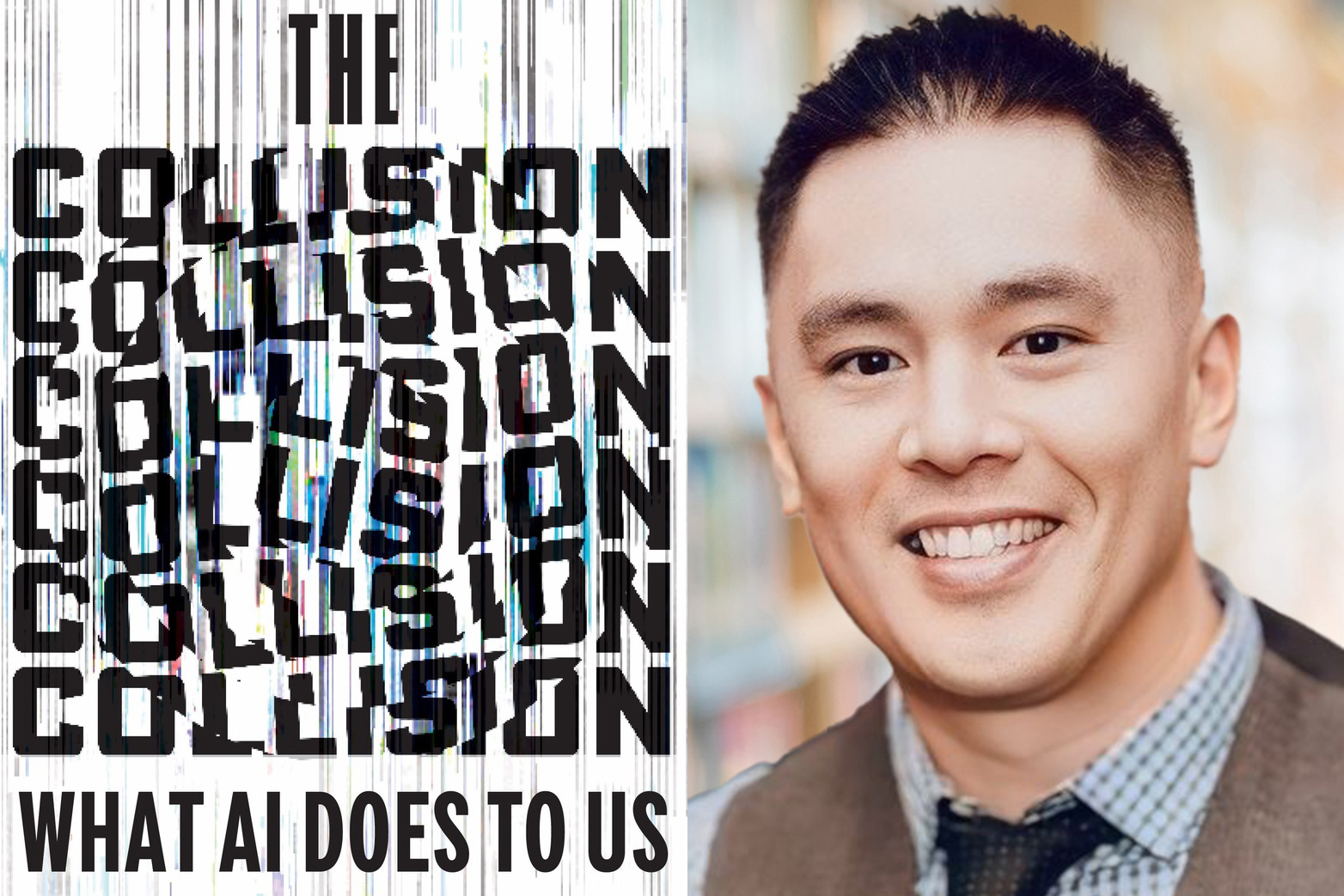
As artificial intelligence use becomes more widespread, scholars are working to understand its effects on the people who use it. MIT Professor Eric So offers one of the most complete syntheses yet, in his new book, “The Collision: What AI Does to Us,” published this month by W.W. Norton. Recognizing that AI offers opportunities to complete work faster, and in some cases has been turned into useful domain-specific tools, So nonetheless looks at the costs of relying on it too broadly. He contends that heavy use of AI can lead to a kind of cognitive atrophy, in which people fail to develop and retain essential thinking skills. In general, he says, evidence shows that our ability to learn gets dramatically better when we wrestle with material, work through initial failures, keep iterating, and in the process acquire better thinking skills while retaining more knowledge.
These conclusions are drawn from recent research by So and others, in academia and industry, including analysis from AI firms themselves, such as an Anthropic study showing that about half of queries from college students were low-effort queries for simple answers. So also weaves personal reflections into his narrative — having long studied financial markets and behavior, he is familiar with analyzing how new tools and information affect our decisions. MIT News talked to So, who is the Sloan Distinguished Professor of Global Economics and Behavioral Science in the MIT Sloan School of Management, about the book.
Q: What prompted you to write “The Collision”?
A: I wrote this book in response to patterns I was seeing in myself and other individuals. I open the book with this story where I was instinctively reaching for AI to help me think through problems I normally would have handled myself. A colleague had reached out for assistance and I had essentially taken her question and written half a sentence, then said, “ChatGPT, help me finish this professionally.” I made a few light edits and sent it off. And I sat back and really felt incredibly concerned about how I had removed my own thinking from the process.
I have found students are outsourcing their thinking to AI, rather than thinking through things themselves, turning to it to answer homework that would normally help them build mastery in a subject. We need to start understanding what this technology is doing to us and how it interacts with human cognition and our psychology, and give people some practical insights.
Q: Part of that means understanding the incentives people have to use AI, or how the allure of AI takes hold, even when there are long-term costs, in your view.
A: There are converging factors drawing us to AI. For example we have a real biological instinct to conserve our mental energy, and socially, we face situations where AI is used by other people to race ahead, and it rachets up the pressure on everyone else to use AI. Combine that with the problems detecting AI use in a practical way, and all these factors create what I call “AI gravity,” this constant pull to use AI. It’s not simply a matter of telling people to think for themselves. At this moment we’re in, AI is colliding with society.
Q: So we need to look at these systemic factors, not just individual decisions, when it comes to AI use, like businesses urging employees to use it.
A: Many organizations are not just suggesting use of AI: It is now the basis of your evaluation, meaning if you want a bonus or promotion, it is incumbent upon you to use these tools. I think a subtle process is taking hold in academia, where people say, “My future employer will want me to use AI, so I’d better start using it now.” But the problem is that as you start to use AI now, we’re losing touch with the practices and capabilities we’re seeking to build, and in turn that makes us more dependent on using AI in the future, and it becomes a self-fulfilling prophecy.
Q: What is AI doing to our minds?
A: AI is not just changing what we can do, it’s changing who we are as thinkers. AI removes a lot of the friction necessary to build foundational mastery. It is causing many people to lose their capacity for pushing through problems. AI offers instant relief, and we become accustomed to that. Many people are turning to it as an access point for information, so it’s affecting our ability to remember. Also, AI is changing our interpersonal relationships. A key point in the book is that these models are simultaneously sycophantic, meaning they want to make us happy because that’s how they drive engagement and get positive feedback, but they are also really persuasive. We lose the ability to connect with other people because we’re so accustomed to this frictionless environment where the models always agree with us.
Q: Your book emphasizes the value of “productive struggle.” You write, “Struggle doesn’t mean you’re suffering.” Instead, we get a handle on things by struggling to learn them.
A: We need to recast how we think about struggle, as something that is formative rather than a problem to be solved. I draw a lot of parallels in the book between some of the societal changes that occurred post-industrialization, when suddenly people no longer needed to be physically active to be economically productive. We saw more people suddenly develop physical exercise as something we do intentionally, that required reframing of what physical struggle meant. And I think we need that sort of shift about what we think about cognitive struggle.
Q: Given all this, what can we do to maintain some reasonable level of cognitive effort today?
A: At the personal level, I emphasize four principles for navigating this age of AI. One is embracing the struggle, as we’ve talked about. The second rule is: Value who you are without AI. I’ve seen so many presentations over the last couple of years where someone has put together this very polished-looking presentation with Claude, but when they present it, it’s clear they didn’t put in the work necessary to understand the material. The formative struggle creates what I refer to as an “inseparable task bundle,” since making the slides allows me to engage in substantive discussion. In the absence of valuing who you are without AI, we get the product, but not the ability to capitalize on it.
The third rule is about reinvesting your cognitive surplus. There are a lot of tasks for which AI can save you time — rote activities — but it matters what you do with those time savings. If you’re just funneling the same energy into the same tasks, you’re missing out on the potential transformational benefits of AI. The most innovative changes are not the ones that simply allow us to automate, but stretch the capabilities of humanity in a productive way and build expertise. Or, people can channel that freed-up time to focus on family, learn a new language, cultivate skills.
The last rule is about using AI as your cognitive trainer. AI is this dual force, where it is very bad for thinking if you use it as an answer machine, but can be great for learning if you use it as a tutor. AI can be tailored to you. However, it requires that you seek out the friction of having a tutor, relative to having an answer machine. And that requires motivation.
This is a very challenging moment, and the problem is one we need to take seriously.