


Ever since DLSS 5 dropped, I’ve been throwing it at any game that catches my fancy. I’ve “remastered” classic PS2 and PS3 games with DLSS 5, and AAA titles run pretty well with neural rendering despite my aging RTX 4070 Ti. In winding the clock back and remastering old games, I wondered what would happen if I threw DLSS 5’s neural rendering layers on the pixelated worlds of some of the oldest games I’d ever played — my classic DOS collection.
Since these games came out well before modern graphics APIs and the hardware that supports them, I wasn’t really expecting miracles. Still, between creative workarounds and a little experimentation, I managed to get DLSS 5 working on some of my favorite DOS-era classics.
DLSS 5 was never meant for games this old
Modern neural rendering pipelines don’t play nice with DOS shooters
Getting DLSS 5 to work with games from the DOS era isn’t quite as simple as pointing NVIDIA’s neural rendering technology at an executable and hoping for the best. Modern graphics APIs didn’t exist back then, so their rendering pipelines weren’t designed with the kind of scene information that neural rendering requires — there are no motion vectors to read or latch on to. As such, I had to work around those limitations before I could even begin judging the results.
This is where my trusty method of using ReShade came in handy. OptiScaler is a pretty popular method of injecting DLSS 5 into a game, but it wouldn’t have worked with games as old as Doom, Quake, or Blood. ReShade, on the other hand, uses DLSS 5’s DLL files and applies a neural rendering overlay onto the game in real time.
I approached each game as a separate compatibility challenge, since DOSBox doesn’t quite work well with a full-screen overlay like ReShade, either. Most importantly, though, getting DLSS 5 working would only be half the battle. I wasn’t going to declare victory just because an AI-enhanced screenshot looked sharper. After all, retro DOS games have deliberately low-resolution textures, sprite-based enemies, and very carefully crafted visual identities.
Related
Stop calling it AI slop — upscaling is democratizing high-end gaming for the 99%
Better visuals for those not on the bleeding edge.
Doom and Doom II genuinely looked like remakes in some ways
DLSS 5 adds details to my classics, but also forgets what makes them iconic
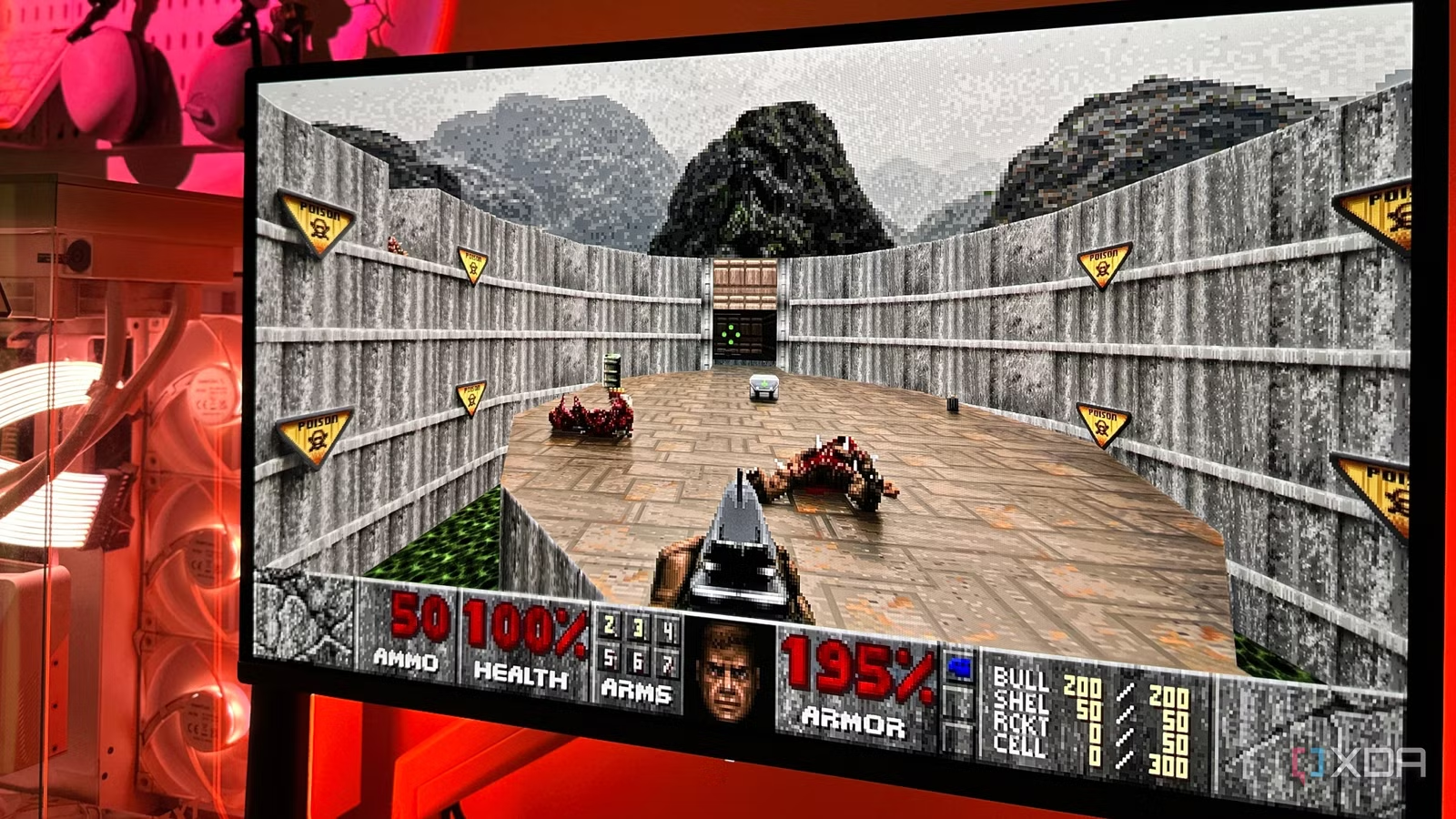
I started with Doom and Doom II, two games with chunky sprites and muddy textures are as integral to their identity as the shotgun. With DLSS 5 enabled, the industrial corridors immediately gained much more convincing surface detail. The metallic panels became easier to distinguish, but the original sprite art did lose some of its deliberate crudeness.
The lighting difference with DLSS 5 was absolutely the biggest difference maker. The games took on a life of their own with DLSS 5’s neural lighting, although it did take me three neural rendering passes to make the difference impressive. However, when it came to the enemies, doors, and other textures that have always been 2D sprites, DLSS 5 could make no difference at all. Doom‘s demons on Mars gained a bit more detail with more defined facial features (and abs), but even though DLSS 5 was changing the environment completely, the 2D sprites remained largely unchanged.
Doom II delivered similarly mixed results. Wall panels, ledges, and stonework looked more defined with DLSS 5, but the brighter presentation also changed the atmosphere, and considerably so. Some of these improvements were genuinely appealing, but to be fair, added detail isn’t necessarily accurate detail.
Related
I tested DLSS 5 on a DGX Spark, and it showed me the future is bright for Nvidia’s first laptop
RTX Spark is going to be a game changer.
It looks “modern,” but at what cost?
The Doom games left me rather impressed with how they handled DLSS 5. The lighting, textures, and surfaces really did work to enhance the original game’s feel, and the neural rendering acted as a remarkable fresh coat of paint. On the other hand, when I tried DLSS 5 with Blood, things changed considerably.
The original game relies heavily on a grimy and oppressive aesthetic. Stone walls and stony floors coated in blood, torches illuminating gory corners, and macabre lighting are what give Blood its iconic imagery and visual language. With DLSS 5, the crypts gained dramatic lighting, and the stone walls looked a lot more textured, with depth that the original presentation could never match. Unfortunately, the game lost all of its wonderfully grimy atmosphere in the process.
While DLSS 5’s neural rendering passes never changed the enemy sprites in Doom, they transformed the ones in Blood. The pixelated sprites became disturbingly detailed human figures, with more defined clothes and musculature. They were possibly the only good thing to come out of the neural rendering transformation, but they were also complete AI interpretations of what those characters should look like, since the newly-added detail wasn’t coming from the original assets.
Interiors in the game (which is pretty much 80% of the entire experience) suffered a rather concerning identity crisis. The textures became more pronounced, but the brighter lighting made the environments feel less oppressive. Blood is supposed to look filthy, sinister, and occasionally downright grotesque.
I can appreciate the technical wizardry involved, but I wouldn’t want this treatment permanently enabled. When neural rendering starts rewriting a game’s atmosphere and character designs, I would much rather keep the original pixels.
But that never translated to objectively better
My experiments with Doom, Doom II, and Blood: Fresh Supply have left me with a rather complicated relationship with DLSS 5. The technology can dramatically improve environmental lighting and make decades-old textures appear more elaborate, but it also sometimes redesigns them from scratch.
Clearly, DLSS 5 doesn’t always understand when to leave “good enough” alone. It ends up changing the character of pixelated, 2.5D games dramatically, and that makes sense, too, since the neural rendering tech was never made with 2.5D DOS-era games in mind. When it comes to genuinely retro games, DLSS 5 pretty much alters the qualities that make them memorable.
That doesn’t mean I’m giving up on neural rendering for retro games. Quite the opposite. I’m fascinated by how far I can push it, but these experiments have convinced me that more detail isn’t always an upgrade. If DLSS 5 wants to remaster my classics, it first needs to learn when to keep its hands off them.
Related
I moved one thing in DLSS 5’s pipeline, and it gave me back 50% of my frame rate
DLSS 5’s transformative changes are so much more playable now
Modern upscaling is all the remastering I need from my retro games
It’s fascinating how DLSS 5 impressed me with its neural rendering all the way down to my PS1 games, but going back to last century’s titles forced me to reconsider what I actually want from a remaster. I’ve spent years chasing sharper textures, better lighting, and higher resolutions, yet these experiments reminded me that technical improvements aren’t worth much if they come at the expense of artistic intent.
I’d really rather have an ugly, authentic Baron of Hell than a photorealistic demon that looks like it wandered in from another game. If nothing else, my retro gaming backlog has taught me that sometimes, nostalgia doesn’t need an AI makeover.