


I stopped viewing 3D printing as a hobbyist’s toy around a decade ago, and since then, I’ve engineered and printed my way out of several challenges posed by store-bought products. It’s typically small stuff that leads to greater ease of use or a better quality of life. Six months ago, I bought a new sit-stand frame for my workstation tabletop. In setting it up, I was repeatedly reminded of the significance of 3D-printed bits and bobs.
I found many of these printable models online, which only justified my experience that I wasn’t the only one bothered by the subtle quirks of these products. Since I’ve set it up, I’ve added a few more 3D-printed bits and bobs, so here are the six most noteworthy additions to my home office, ranging from an IKEA-style diffuser my IKEA work lamp was missing to glow-in-the-dark keyboard wrist rests for more comfortable typing.
Ikea really cheaped out on this one’s stand
IKEA’s Tertial work lamp has been a staple in its catalog since its introduction nearly 30 years ago in 1998. The novel base can clamp the light to a tabletop or mount on a wall with four screws. I needed the repositionability and chose the former, but the constant clamping stress and cantilever load of the lamp created cracks in the plastic base. This also gave it wiggle room to shift out of place.
I earlier wrote about replacing this clamp base with a 3D-printed adapter that converted my car’s retired brake rotor into a sturdy stand. However, with the new sit-stand desk, its weight became a major concern, so I printed a replacement for the original IKEA clamp design with a wider foot to stabilize it against shifting, since the larger contact area adds friction and distributes the cantilever load better.
Related
7 practical problems I solved with a 3D printer
My 3D printer has proven itself not just fun, but also a household problem-solver. Here’s how
I had to take this road because IKEA refused to replace my cracked lamp foot, and I’m glad I did, because the larger footprint has held the lamp firmly in place since the initial install.
IKEA Tertial lamp diffuser
The essentials I never got
While I’m discussing my IKEA work lamp, I can’t skip the missing diffuser. Typically, the Swedish-designed wall and ceiling lamps ship with an integrated diffuser comprising concentric circles. Some of them are adjustable, serving as a dimmer too. My Tertial lamp never got one, and could really benefit from one so the bulb didn’t create a spotlight effect.
I found another design online that imitated the brand’s iconic diffuser design for printing in white PLA. It’s pliable enough to fit inside the hood without disassembly and uses four little protrusions to stay put. This design is the embodiment of the simplicity and ease of use that the 3D printing community has fostered over the years. It looks like a piece of original kit, unless you have a Tertial yourself and know this isn’t included. The PLA diffuses the light sufficiently, and though this design isn’t adjustable, I’ve compensated for that with a dimmable smart bulb that seamlessly integrates with my smart home controls and voice assistants.
Wrist rests for typing and mousing around
A lasting solution to wrist strain and carpal tunnel
I spend a majority of my day clacking away at the keyboard and using my mouse. Understandably, I want that to be a comfortable experience. Since switching to a mechanical keyboard, I became acutely aware that they were taller, tilting my wrists upward as I typed. I couldn’t hover-type for long, so a wrist rest was inevitable. I started out with a simple plank of wood cut to size, and painted to match.
Eventually, jumping over to my mouse and the transition to split keyboards became two pain points that sent me scurrying to the interwebs in search of a better solution. The DeltaHub Carpio stood out as a classic example that inspired my wrist rest design that moves with your hand so you don’t need to lift it off the desk repeatedly. I can just glide over to the mouse and use a split keyboard without issues.
Related
5 ergonomic enhancements you can 3D print for your desk
Improve your posture with these ergonomic prints
While my version used PLA bases with swappable TPU cushions for some squishy comfort, I’ve now moved to another design found online, printed out in glow-in-the-dark PLA. This design is lower profile and better ventilated with the honeycomb pattern, which also helps save filament. All I needed to do was slap a few mouse feet underneath for smooth gliding.
Cable managers
Keep the clutter out of sight, and well organized
I need my workstation to be Zen to get anything productive done, and keeping the cable clutter out of sight was essential to achieve this goal. The sit-stand desk, dual PCs, and a KVM switch for them didn’t make matters easy, but 3D printing helped big time. Sure, I used a store-bought cable drag chain and server cable rail to tuck excess lengths and run them to the mid-tower on the floor, but all my wire managers are 3D printed.
I found an effective design that requires inserting or removing each cable at an angle, with enough play to slide through when straight. I printed a few out in PLA for immobile wires under the desk that I’d touch perhaps once in a few months. Then, I used black TPU to string four to five such managers in a row, and mounted them to the desk’s edge with 3M VHB tape for daily-use charging cables and such. They’ve held up just fine for months, and I’m now looking to print one-way cable winders to mount longer charging cords under the desk for an even cleaner look when they’re not in use.
Webcam mount
A phone stand just doesn’t cut it
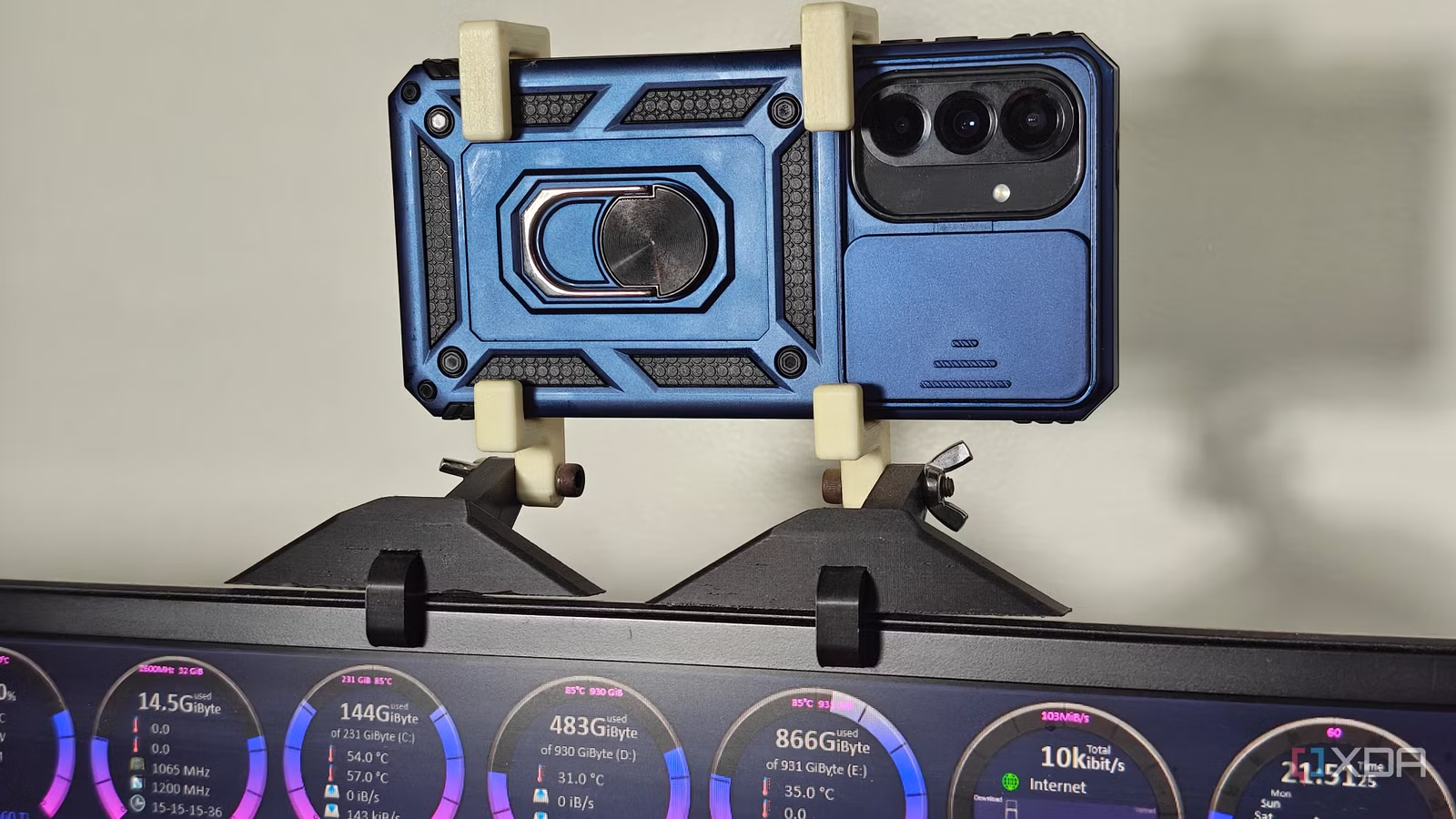
My pandemic-era PC build never used a dedicated webcam because I always found them expensive. I’d use my phone instead and enjoy the privacy of webcam-on-demand. I printed several phone stands over the years, because Thingiverse and Printables are full of them, and they only get better. However, a phone stand gave me a ridiculous camera angle staring up at my nostrils, resembling laptops with webcams hidden at keyboard height.
With my display on an arm, I needed to engineer a new solution that moved with the screen, but still gave enough angle adjustment to compensate for screen tilt. I set out to design a universal solution, but found it challenging to account for every monitor thickness and bezel size without ugly screw clamps. While my design eventually worked with just my screen, it can accommodate the thickest of phones.
Related
8 unique 3D prints that I actually use every day
These are the genuinely useful 3D prints that I use the most in my home.
The adjustability comes from two bolts with wing nuts I can tighten by hand. Sure, this design could be better, but it wouldn’t exist at all without access to desktop 3D printing at a viable price with room for experimentation.
Headphone hanger
Economizing on tabletop space
The final standout in my home office is the headphone hanger I printed off the internet. There are thousands of variations online, but my search parameters were simple. I didn’t want to drill the desk; I needed something repositionable that wasn’t a tabletop option, with integrated cable management. I finally landed on this design I printed out in grey PETG. It uses a screw clamp design to attach to tabletops of varying thicknesses, and has a secondary grooved hook for excess wire length.
I’ve used this hanger for my reasonably heavy, fully 3D-printed open-back headphones, and it’s held up exceptionally so far. Without this print, I would’ve paid a lot for a niche product with similar functionality, or a needlessly expensive stand that’d hog valuable space on my desk.
Find a problem to solve
Related
5 things I 3D printed for my home lab that fixed problems I’d been living with
A 3D printer was a surprisingly useful investment for my home lab
A home office is an eclectic mix of small hiccups that snowball into a place you don’t find productive. Eliminating small friction and giving everything a clear, designated space is easier than ever with 3D printing. Moreover, if a solution doesn’t exist, you can design your own using simple online tools and print refinements or replacement parts as needed.