


Pros & Cons
-
Thin, light and cheerfully colorful design -
Color-matched, backlit keyboard -
Touch OLED display is nice at this price -
More than 24 hours of battery life
-
Build quality not on the level of MacBook Neo or Dell XPS 13 -
Miss out on high-res display of Neo or XPS 13 -
Starts with just 8GB of RAM and 256GB of storage -
16GB RAM option currently unavailable
Editor’s note: This review is currently unrated because the configuration HP sent CNET for testing, which features 16GB of memory, is unavailable, and HP couldn’t confirm exact pricing. As soon as it’s available, the review will be updated with a final rating.
Apple’s near-perfect budget laptop, the MacBook Neo, has forced a response from Windows manufacturers. Dell has released not one but two Neo clones, and now it’s HP’s turn. It’s reworked its mainstream OmniBook 5 14 into a budget form to create a $700 version to rival the Neo. (And there’s more on the way; look for reviews soon of Acer’s and Lenovo’s Neo-like efforts.)
HP’s new OmniBook 5 14 checks many Neo boxes. Starting price of $700? Check. Discounts that mean you’ll likely pay less? Check. All-aluminum design? Check. Colorful case options, complete with color-matched keys? Check and check. Modest RAM and storage offerings? Sadly, check and check. Enough performance for everyday tasks? Check.
The OmniBook 5 14 also marks a few boxes that go unchecked with the Neo, offering a touchscreen OLED display, keyboard backlighting and more than 24 hours of battery life. I like getting an OLED with the OmniBook 5 14 and the freedom that comes with such long battery life, but the MacBook Neo and Dell XPS 13 remain my $700 laptop recommendations for students and other budget buyers. Not all all-metal builds are created equal, and the MacBook Neo and XPS 13 are still the best-built laptops at this price. And I’ve yet to see a display, OLED or no, on another $700 laptop that’s as sharp as the Neo’s and XPS 13’s high-resolution panels.
HP OmniBook 5 14 (Intel)Price as reviewedTBA (starts at $650 with 8GB of RAM)Display size/resolution14-inch 1,920×1,200 touch OLEDCPUIntel Core 5 320Memory16GB LPDDR5-6400GraphicsIntel GraphicsStorage512GB SSDNetworkingWi-Fi 6E and Bluetooth 5.3PortsUSB-C 3.2 Gen 2 (10 Gbps, x2), HDMI 1.4, combo audioOperating systemWindows 11 HomeWeight2.6 pounds (1.2 kilograms)
The OmniBook 5 14 starts at $650, and I’ve seen it discounted to as low as $600. That puts it on equal footing with the MacBook Neo that starts at $699 and drops to $649 with Apple’s student discount. Dell’s XPS 13 is slightly more expensive, starting at $750 and dropping to $650 for students (it is more feature-rich than the Neo, though).
Like Dell’s two Neo clones, the OmniBook 5 14 is based on an Intel Wildcat Lake processor. It offers two nearly identical chips: the Core 5 315 and Core 5 320. Each is a low-end, power-efficient 15-watt processor with six cores — two performance cores and four efficient cores. The only differences between the two chips are that the Core 5 320 runs at slightly higher frequencies and has a GPU and NPU with marginally higher TOPS counts that measure local AI processing capabilities. Neither can compete with true AI chips like Qualcomm’s Snapdragon X2 series or Nvidia’s new RTX Spark lineup.
Not surprisingly, the baseline model has only 8GB of RAM and 256GB of storage. That’s what you get with the MacBook Neo and each of Dell’s Neo-like laptops. There are two display options: a 2K (1,920×1,200-pixel) OLED with or without touch support. HP sent me a higher-end model with the Core 5 320 processor, a more-suitable-for-Windows 16GB of RAM, a more-suitable-for-any-laptop-regardless-of-OS 512GB solid-state drive and the touch display.
Matt Elliott/CNET
You’ll need to play around with HP’s configuration tool, especially the color choices, for the OmniBook 5 14 to find the best price. Although there are four color choices — pink, green, blue and silver — the pink is tied to a different configuration than the others. Only with the pink model can you get the lower-end CPU with the 256GB SSD and non-touch display for $650. At the time of this writing, it was on sale for $600.
The touch display becomes an option after you select the Core 5 320 CPU. You can get it with the base storage only in blue for $700. The other colors are available only with the touch display and the 512GB storage upgrade for $750. Two colors with this configuration, the silver for $700 and pink for just $600, were on sale when I last looked.
The above models feature 8GB of RAM. My test system has 16GB, but that option is currently unavailable. HP told me it should return within a few days of this review. Pricing for the memory upgrade remains a mystery, but I think it’s safe to assume that in this era of RAMageddon, it will cost more than you or I would like. I’d guess it’ll add $200 to the bill. That’s what Dell charges on the Dell 14S and seems to be the going rate for 8GB of DDR5 memory at the moment.
If I’m correct, my test system with the Core 5 320, 16GB of RAM and a 512GB SSD will cost $950, stretching the definition of a budget laptop as it edges into mainstream territory. Price is an important consideration for any laptop purchase but is especially so for a budget model. Until I can confirm pricing, I will withhold the rating for the OmniBook 5 14.
International pricing details are more readily available. The OmniBook 5 14 starts at £880 in the UK with 8GB of RAM and a 256GB SSD and costs £1,150 with 16GB and 512GB. I couldn’t find the baseline model with 256GB of storage in Australia. The starting model there with 8GB of RAM and a 512GB SSD costs AU$1,499. With 16GB of RAM, the price jumps to AU$2,299 but is currently nearly half off, discounted to just AU$1,199.
HP OmniBook 5 14, take 2
This latest OmniBook 5 14 looks similar to the Qualcomm Snapdragon X-based model I reviewed a few months back but actually has the better design of the two, despite its lower price. The Snapdragon X model had a plastic keyboard deck, and this lower-end Intel model boasts an all-aluminum design. And this metal enclosure allows it to shave off some weight, dropping from 2.9 pounds to a more portable 2.6 pounds. That makes it a hair lighter than the 2.7-pound MacBook Neo, which has a smaller 13-inch display. If you’re after the lightest budget laptop, then Dell’s the pick. Its XPS 13 weighs just 2.3 pounds, and the Dell 14S is 2.5 pounds.
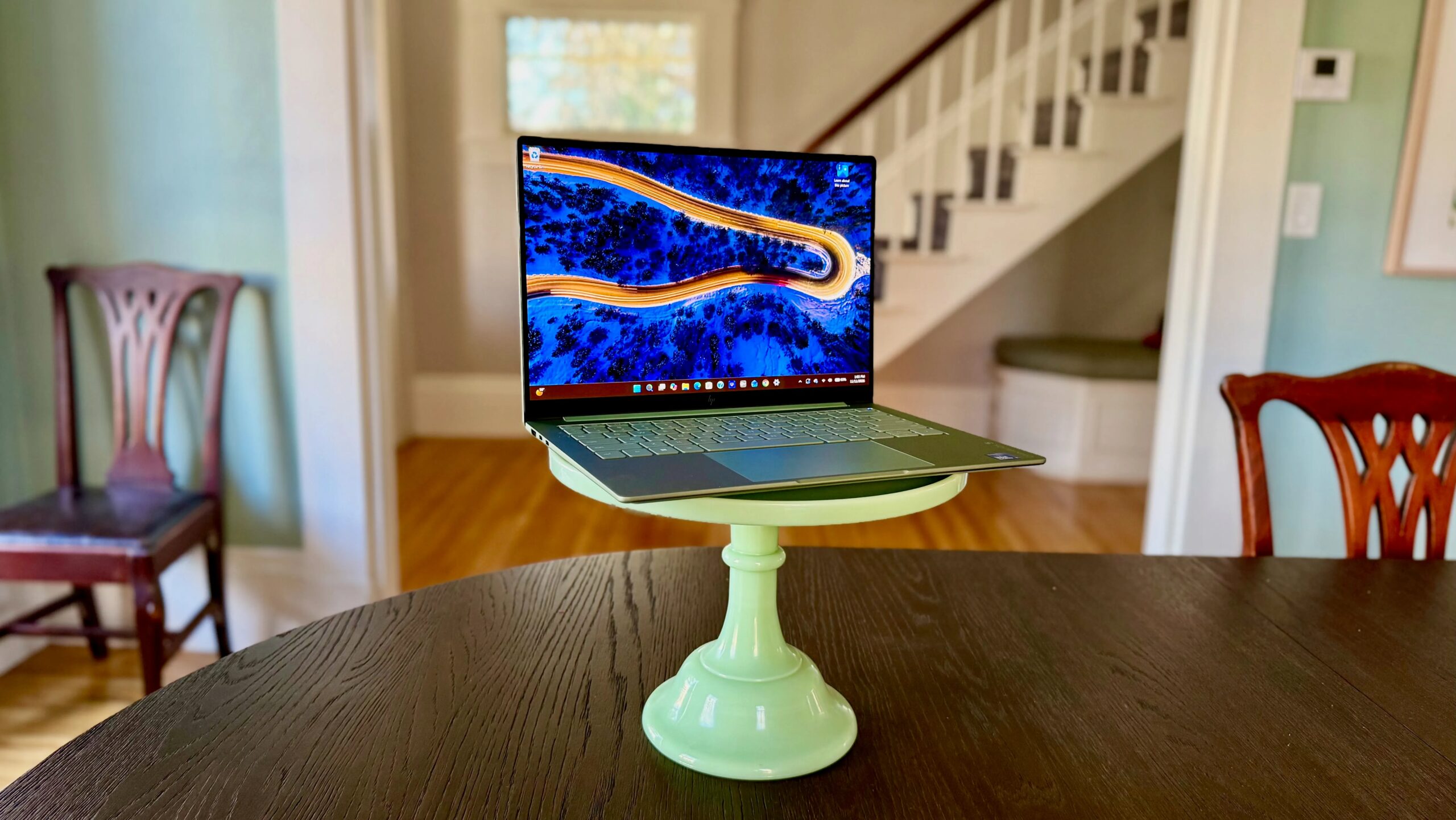
Like any good Neo competitor, the OmniBook 5 14 offers a handful of pleasing pastel hues. I received it in green, which HP calls soft honeydew. The other choices are peony pink, starlit blue and smoke silver. The OmniBook 5 14 is closer in appearance to the Neo than either of Dell’s efforts because it has a color-matched keyboard to complete the look. And this color-matched keyboard also comes with backlighting, which goes missing on the Neo.
At first blush, the OmniBook 5 14 does a good approximation of a MacBook Neo. But when you pick it up, the illusion begins to fade. I’m not saying the OmniBook 5 14 is poorly constructed, but its aluminum shell doesn’t have nearly as rigid, solid a feel as the Neo or XPS 13. The aluminum used for the OmniBook 5 13 feels thinner and flexes under your fingertips. This flex makes typing feel a bit mushy, even on the shallow-travel keys.
The touchpad is roomy and offers an easy click response, which isn’t always a given on a basic mechanical touchpad. There’s a bit of the diving-board effect where clicks get firmer and harder to initiate as you get closer to the top edge of the touchpad, but nothing that’s a deal breaker. Still, the MacBook Neo’s touchpad is superior, offering a consistent click response across its entire surface.
The OmniBook 5 14 is the first Neo competitor to offer an OLED display, but along with the deep blacks and fantastic contrast comes limited brightness. It’s rated for only 300 nits, and it hit 288 on my tests with a SpyderX Elite colorimeter. Color performance is strong, with 100% coverage of the sRGB and P3 gamuts. And while it has the OLED advantage, the OmniBook 5 14’s 2K display has a lower resolution than either the MacBook Neo or Dell XPS 13. HP says a 2.5K OLED is coming in March 2027, which would put it on par with the Neo and XPS 13 in terms of screen resolution.
The OmniBook 5 14 also provides the option for a touchscreen, which the Neo lacks. But if you want touch, I’d recommend the XPS 13. I prefer its 2.5K touch IPS panel to the OmniBook 5 14’s 2K touch OLED. I’m willing to trade some contrast and black levels for a sharper, brighter display.
The OmniBook 5 14’s dual speakers and 1080p webcam are standard issue. The speakers produce tinny, underwhelming sound, and the webcam produces a sharp-enough, if a tad oversaturated, image. The camera supports Windows Hello facial recognition logins, which I was happy to see, given the lack of a fingerprint scanner.
The port selection covers the basics. You get a pair of 10Gbps USB-C ports and an HDMI port on the left edge and a headphone jack on the right.
HP OmniBook 5 14 performance
The OmniBook 5 14 uses the same Intel Core 5 320 processor as found in other Neo clones, including the Dell XPS 13, Dell 14S and Acer Swift Air 14. So it should come as no surprise when I tell you that it performed similarly to those laptops on our multicore and single-core application benchmarks, Geekbench 6 and Cinebench 2026. It trailed the MacBook Neo in Geekbench 6 tests and finished ahead of it only on the multicore test in Cinebench 2026.
The more expensive Dell 14S based on an Intel Core Ultra 7 355 had much better Geekbench 6 multicore scores as well as better results on Geekbench AI. The MacBook Neo also had a stronger showing than the OmniBook 5 14 on Geekbench AI.
The OmniBook 5 14’s best result came on our battery drain test, where it lasted 24.5 hours. That’s roughly 11 more hours of uptime than you get with the MacBook Neo or Dell XPS 13. With the OmniBook 5 14, you can go away for a weekend and probably leave the charger at home. Then again, the charger is so compact and light that bringing it along won’t slow you down.
Is the HP OmniBook 5 14 better than the MacBook Neo?
I can see only one reason to pick the OmniBook 5 14 over the MacBook Neo or Dell XPS 13. You want a $700 laptop with Windows and one with a touch display that’s larger than the 13.4-inch display on the XPS 13. The 14-inch OmniBook 5 14 offers more screen real estate than the 13.4-inch XPS 13, but at the expense of build quality and display resolution.
For your $700 budget, choose the MacBook Neo if you’re OS-agnostic, and go with the XPS 13 if you favor Windows. It’s still that simple for students and other budget laptop shoppers.
How we test computers
The review process for laptops, desktops, tablets and other computer-like devices consists of two parts: performance testing under controlled conditions in the CNET Labs and extensive hands-on use by our expert reviewers. This includes evaluating a device’s aesthetics, ergonomics and features. A final review verdict is a combination of both objective and subjective judgments. The list of benchmarking software we use changes over time as the devices we test evolve. The most important core tests we’re currently running on every compatible computer include Primate Labs Geekbench 6, Cinebench R24, PCMark 10 and 3DMark Fire Strike Ultra. A more detailed description of each benchmark and how we use it can be found on our How We Test Computers page.
System configurations
HP OmniBook 5 14 (Intel)Microsoft Windows 11 Home; Intel Core 5 320; 16GB DDR5 RAM; Intel Graphics; 512GB SSDDell 14S (8GB)Microsoft Windows 11 Home; Intel Core 5 320; 8GB DDR5 RAM; Intel Graphics; 256GB SSDDell 14S (16GB)Microsoft Windows 11 Home; Intel Core Ultra 7 355; 16GB DDR5 RAM; Intel Graphics; 512GB SSDDell XPS 13 (8GB)Microsoft Windows 11 Home; Intel Core 5 320; 8GB DDR5 RAM; Intel Graphics; 512GB SSDDell XPS 13 (16GB)Microsoft Windows 11 Home; Intel Core 5 320; 16GB DDR5 RAM; Intel Graphics; 512GB SSDHP OmniBook 5 14Microsoft Windows 11 Home; Qualcomm Snapdragon X Plus X1P-42-100; 32GB DDR5 RAM; Qualcomm Adreno Graphics; 1TB SSDAcer Swift Air 14Microsoft Windows 11 Home; Intel Core 5 320; 8GB DDR5 RAM; Intel Graphics; 512GB SSDApple MacBook NeoApple MacOS Tahoe 26.3.1; Apple A18 Pro (6‑core CPU, 5‑core GPU); 8GB LPDDR5; 256GB SSD
Matt Elliott
See full bio