

Moth announced Tessa on November 16, 2026, reporting that the method encoded and recovered 1,568 real values across all 120 qubits of IBM’s Phoenix Nighthawk r2 processor. The work addresses a persistent obstacle for quantum machine learning: loading classical data into fragile qubits on sparsely connected hardware.
Daniel Bultrini’s paper gives the claimed record a specific scope: experiments that loaded freely chosen numeric lists onto physical quantum processors and retrieved the individual values, excluding runs that returned only a derived quantity. Under that definition, QCrank previously recovered 128 values from 12 trapped-ion qubits. A separate Fez experiment recovered 1,024 pixels from 13 qubits, but is not directly comparable because it used a trained tensor-network approximation rather than an arbitrary list of real values. The paper therefore identifies Tessa’s run as the largest reported under its definition.
How Tessa Uses the Chip’s Wiring
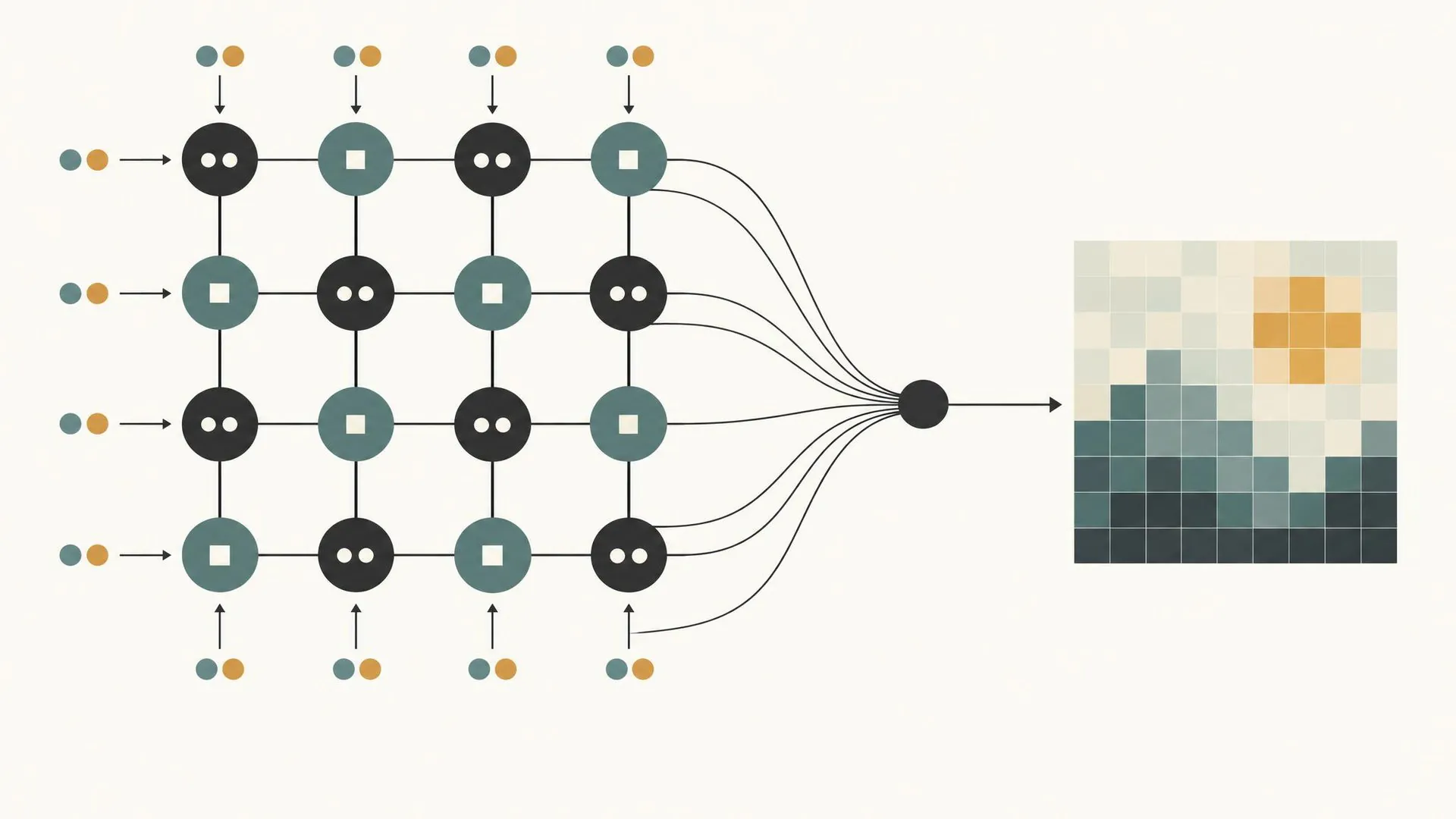
Tessa, short for Tessellated QPIXL, alternates data and address qubits in a checkerboard laid over the processor’s physical connections. Each data qubit is controlled only by neighbouring address qubits, which nearby data qubits can share. Every additional address neighbour doubles a data qubit’s storage, so an interior qubit with four neighbours holds 16 values.
The construction works on any bipartite coupling graph, where every coupler joins a data qubit to an address qubit. Using the device’s own layout avoids SWAP gates and routing, and requires no ancilla, or helper, qubits. The paper proves that values on each data qubit remain independently recoverable despite the shared controls.
All values stored in a single basis can be decoded from one round of computational-basis measurements across the chip. Tessa can also store a second number in each slot’s phase. The Phoenix run used this pair mode for an image’s brightness value and hue, placing two numbers in each of 784 used slots; spare slots held zeros so every qubit participated.
That density has two costs. Pair mode adds measurement bases and doubles circuit depth. More generally, shots are divided among local address configurations, so the number needed for equivalent accuracy grows exponentially with local coupling degree, although the experiments kept that degree small.
What the Hardware Recovered
Single-basis tests used 8,192 shots per basis to recover a 28-by-28 QCAT image using 784 of Phoenix’s 792 slots and a 21-by-21 image using 441 of Fez’s 448 slots. The paper reports raw hardware value correlations of 0.96 on Phoenix and 0.95 on Fez, with mean absolute errors of 0.130 and 0.131, respectively. Dynamic-range recovery, which uses summary statistics of the input rather than the input itself, reduced those errors to 0.075 and 0.078. The experiments used no error mitigation.
The 1,568-value pair run was less accurate: the paper reports a value correlation of 0.69, value mean absolute error of 0.152 and hue mean absolute error of 0.092 on Phoenix. Its circuit used 1,456 two-qubit CZ gates, compared with 728 for the single-basis Phoenix run. Full-chip retrieval therefore worked on two coupling graphs, but the second phase value came with higher circuit demands and lower reconstruction quality.
Biological Tests and Public Code
Beyond pixel art, the experiments covered audio, MIDI, DNA and protein amino-acid sequences, including p53. The biological sequences were chosen for their lengths or names, not their biology, making these tests of data handling rather than biological analyses.
At 32,768 shots per measurement, the paper reports that Phoenix recovered the 784-nucleotide MT-CO3 sequence with 92.1% of nucleotides exactly correct without post-processing and 92.3% with the best tested dynamic-range recovery, selected using the true sequence. Recovery remained worse for densely packed protein sequences. The paper cautions that even one incorrect nucleotide or amino acid can have serious biological consequences.
Moth says Tessa is available for image-processing experiments on its Atlas platform. The repository’s documentation provides the library, raw hardware counts, job records, simulation outputs and notebooks that regenerate the paper’s figures and tables without an IBM account. Its run log dates the principal Phoenix and Fez QCAT experiments to September 26, 2026, and later genetic and pixel-art runs to October 2026, distinguishing the hardware work from the November announcement.
Tessa’s immediate contribution is a hardware-aware way to load and verify classical data across an entire processor. For quantum machine learning, the central open question is whether subsequent computations can exploit that encoded state without paying for full reconstruction, while keeping shot growth and the errors of denser pair encoding under control.