


I have a confession to make. I was absolutely obsessed with ASCII art as a kid. We’re talking early 2000s chatrooms and MSN Messenger, where I would spend an unreasonable amount of time tracking down the perfect ASCII rose or cat to paste into conversations.
Entire evenings went into finding the perfect one and arranging them into conversations that ended up looking more like abstract art galleries than actual communication. I loved it unreservedly, and I maintain to this day that it was a legitimately creative medium.
Related
10 Indie Games with Near-Perfect Metacritic Scores
Independent productions can also unanimously approach flawlessness.
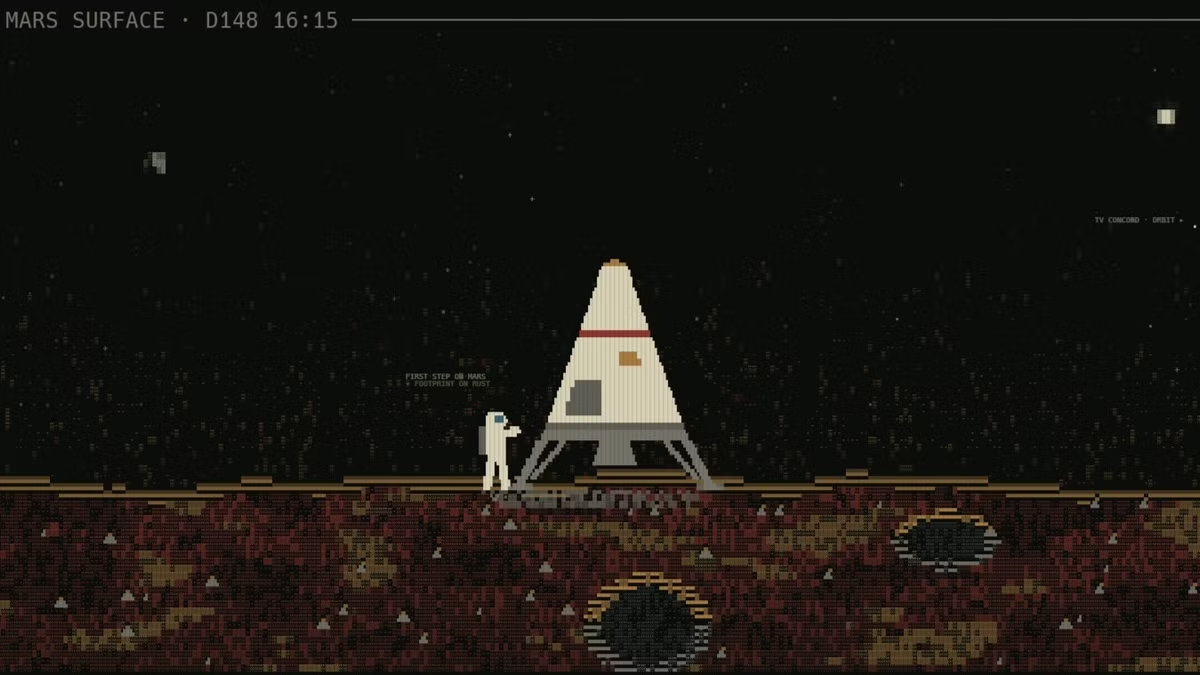
That is part of why Third Bloc caught my eye immediately. Developed and published by ASCII Interactions, this text-based political management sandbox is set in the Cold War and renders everything – including its space launches, weapons tests, and nuclear cinematics – in detailed animated ASCII.
It lands on Steam on January 18th, 2027 – but before that, we can exclusively confirm today that a demo will drop on October 4th. If Third Bloc sounds like your kind of thing, you won’t have to wait long to find out.
You Are a Small Republic, The US and USSR Are Not
ASCII Interactions
It’s 1945. Your republic has little industry, few trained specialists, and no international recognition. The United States and Soviet Union are the two superpowers dictating the very fabric of the world, and you are somewhere in the middle – a small country that has to figure out very quickly which way to lean, how much independence you can afford, and what you’re willing to trade for the help you desperately need.
Third Bloc gives you 90 turns to navigate 45 years of the Cold War, from 1945 to 1990. You manage an economy built around 42 facilities covering everything from basic infrastructure to the foundations of a space program. You set laws, shape your regime, recruit named agents with individual stats and post them abroad to find scientists, steal technology, and cultivate relationships that may bear fruit several turns later. You respond to telegrams from 312 named correspondents across 936 decision letters, each reply potentially affecting who contacts you next and under what circumstances.
The promised scale of it so far is remarkable for an indie title. A six-stage nuclear program that ends in either a continental shelter or one of six nuclear outcomes. Twenty space missions across Earth, the Moon, Mars, various asteroids, and Jupiter. A Mars colony that can be developed further until you physically move the republic’s capital there – and then keep playing, with the republic’s future continuing beyond Earth entirely.
You can also, if things go badly enough, go bankrupt and watch a nuclear war end everything. The game is very honest about that being a possibility, too.
The Art Form That Never Actually Went Away
ASCII Interactions
ASCII art has a longer history in gaming than most people realise. Rogue, released in 1980, pioneered the roguelike genre using nothing but ASCII characters to represent its dungeons, enemies, and items. @ was your character. D was a dragon. The entire world existed as text on a screen, and players learned to read it fluently. NetHack, a fork of the 1984 game Hack, still receives updates to this day and maintains a devoted playerbase that has never wanted anything more than what ASCII can provide.
The reason ASCII endures in games is not nostalgia, though nostalgia is part of it. It’s that ASCII forces a certain kind of imagination. When a D is a dragon, your brain does the rest of the work. The abstraction creates engagement rather than distance, because you actively get to participate in constructing the world.
This text-based political management sandbox is set in the Cold War and renders everything in detailed animated ASCII.
Third Bloc’s animated ASCII cinematics – the launches, the nuclear tests, the failures – take that tradition and apply it to something genuinely cinematic. A rocket rendered in ASCII characters ascending through animated stages is doing something different to a photorealistic equivalent. It’s asking you to meet it halfway, and that collaboration between game and you as a player is not something most modern games attempt.
This Is Exactly Why Indie Games Matter
ASCII Interactions
Third Bloc is being brought into existence because someone had an idea that didn’t fit neatly into a market category, but felt empowered to make it anyway. A Cold War political sandbox where you can move your capital to Mars and watch your nuclear tests play out in animated ASCII is not a pitch that passes easily through any form of corporate structure.
Without a publisher’s quarterly expectations to satisfy, without the obligation to appeal to the widest possible demographic, ASCII Interactions get to make exactly the game they want to make. A management game about Cold War geopolitics that ends either on Mars or in a nuclear shelter, rendered in a visual style most studios abandoned decades ago.
I find a lot of beauty in the fact that a specific, uncompromising idea like this gets to exist on its own terms, but remember: without people supporting games like this today, they won’t get made tomorrow either. The demo lands October 4th. The full game releases January 18th, 2027. Add it to your wishlist – and clear your calendar for next weekend!
Next:
10 Indie Games that Truly Felt Like the Beginning of an Era for an Entire Generation
These games were responsible for transforming our impression of the interactive medium from their releases onwards.