

Killing time during travel looks a lot different for me now than it did before I started a remote job, but that doesn’t mean I can’t sneak a quick gaming session while on the move, and that’s precisely why I bought a Windows handheld. The Lenovo Legion Go 2 cost me a pretty penny; it has an 8.8-inch OLED panel running at 144Hz, a Ryzen Z2 Extreme, 32GB of memory, and the last time I actually rendered a game on it was months ago.
Nothing on it broke, and it still ran most of my library well, but I found that streaming my favorite titles remotely instead of running them on bare metal provided a much better experience. It’s not perfect, and anyone who’s tried Sunshine and Moonlight knows that streaming when away from home is far from flawless. However, it has shown me that I can safely leave my handheld at home and still be able to game perfectly on the road, and from the couch.
Related
I just don’t care about the Steam Deck 2 anymore
The Steam Deck’s sequel won’t revolutionize the industry in the same way the original did.
The performance ceiling is shattered completely with a remote setup
My PC is now the main source of horsepower
When you game on a handheld, its performance is limited by the silicon and thermal solution inside, and while they have become quite impressive when compared to what was possible a half-decade ago, they’re still no match for a full-size ATX PC. Game streaming with Sunshine enables you to stream games straight to virtually any device over the network, and once that’s setup, the comparison stops being between which handheld to buy.
In my case, that ATX desktop runs a Ryzen 7 7800X3D and an RTX 5080. There is no version of this fight that the Legion Go 2 wins on performance. The Z2 Extreme is a genuinely impressive part for its power envelope, but its power envelope is part of the entire problem. Streaming means running games at the settings the desktop can sustain rather than the settings the handheld can survive, and this includes things like ray tracing.
It also renders the tuning hassle completely pointless. You’re no longer creating per-game TDP profiles, fiddling with resolution scaling and upscaling settings across your titles, and you’re definitely not worrying about battery life. Streaming collapses all of it into one configuration on the host. You set your bitrate and resolution in Moonlight on your particular devices once, and then you stop thinking about it.
Related
I streamed my Steam library to my handheld and stopped worrying about storage
It’s much better than you’d think
The client hardware you already own is better at being a client
The client is in the room with us right now
When streaming games, the host takes on all the usual rendering workload that comes along with actually running the game, and the client you connect with is tasked with decoding a video stream. These are not even remotely comparable workloads, and a streaming client needs only a small fraction of the performance. Decoding is a fixed, predictable job handled by a dedicated media block that sits idle most of the time on almost every device you own. Rendering scales with the game and eats every watt you give it, so once the host is doing the rendering, the client’s only real requirement is a hardware decoder and a decent display, and that requirement is met by devices that cost a fraction of a premium handheld.
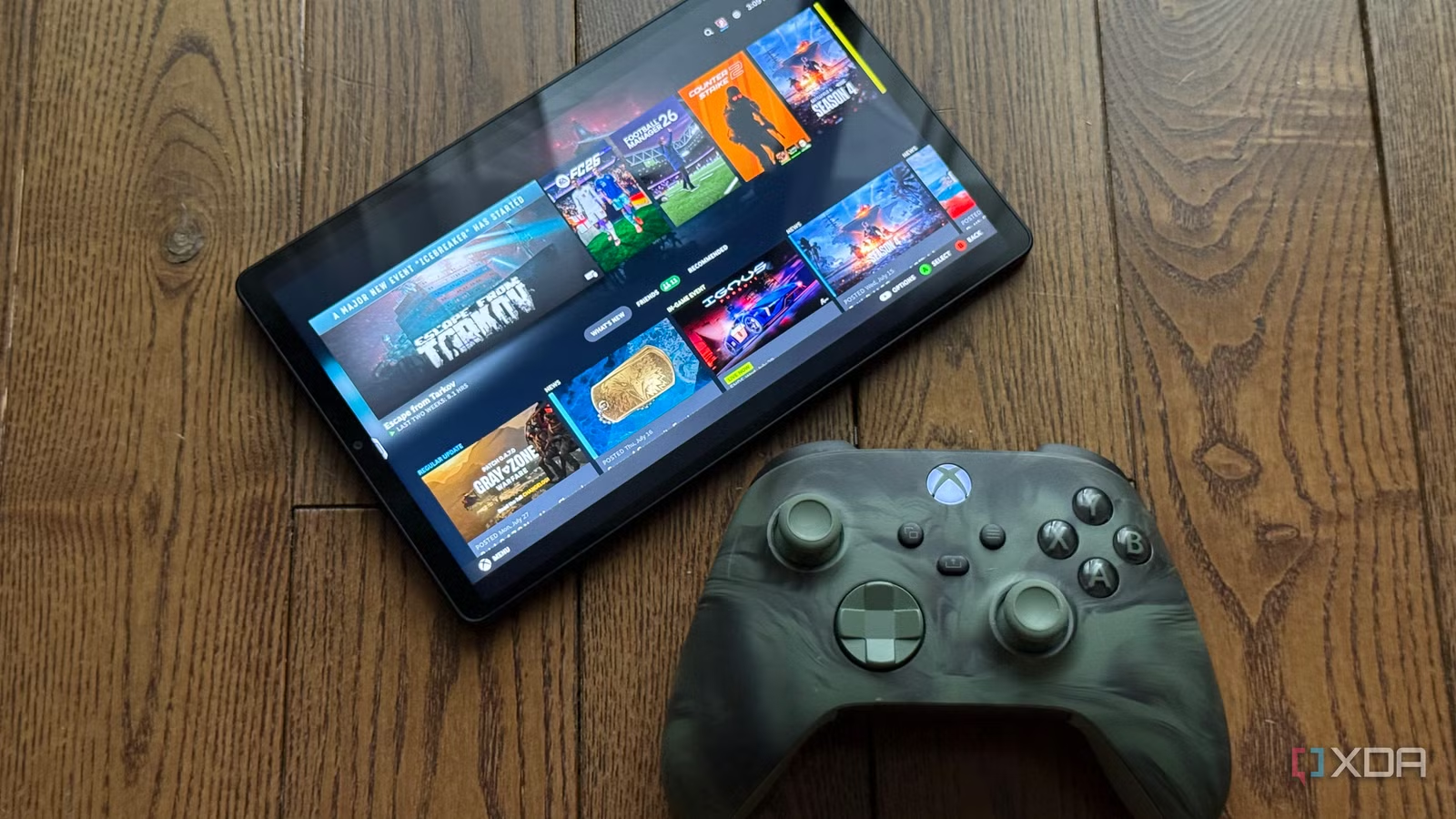
I can use basically anything in my house as a client, but I primarily lean on my M2 MacBook Air and an Android tablet. The Air specifically decodes HEVC in hardware and does it while staying cool and silent, because it is doing almost nothing. Notably, it cannot decode AV1 in hardware at all, since Apple did not add that until the M3 generation, and it makes no practical difference to the experience. Meanwhile, the Legion Go 2 running the same game natively would be dumping its entire thermal and power budget into an APU, spinning fans, and heating the grips you are holding. The device with the smaller battery frequently lasts longer, because it doesn’t render anything at all.
And then there’s the controller part of the equation. I can connect my Xbox One controller to anything with a Bluetooth receiver, and it passes through Moonlight to the Sunshine host flawlessly.
Related
I’ve been using the most powerful PC gaming handheld, and it’s not the one you might think
MSI has put its Claw(s) into my soul.
You can dodge the software layer entirely
Windows handhelds come with their own software challenges that streaming nullifies
Windows handhelds ship a vendor launcher layered over a desktop operating system that was never designed for a gamepad. On the Legion Go 2, that layer is Legion Space, and it is competent, but it is still a shell trying to hide the fact that you are holding Windows 11. Sleep and resume behavior is inconsistent and drivers can be a bit finicky.
Streaming doesn’t fix the Windows part of gaming remotely, but it just relocates where it’s placed. The desktop OS stays on the desktop and the client runs Moonlight, which is a single-purpose app that connects and gets out of the way. You don’t even have to stream from Windows; I’ve only chosen it because it’s compatible with every game. You could just as easily stream from Linux, albeit, with some features being experimental, like HDR.
Related
Microsoft won’t fix Windows handhelds, so someone else is finally trying
Winhanced is trying to make the handheld Windows experience better.
Handhelds sell for a reason
None of this makes handhelds pointless, and there are cases where streaming simply loses because it’s not an option, full stop.
The first case is offline play. On a plane, on transit, at a cottage with no usable connection, or on terrible hotel Wi-Fi, a handheld plays games and a streaming client does not. There is no clever workaround for this. It is the one thing dedicated hardware does that no amount of network engineering replaces.
The second is latency-sensitive genres. Every frame you see has been captured, encoded, sent over a network, decoded, and displayed. That pipeline is short, but it is by no means free, and in competitive shooters, fighting games, and rhythm games it becomes cumbersome enough to not bother with it at all. This is compounded when streaming outside of your local network, and especially so if you’re trying to stream through a mesh VPN.
My home connection is behind CGNAT, so accessing anything on my home network from the outside requires use of a mesh VPN relayed through a rented VPS, which adds a ton of latency because of the extra hop. In this scenario, having a gaming handheld to travel with is the better answer.
Related
Moonlight and Apollo help me experience my PC games the console way
My PlayStation is shaking in terror
Handhelds aren’t dead, but streaming solves many of the same problems
The Legion Go 2 is still in the drawer. I take it out occasionally, usually before a trip, and every time I do I am struck by how good it is at the job it was built for. The problem is that, at home, streaming solves basically all the same problems while providing a much better experience. Installing Sunshine on the host PC and getting up and running on your client of choice with Moonlight is about as easy as it gets when it comes to locally hosted services.