


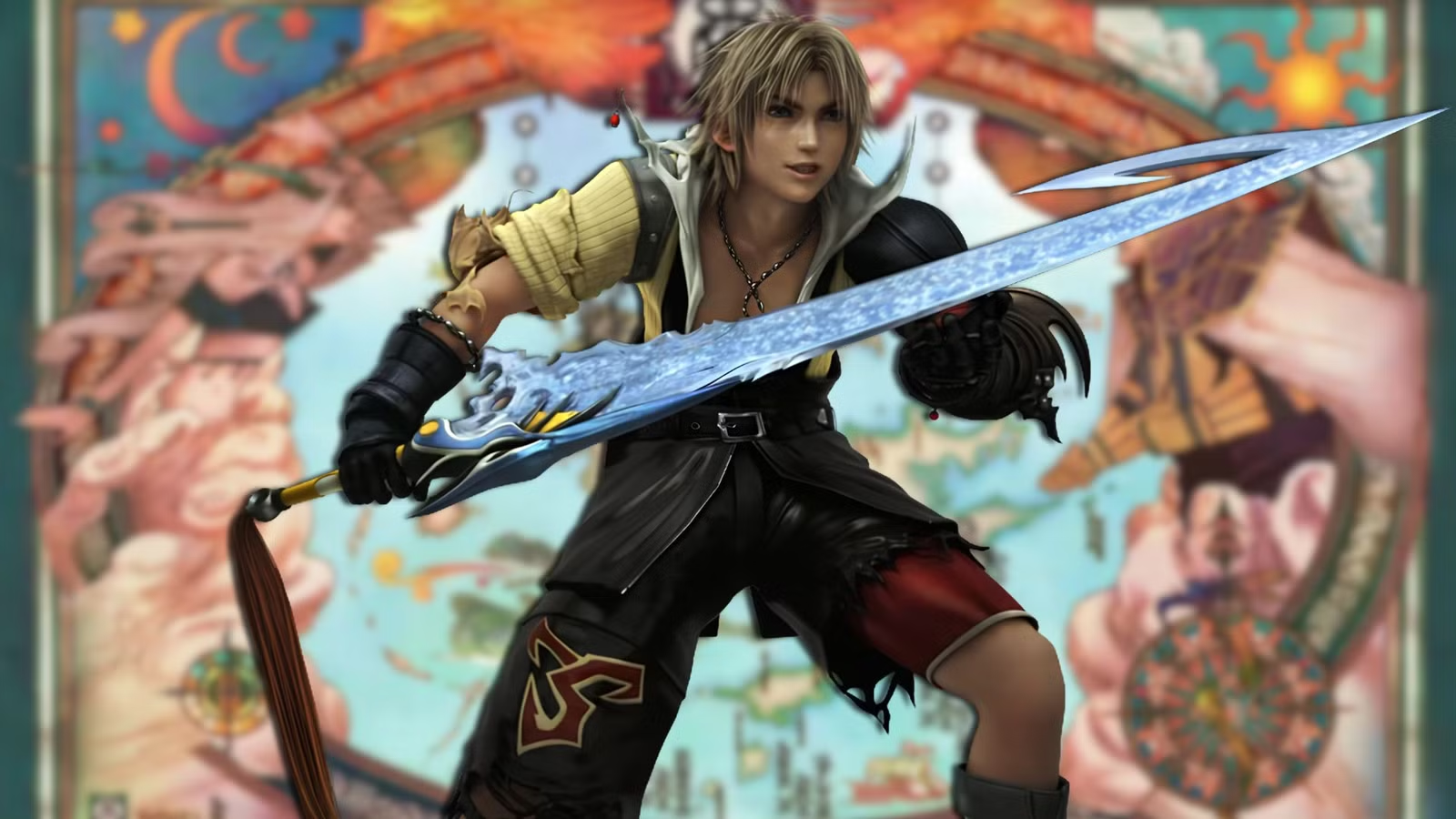
The sixth-generation of video game consoles can best be described as a time of change. Sega was out of the hardware business while Microsoft was entering at the same time, and Sony had positioned itself as a top contender. Things were changing on what felt like a daily basis.
It wasn’t just hardware that was changing, however. Video game franchises that had made a major impact during the 80s and 90s were seeing themselves challenged, as it was an opportunity to take what was so revolutionary in the previous generation and see what could be done. There was perhaps no franchise-altering game that demonstrated this more than Final Fantasy X.
RELATED
8 Most Revolutionary JRPGs Every Fan Needs to Experience
These are games for those who want to dig deeper into the genre.
First released on the PS2 in November 2001, Final Fantasy X was the year’s most anticipated JRPG. I don’t think it was possible to realize how important this game was going to be to Final Fantasy, and no game since FF7 in 1997 would have as much impact on the series, as it made a lot of big changes that would become standard moving forward.
8
No World Map
A Great Loss
There was something really magical about PS1-era JRPGs, where you would escape the confines of the game’s opening hours, then find yourself on an expansive vista with unlimited possibilities. The memory of reaching the enormous world of Gaia in Final Fantasy 7 is one that’s seared directly into the very fabric of my brain.
A lot of games during this time were slowly phasing out elements from the previous generation that developers felt were a bit dated, but Final Fantasy X ditched the world map in what felt like the most harsh way possible. There was no gentle easing. It was just gone.
The loss of world maps during many sixth-generation JRPGs didn’t just impact Final Fantasy, as JRPGs across the industry started to omit them. Final Fantasy wouldn’t feature a world map in any mainline game following FF9, and FFX was the catalyst to that.
7
More Complex Summons
A Temporary Party Boost
The summon systems in previous Final Fantasy games were always some of the best parts of engaging with their combat systems. I don’t really care how long the Knights of the Round summon is, or how long Sephiroth’s Supernova attack is, these battle animations were groundbreaking at the time they came out.
Final Fantasy X took the summon system and completely overhauled the way everything about them works. Instead of a one-off attack animation that concludes with the majestic creature disappearing, Final Fantasy X introduced Aeons.
Aeons have their own health bars and unique attacks, and once defeated, the combat returns to normal. Future Final Fantasy games continued to refine this concept, but FFX’s introduction of fully-realized, controllable creatures was such a huge, impactful change.
6
Voice Acting
Baby’s First Voice Acting
Final Fantasy’s lack of voice acting prior to FFX wasn’t necessarily the worst thing in the world. What helped was that the games almost felt like interactive novels, with a prose to match. Some of the writing in older FF games, especially the PS1-era trilogy, was stupendous.
If you were releasing a game on the PS2 back in the day, however, chances are you couldn’t resist the allure of having fully voiced characters. The concept was not unique to the PS2, as multiple PS1 games had comprehensive voice acting, but it was to Final Fantasy.
Even back then, it was such a huge moment. The mere thought of Final Fantasy having voice acting felt like uncharted territory, and it’s a game that feels like it’s the first time. There is, of course, a certain charm to the voices now, but you can definitely feel just how new it was. Even so, this commitment to voice acting would drive every future mainline game for the next two decades.
5
3D Worlds
Farewell, Pre-Rendered Backgrounds
One thing I’ve always admired about Square is their commitment to cutting-edge visuals and new, innovative techniques. They are not afraid to try something absolutely bizarre, and it usually works out for them. In addition to their mastery of high-end CG cutscenes, Square was also consistently attempting to alter how Final Fantasy looked.
The first six games used traditional sprites and tile-based environments, while the PS1 introduced 2D pre-rendered backgrounds with 3D characters. While Final Fantasy X does use a few pre-rendered backgrounds for certain things, the game is largely played in 3D.
RELATED
8 JRPGs That Break the Genre’s Rules
These JRPGs sought to redefine the conventions of the genre and introduce their own rules.
It’s hard to describe how enormous that felt back in 2001. Every aspect of gaming felt like some far-flung, futuristic innovation back in the early 2000s, and FFX being a fully 3D JRPG in a lot of places was quite surreal honestly. Future FF games followed suit, and while I dearly miss pre-rendered backgrounds, Square’s commitment to staying at the front of technological innovation is admirable.
4
Sphere Grid
Sphere of Influence
Leveling up in previous Final Fantasy games, as well as other JRPGs of the time, was fairly straightforward for the first nine games. It was a simple concept of defeating monsters, which gave you experience points that made the numbers on your stat screen go up, and that system worked like a charm. Even as far back as Final Fantasy 6, however, you could see Square experimenting with different ways to make leveling more compelling.
Final Fantasy X took all that and completely changed everything about it. The Sphere Grid was a huge board that was designed to allow you to customize your leveling experience, which was a major shift for the franchise. Traditionally, stats like HP and MP would be upgraded automatically upon reaching a new level.
With the Sphere Grid, however, you could choose when to upgrade those things. It seems like a small thing, but that tiny change opened up a whole new way to build out your party in Final Fantasy X. This concept influenced every leveling system that Final Fantasy mainline games built.
3
A Faster Pace
Speed Demons
In spite of the constant debate about whether turn-based combat has a place in modern JRPGs, I find the fact that it’s still around, and having something of a resurgence to boot, to be quite endearing. For the first nine entries in the franchise, Final Fantasy pushed the absolute limits of turn-based combat.
The introduction of new systems and methods to engage enemies was a constant trend throughout the first nine games, but Final Fantasy X was committed to one thing, which was increasing the pace and flow which combat unfolds at. Imminent turns of party members could be seen, and you could also swap combatants in and out at will.
Previous Final Fantasy games, and indeed the JRPG genre as a whole, had been criticized for the slow, methodical pace of battles. Final Fantasy X made a lot of major and minor alterations to combat that, when all held together, changed the entire structure of combat for every game to come.
2
A Linear Path
Across the Lands of Spira
There’s something about the level of almost intimidating freedom that you get when you reach the world map in an older Final Fantasy game. While there’s a direct path that those games had in store for you, the ability to just wander around anywhere was quite thrilling.
Beginning with Final Fantasy X, Square took the franchise in a different direction. I don’t necessarily think it was an entirely bad direction, but it was one that had a profound impact on Final Fantasy for quite a while. With no world map, your progress from one location to another was almost entirely on rails.
It was a straight shot from one point to another, with little to no exploration happening in between. This was a stark contrast from the previous games, as you could often find yourself getting side tracked with some sort of funky mini-game or side quest. The linear approach influenced multiple Final Fantasy games in the future, but it also created something of a playground for Square, where they could pick and choose what each new game may need.
1
Direct Sequels
No More Rules
Prior to Final Fantasy X, the mere thought of an FF game getting a sequel seemed preposterous. Even as popular as Final Fantasy 7 was, the Compilation project wouldn’t start until 2004, but FFX was about to break the rules in all the best ways.
For the first time ever, a Final Fantasy game was given a direct narrative sequel. Final Fantasy X-2 takes place two years after the events of the original, following Yuna as a member of the Gullwings alongside Rikku and newcomer Paine. After that, the prospect that a Final Fantasy game was one and done was thrown out the window.
Final Fantasy sequels are far more common now, as even older titles have been given some continuations over the years. As a game, Final Fantasy X-2 is also a true delight to experience. It wasn’t just a one-off, but rather the start of Final Fantasy beginning to expand the ways that each new entry could be explored by Square.
NEXT
10 JRPGs That Shaped Modern Gaming More Than Players Realized
The release of some JRPGs had massive, rippling effects, both in the genre and outside it.
Systems
Released
December 17, 2001
ESRB
T for Teen: Mild Blood, Mild Suggestive Themes, Violence
Developer(s)
Square Enix
Publisher(s)
Square Enix