

Getting clear dental aligners means building a sequence of slightly different aligners, each based on how a specific patient’s teeth are expected to move. Before the clear plastic trays can be formed, a lab needs the corresponding dental models. Carimatec, a Seoul-based 3D-printing company, thinks that repetitive but highly individualized workflow is exactly where industrial 3D printing starts to make economic sense.
The company says its printers have produced more than 500,000 clear-aligner setup molds. The underlying use case is easy to understand: dental labs need lots of geometrically different models, often in short runs. That’s the opposite of traditional manufacturing which is very good at making thousands of identical objects.
During an in-person briefing in Seoul, a Carimatec representative described the process in practical terms. A dental scan becomes a digital model, and the printer can produce a set of molds representing successive stages of treatment.
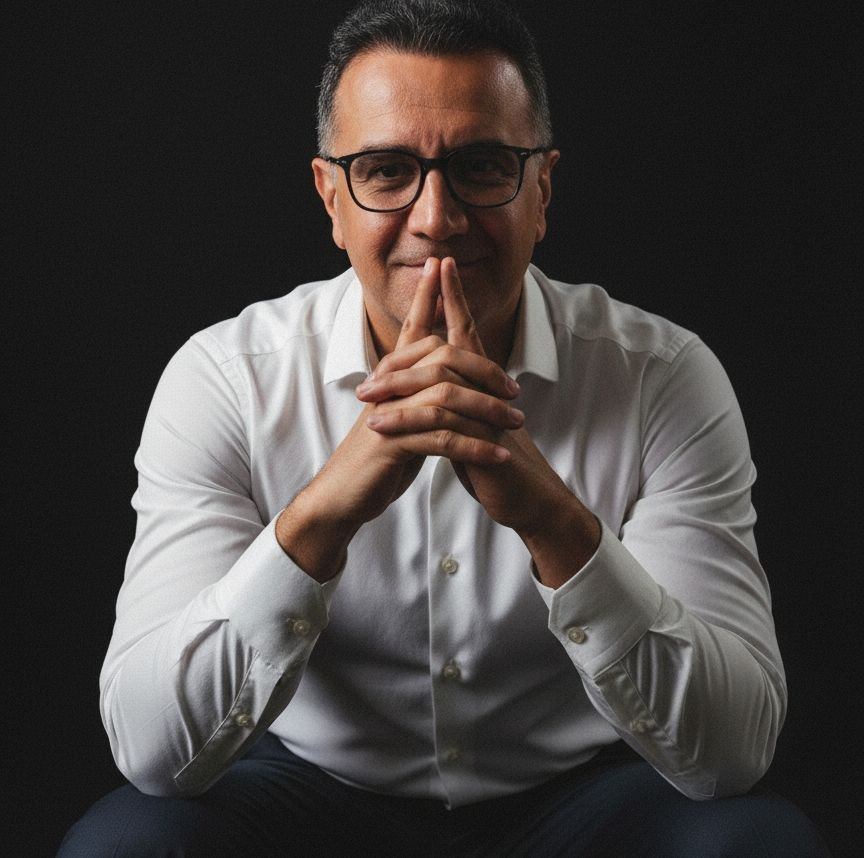
Sanghoon Rhee, Senior Manager at CARIMATEC, presents at the ‘Global Media Meetup’. | Photo by AVING News
The clear trays are then vacuum-formed over those molds. The representative said a single print run can produce roughly 50 to 60 molds in about 60 to 90 minutes.
Carimatec’s core pitch is not simply that it makes 3D printers. Many companies do. It sells the printer, resin materials, and slicing software as one system, arguing that the whole platform is more useful for production.
Its machines use DLP, or digital light processing, a technology our readers typically associate with televisions from the 2000s. It’s nice to see that this technology is still around and used in manufacturing.
Instead of steering a laser point by point, DLP projects an image that cures an entire layer of liquid resin at once. That creates a natural speed advantage, but the process still has a bottleneck: after a layer is made, conventional resin printers often have to separate the fresh part from the film at the bottom of the resin vat before continuing.
Carimatec calls its answer C-CAT, short for Carima Continuous Additive Technology. The company says it lowers the separation force enough for the printing process to proceed more continuously, rather than repeating a lift, peel, refill, and reset cycle.
Its current Carimatec’s X1 page claims speeds of more than 40 centimeters per hour, while other company material describes C-CAT at up to 60 centimeters per hour under certain conditions. The difference matters: high-speed printing claims are meaningful only when the material, layer thickness, and finished-part requirements are specified.
The second technology, S-BAT, solves a different problem. Large resin printers may use multiple optical engines to cover a wider area, but the boundaries between those projections can create visible seams or inconsistent curing. Carimatec says S-BAT calibrates those overlaps to produce a more uniform surface. Basically, C-CAT is about keeping production moving; S-BAT is about making a bigger printed object look like it was made under one continuous light source.
The materials side may be the more defensible part of the pitch in my opinion. In the briefing, the representative explained that each resin needs its own exposure settings, such as UV intensity and curing time.
A printer can accept a third-party material, but a vendor that develops both hardware and resin has more control over those parameters. That does not automatically make its materials better than competitors’ materials. It does create a potential operational advantage when customers care about repeatability more than experimentation.
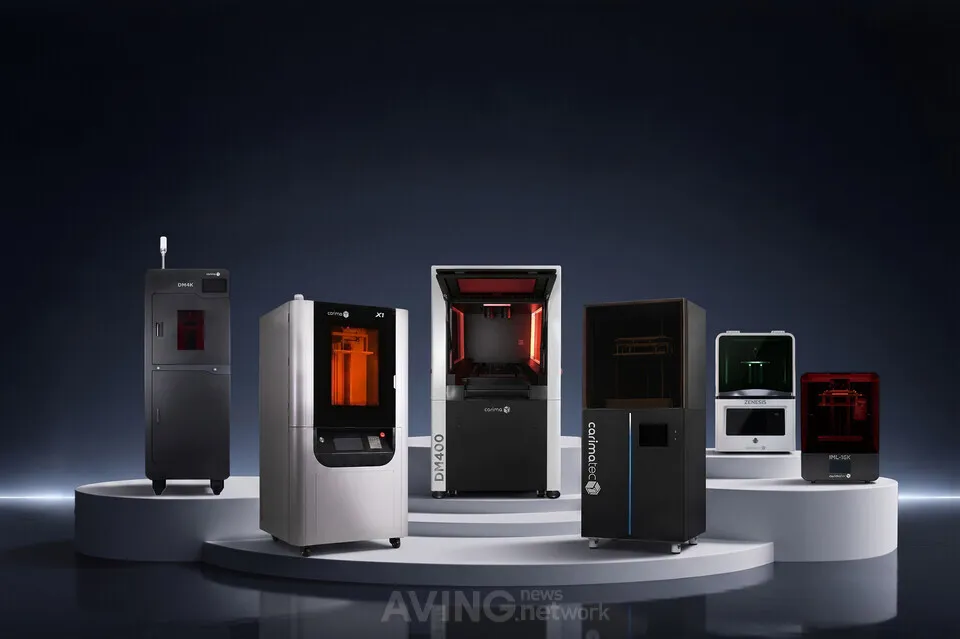
Carimatec says its material lineup includes elastomeric, high-temperature, ceramic, and flame-retardant options. Its DM400 is positioned as an automated industrial system that can print, remove, clean, cure, dry, and collect parts with limited operator intervention. The company says the machine can produce more than 800 units daily in one configured workflow.
Japanese dental company Shofu lists the S-WAVE IMD-S as a DLP dental printer and provides Carima Slicer software and firmware resources for it. Carimatec also says it has relationships with U.S. ceramic-materials supplier Tethon 3D and mining supplier CR Mining Solutions, but I’m not sure to what extent.
Sanghoon Rhee, Senior Manager at CARIMA (right), gives an interview at the ‘Global Media Meetup’ on the 27th. | Photo by AVING News
The company’s history also makes it less of a brand-new startup than the presentation’s tone suggests. CARIMA says it was founded in 2000, introduced its first DLP printer in 2009, and unveiled C-CAT in 2016. The current opportunity is not inventing 3D printing from scratch. It is proving that resin printing can meet production expectations for speed, reliability, finishing, material qualification, and cost.
The potential is there: custom footwear, automotive interior components, and dental models sound like a broad addressable market, but each has different durability, certification, and economics requirements. We’ll see if the speed gains match real-world materials and quality-control demands.
Filed in . Read more about Korea and Korean Startups.