


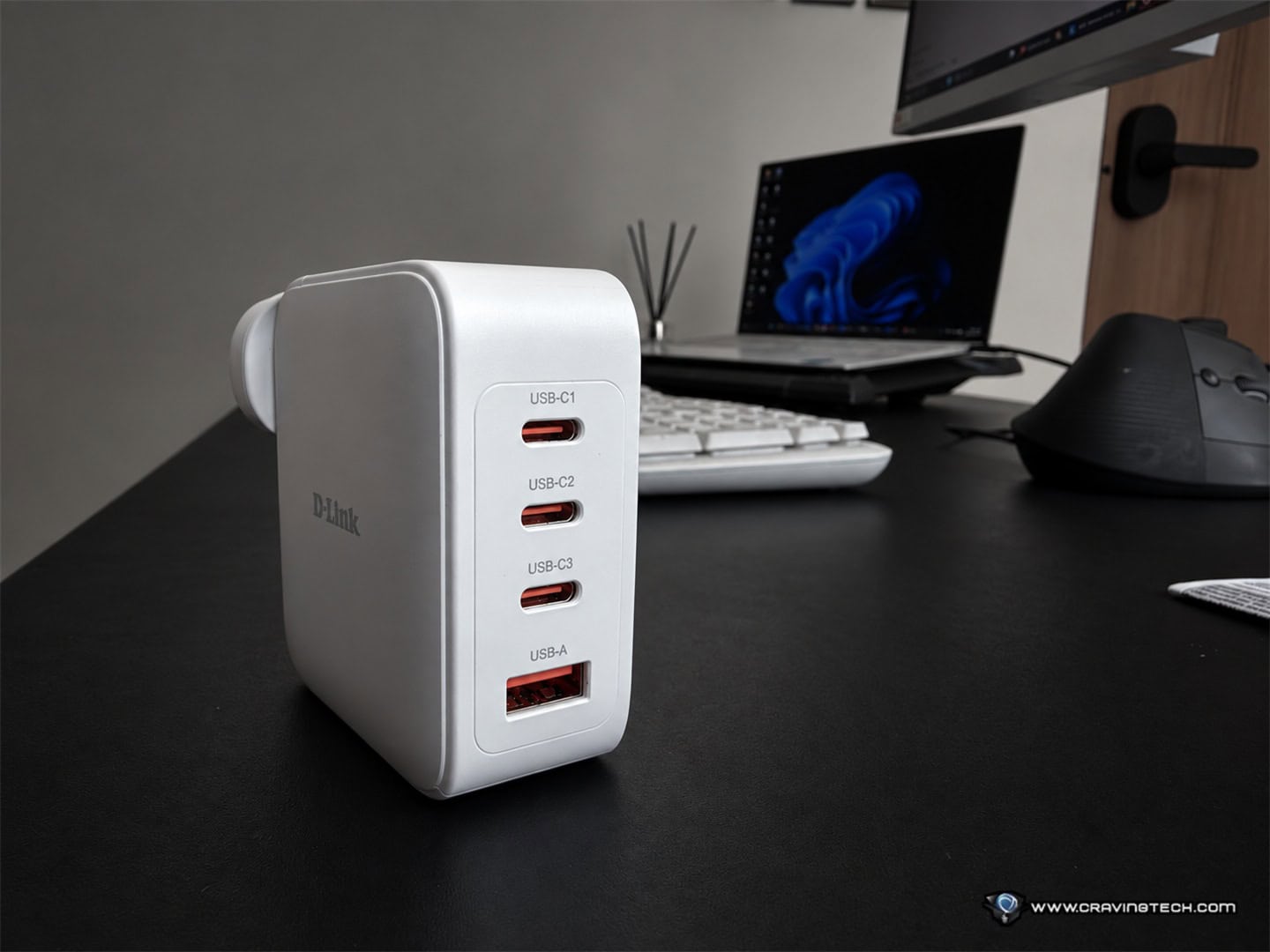
The D-Link DCF-141 140W GaN Charger is designed to replace several separate power adapters with one compact charger. With three USB-C ports, one USB-A port, support for USB Power Delivery 3.1 and Qualcomm Quick Charge 4.0, it can deliver up to 140W from a single USB-C connection while also supporting several useful multi-device charging configurations.
For anyone travelling with a laptop, smartphone, tablet, smartwatch, earbuds and other USB-powered devices, having a single charger that can handle most of them is certainly much more convenient than carrying several power bricks around. Plus, this one can support up to 140W which covers most modern laptops – even my Dell XPS 13 only needs 65W.
Packaging Contents
Design and connectivity
The D-Link DCF-141 has four charging ports on the front: three USB-C ports labelled USB-C1, USB-C2 and USB-C3, plus a USB-A port. And yes, I’m glad they include a USB-A port at least. While almost everything I use nowadays has moved to USB-C, I still have older accessories and cables that require USB-A. Having one legacy port therefore makes the DCF-141 more versatile without sacrificing too many USB-C connections.
GaN, or gallium nitride, technology allows manufacturers to build high-output chargers in a considerably more compact package than traditional silicon-based chargers. So, instead of having a large laptop charger taking up one power outlet alongside separate phone and tablet chargers, the DCF-141 can potentially handle all of them from the same outlet. You can leave that brick charger at home while you travel.
Up to 140W from a single USB-C port
It comes with USB PD 3.1 support and a maximum output of 140W. Both USB-C1 and USB-C2 can individually provide up to 140W when used on their own. USB-C3 is rated for up to 30W when used individually, while the USB-A connection can also provide up to 30W with QC 3.0 according to D-Link’s charging diagram. So technically, you still need to remember not to plug your laptop to the USB-C3 here.
The 140W output makes the DCF-141 suitable for considerably more than smartphones and tablets. Compatible USB-C laptops can take advantage of the additional power available through USB PD 3.1, including machines that require substantially more power than the typical 45W or 65W USB-C charger can provide.
Of course, a device only draws the amount of power it supports. Connecting a phone capable of 30W charging to a 140W USB-C port doesn’t mean the charger will suddenly push 140W into it.
Your USB-C cable is important as well. To actually get 140W USB PD charging, you’ll need a cable rated appropriately for high-power USB PD rather than simply using any USB-C cable you happen to have lying around.
Charging two laptops at the same time
Technically you can charge two laptops at the same time too. If USB-C1 and USB-C2 are used simultaneously, the charger can allocate up to 70W to each port. That gives you 140W in total and makes it possible to charge two USB-C laptops from a single charger, assuming both machines are happy with a 70W supply. As I mentioned, my work laptop (Dell XPS 13) and HP OmniBook Ultra Flip 14 only requires 65W, and a Chromebook like my ASUS Chromebook Plus CX34 only needs 45W.
So you could have a work laptop and personal laptop connected to the same charger rather than having two bulky laptop power adapters around. When you are travelling, you can save so many extra space and weight in the luggage – really important when you are flying a budget airline.
There are several useful 100W + 30W combinations. Based on D-Link’s power distribution specifications, USB-C1 can deliver up to 100W while USB-C3 provides up to 30W. USB-C1 can similarly supply 100W alongside the USB-A port at up to 30W. The same combinations are available using USB-C2: up to 100W from USB-C2 together with either 30W from USB-C3 or 30W from USB-A.
That means you can prioritise most of the available power towards a laptop while simultaneously fast-charging another device.
What happens when you connect three or four devices?
As with practically every multi-port charger, the advertised 140W doesn’t mean every port can provide its maximum individual rating simultaneously. The charger dynamically divides its available power depending on which connections are being used. This is probably the most important thing to understand about the DCF-141 (and maybe a confusing part to remember – if you want to remember it).
Using all three USB-C ports, for example, distributes power at up to:
- USB-C1: 65W
- USB-C2: 45W
- USB-C3: 30W
That’s actually a particularly useful 140W split. A laptop could receive 65W, another lower-powered laptop or tablet 45W, and a phone another 30W.
When all four ports are occupied, D-Link specifies:
- USB-C1: up to 65W
- USB-C2: up to 45W
- USB-C3 + USB-A: 18W combined
So while you can charge four devices simultaneously, the third USB-C and USB-A ports have to share considerably less power in this configuration. That’s not necessarily a problem if those final ports are being used for something such as earbuds, a smartwatch or another low-powered accessory. It’s something worth knowing, however, if you’re expecting to connect four demanding devices and fast-charge all of them simultaneously.
There are other combinations as well. For example, one USB-C port can provide up to 100W while USB-C3 and USB-A share 18W.
The flexibility is good, but the various power allocations do mean it’s worth knowing which ports you’re plugging your devices into. If you want maximum charging performance for a laptop, USB-C1 or USB-C2 should generally be your priority.
Apart from allowing the charger to be smaller, GaN components are generally more efficient than conventional silicon components when operating at high frequencies. Less wasted energy also helps manage heat, although a high-powered charger can obviously still become warm while supplying significant power. D-Link specifically highlights the compact design and reduced heat build-up as benefits of its GaN implementation.
There’s also a comprehensive set of electrical protection mechanisms built into the charger. D-Link says the DCF-141 can automatically shut down when it detects conditions including overcurrent, overvoltage, overcharge, excessive temperature or a short circuit.
D-Link DCF-141 140W GaN Charger Review Conclusion
The D-Link DCF-141 140W GaN Charger has one major job: replace a pile of individual chargers with something much simpler. With three USB-C connections, USB-A, USB PD 3.1, QC support and up to 140W from either of its two primary USB-C ports, it has enough flexibility for everything from smartphones and tablets to fairly demanding USB-C laptops.
Its power distribution is also quite sensible. Two laptops can receive up to 70W each, while a 100W + 30W configuration works nicely when you want to give most of the available power to a laptop while fast-charging another device like a tablet.
The main thing you’ll need to remember is that plugging more devices in changes the available output. In particular, USB-C3 and USB-A share just 18W when all four ports are being used. That’s completely normal behaviour for a multi-port charger, but understanding the different combinations will help you get the best charging performance from it. And while all these combinations might confuse people, you only have to remember to plug your laptop only to the first two USB-C ports.
A product like the DCF-141 is good to have around when you look at how many chargers normally accumulate around your desk and bag. A laptop might have its own 65W or 100W adapter. Then there’s a phone charger, tablet charger and perhaps another charger for smaller accessories. Apart from taking up several outlets, you end up with several power bricks and cables around the desk. With the DCF-141, you can connect your laptop to one of the higher-powered USB-C connections, use another USB-C port for your phone or tablet, and leave the remaining USB-C and USB-A connections available for accessories.
D-Link DCF-141 140W GaN Charger retails for A$129.95 and is available now at D-Link website and authorised retailers around Australia.
Disclosure: D-Link DCF-141 140W GaN Charger review sample was supplied for reviewing
D-Link DCF-141 140W GaN Charger Review
Summary
The D-Link DCF-141 is a versatile 140W GaN charger that can efficiently power multiple laptops (even two modern laptops at 70W each simultaneously), phones, tablets and accessories from a single compact unit.
Pros
- Compact design for high power output
- High 140W USB PD 3.1 output
- 3 USB-C ports and 1 USB-A port
- Can charge two modern laptops at 70W each simultaenously
- Comes with plenty of protection
Cons
- Might take a while to remember where to plug your stuff into which port
- Doesn’t come with any USB-C cable
About Michael Aulia
Owner of CravingTech.com, Michael is a tech enthusiast who blends a love for gadgets with a passion for gaming. He has been in the IT industry and reviewing consumer products for more than 20 years.
Michael’s been running Craving Tech and reviewing consumer technology since 2007.