


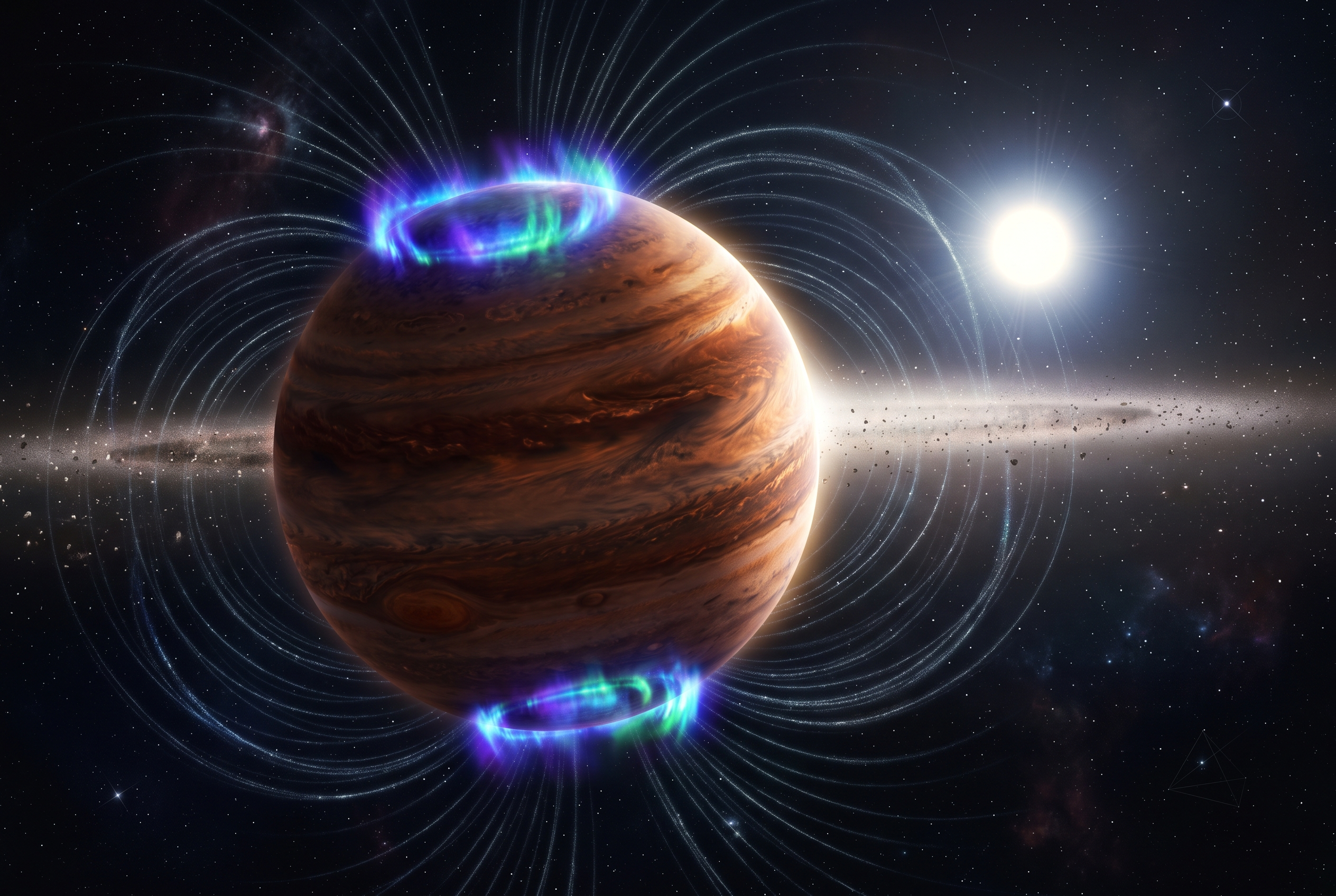
In a historic breakthrough for observational astronomy, researchers at the Center for Astrophysics | Harvard & Smithsonian have successfully isolated and confirmed the first direct radio signal emitted by a planet outside our solar system. The target, Beta Pictoris b, is a massive gas giant discovered in 2008, located roughly 63 light-years away from Earth.
Contrary to speculative hypotheses involving extraterrestrial intelligence, scientists confirmed that this broadcast is a naturally occurring radio aurora. This phenomenon arises when energetic charged particles accelerate along intense magnetic lines, penetrating the planetary atmosphere. While analogous to the auroral displays observed on Earth and Jupiter, this newly detected extraterrestrial event operates on an unprecedented scale.
The star Beta Pictoris b, photographed by the European Southern Observatory, hosts the gas giant discovered in 2008. (Image: European Southern Observatory/AP Photo/Picture Alliance)
The detection was accomplished using the advanced MeerKAT radio telescope array situated in South Africa. Throughout four dedicated observational runs conducted between 2025 and 2026, researchers tracked both steady radiation and intense bursts displaying strong circular polarization, a distinct hallmark of auroral processes. To eliminate potential interference and verify that the emissions originated strictly from the exoplanet rather than its host star, astronomers utilized distant quasars as fixed geometric calibration points.
This landmark observation delivered the first direct calculation of an exoplanet’s magnetic field strength. Because recorded frequencies reached up to 3.5 GHz, calculations indicate the magnetic field within the emission zone is at least 2,500 times stronger than Earth’s surface field, easily surpassing any magnetic intensity previously recorded on Jupiter.
Physically, Beta Pictoris b contains an estimated mass between 10 and 12 Jupiter masses and exhibits a rapid rotational period lasting only eight to nine hours. Although its significant angular separation from its parent star facilitated precise telescope resolution, the extreme radiation, hostile atmosphere, and turbulent magnetic activity confirm that this giant world cannot support biological life as currently understood. The study fundamentally expands planetary science by establishing radio astronomy as a viable pathway for mapping alien magnetospheres.
Filed in . Read more about Science.