
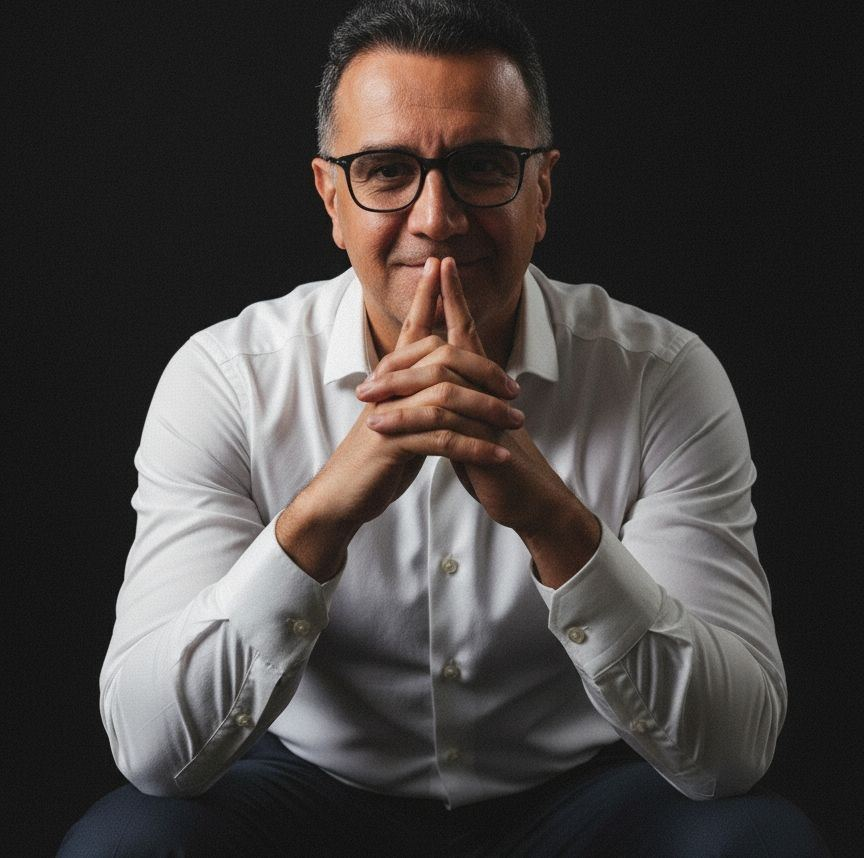

Louis Amira is the Founder of Circuit & Chisel, drawing on experience building products and partnerships across AI, crypto, and payments. His career includes co-founding a venture within Google’s Area 120 incubator, working at Chainlink, and leading crypto and AI partnerships at Stripe. He started Circuit & Chisel with David Noël-Romas to address the infrastructure gaps that prevent AI agents from performing reliable, useful work for businesses.
Circuit & Chisel builds infrastructure for AI agents and is the company behind ATXP, Unbiased, and Pareto. ATXP provides identity and payment capabilities for agents, while Pareto combines frontier and open-weight models to address the quality and cost of AI inference. Unbiased provides access to Pareto through its platform. In this interview, Amira discusses model orchestration, evaluation, inference economics, data retention, and the relationship between reliable agent reasoning and autonomous payments.
Your career has taken you from Google’s Area 120 incubator to leading crypto and AI partnerships at Stripe, before co-founding Circuit & Chisel. What did those experiences teach you about the infrastructure AI agents would need, and what ultimately inspired you to start the company?
At Google, I co-founded a company inside Area 120. The lesson I took from it: what you build first decides what you can build later. At Chainlink and Stripe, I saw the same pattern from the other side. New technology would work in the demo environment on sunny days and perfect conditions, then stall because the plumbing for the real world wasn’t there yet.
David and I started Circuit & Chisel to build agents that do real work for real businesses. They kept failing for boring reasons. An agent couldn’t prove who it was, and it couldn’t pay for anything. So we built ATXP to give agents an identity and a way to pay.
Then we hit the next wall. An agent that can act also has to be right, at a price that makes sense for the task. That’s Pareto. The instinct both times was the same: find the missing piece and build it.
Circuit & Chisel initially focused on ATXP, a protocol designed to enable autonomous payments between AI agents, before expanding into AI model infrastructure with Unbiased and Pareto. What prompted that evolution, and how do these technologies fit into your broader vision for the agent economy?
Our customers (and their agents) showed us that ATXP worked. Agents could hold an identity and spend money. But when we sat with businesses, their first problem wasn’t payments. It was trust in the output. Nobody hands a budget to an agent that picks the wrong model for the job or gets the answer wrong.
So earlier this year we amped up our work on quality and cost. That became Pareto.
The two still fit together. Pareto decides how an agent thinks through a task. ATXP lets it act and pay. You need both, and you need them in that order, because no one gives an agent a wallet before they trust its judgment. We just built them in the wrong order.
Pareto takes a different approach from traditional large language models by combining outputs from multiple frontier and open-weight models rather than relying on a single model or conventional routing system. Can you walk us through how this architecture works, particularly how it synthesizes competing responses into a more accurate or useful result?
Pareto is a system, not a single model. It sends work to models from several labs, both frontier and open-weight, and gives each one a job. Several models might be capable of the work, though sometimes things can be complex and you need one to review and advise. Which models to call, based on how each one scores on capability, cost, speed, and reliability for this type of task. And how much checking the task deserves.
We don’t average answers. Averaging blurs the errors together. We want the models to disagree, because disagreement is where mistakes show up. When the mix of available models changes, we re-test and ship a new numbered version of Pareto.
One of Pareto’s central promises is delivering frontier-level intelligence at substantially lower costs. Given that multiple models may participate in generating a response, how are you able to achieve those efficiencies, and what trade-offs exist between inference costs, latency, and output quality?
Pareto’s job is frontier-level answers. The lower cost comes from how it gets there.
Most of what people send to an AI is routine. A cheaper model gets those requests right just as often as the most expensive one. Pareto sends them there and saves the frontier models, or several models working together, for the requests that need them. In our published tests, that mix scored within a few points of GPT-6 Astra and Claude Opus 5.5 on most major benchmarks at 30-70% lower cost per task.
There aren’t significant trade-offs. Pareto won’t route every request perfectly, but we measure how often it gets the routing wrong and improve on (and publish!) the results.
Your team has published benchmark results positioning Pareto competitively against leading proprietary and open-weight models, including comparisons involving GPT-6 Astra and Claude Opus 5.5. How do you ensure these evaluations reflect real-world performance rather than benchmark-specific optimization, and where do frontier models still hold a meaningful advantage over Pareto?
We publish the evaluation code, so anyone can rerun our numbers. Every model goes through the same harness, Pareto included. And we show Pareto’s losses at the same size as its wins. A scoreboard where the house always wins is just an ad.
We launched in multiple AI gateways and have given preview access of new models to companies of all shapes and sizes. We incorporate their feedback in near real time to constantly improve the model’s performance.
Pareto reportedly processed more than two trillion tokens within its first 48 hours. What did that initial demand reveal about the market for cost-efficient AI inference, and what were the biggest technical challenges involved in maintaining performance, reliability, and scalability at that volume?
Demand was several times what we and our partners expected, and unfortunately we didn’t have enough compute to serve it properly. On the first day, demand exceeded 5 to 10 billion tokens a minute. We were serving about 1.6 billion. To properly serve all of that demand for free would have cost many millions of dollars per day.
What it told us: price is holding back a lot of AI use. There are builders whose product works at one price and doesn’t work at five times that price. Bring the price down and they show up.
The hardest part was simple. We ran out of capacity. On day one the model got slow enough that some people gave up on it. We brought more capacity online overnight and moved to paid access two days after launch, which is the honest way to ration.
We also learned something about disclosure. Some users felt misled when they found out Union Alpha was several models working together, not one. That was part of the point in launching it with the partners as ‘just another model’ – there isn’t a practical difference in how users should experience the output of a router.
Zero data retention is another major component of Pareto’s positioning, particularly as enterprises become increasingly concerned about sensitive information passing through third-party AI providers. How do you enforce and verify these protections when multiple underlying models are involved, and what assurances can enterprise customers obtain about how their data is handled?
On our zero-data-retention plans, we don’t store your prompts or outputs, and neither does any provider we send them to.
With several models in the path, a ZDR promise is only as good as the weakest link. So ZDR requests only go to models running under zero-retention terms. If a provider can’t meet those terms, it doesn’t get ZDR traffic.
Enterprise customers get it in writing: a data processing agreement and a ZDR addendum. We also say clearly which plans are not ZDR, so no one ends up in the wrong camp. For companies that want their data to never leave their own building, we’re working on a version they can run on their own hardware. More on that soon.
As AI agents move from answering questions to executing complex, multi-step workflows, small reasoning errors can compound into significant failures. How does Pareto address issues such as hallucinations, conflicting model outputs, and reliability across extended agentic tasks, and can combining multiple models introduce new failure modes of its own?
This is the problem we ran into first. Outside of a demo, agents fall apart. One small mistake in step two becomes a big one by step ten.
Multiple models help on the hard steps. They can work the same problem separately, check each other, or confirm a result before the agent moves on. A single model has no second opinion. Pareto does.
We measure user satisfaction and performance on real tasks, publish the results, including the bad ones, and fix what we find. Customers who need the same behavior every time can pin a version of Pareto so it doesn’t change under them.
Through ATXP and Unbiased, Circuit & Chisel is tackling two important challenges for autonomous agents: accessing intelligence efficiently and paying for the services they consume. How do you envision these capabilities converging, and could we eventually see agents independently selecting, purchasing, and coordinating AI models and external tools based on performance, cost, and task requirements?
Yes. That’s where this goes.
Today a person decides which model to use, which tools to call and how to pay for them. More and more, the one making those choices will be done via agent. It will pick the right model for each step, find the tools it needs, pay each provider and check the results before moving on.
That takes two things. A way to get the right intelligence for each task, which is Pareto. And a way to prove who it is and pay, which is what ATXP was originally built for.
Many companies are now working on things like limits, liability, etc before anyone trusts agents with money. That’s why we started with judgment. The payment piece gets more useful the more you trust the agent using it.
Looking ahead, do you believe the next major breakthrough in AI will come primarily from training increasingly powerful individual models, or from developing systems that intelligently combine existing models and capabilities? How do you see that distinction shaping competition between emerging AI companies and the major frontier model providers over the next several years?
Both. The labs will keep making better models, and that matters a lot. We ensure that people don’t feel the need to read about and test each one. We should deliver the right model, for the right task, at the right ROI. No more model fatigue.
We’ll never outspend the labs on training, we build on their work and help distribute them. Every time a lab ships a better model, Pareto gets better too.
The labs could build this themselves, and some will. But a lab’s router has a home team. We don’t own a model, so the only way we win is if the customer gets the best answer for the money. The more models there are, the more that matters.
Thank you for the great interview, readers who wish to learn more about Pareto, agent infrastructure, and the tools connecting AI reasoning with identity and payments should visit Circuit & Chisel.