


Ever since The Lean Startup by Eric Ries was published in 2011, prevailing wisdom in the SaaS community has been to launch a minimum viable product (MVP) rather than wait for a perfect, feature-complete release. The lesson was to release quickly, gather real user feedback, and continuously improve through small, iterative updates instead of relying on assumptions.
Another foundational SaaS principle is “Validate Before You Scale.” The assumption is that you shouldn’t invest heavily in building a complete software product before proving that customers actually want it. Launch the MVP, validate demand with real users, and expand functionality based on demonstrated needs.
Another principle closely associated with Paul Graham and the early philosophy of Y Combinator is to build something a small number of people love rather than something a large number of people merely like. In theory, this allows a product to scale as more users discover that they cannot operate without the software being offered.
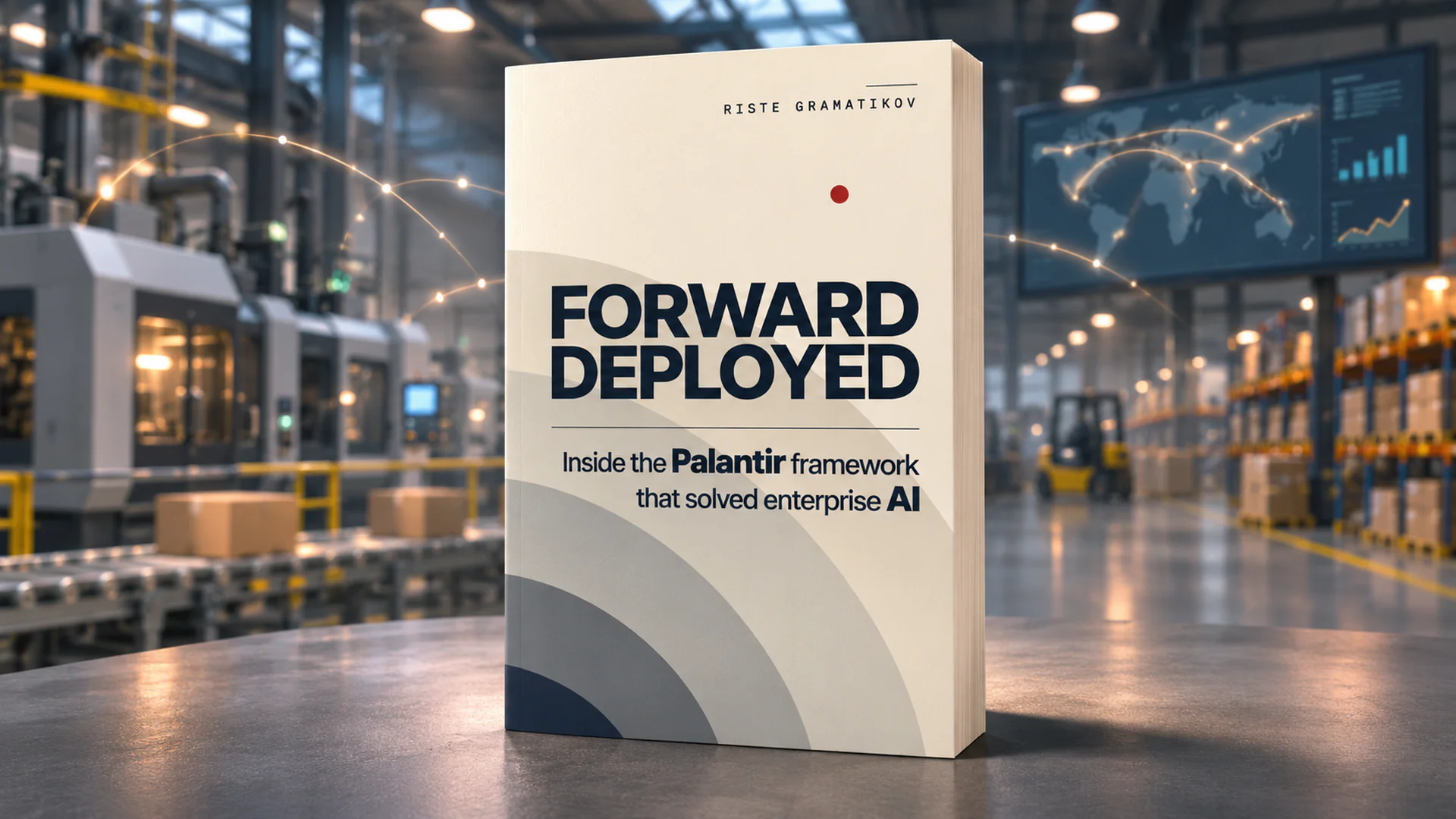
The thing is, Palantir challenges the conventional way these rules are applied. The book Forward Deployed: Inside the Palantir Framework That Solved Enterprise AI by Riste Gramatikov reveals how this is done. It is less about abandoning customer feedback than taking it much further, embedding engineers inside the businesses whose problems they are trying to solve.
How Palantir Conceptualized Forward Deployed Engineers
Palantir approaches its business through first-principles thinking. This extends from its internal workings to its Forward Deployed Engineer (FDE) model, which embeds software engineers directly with customers to understand their problems firsthand, develop tailored solutions, and continuously refine the software based on real-world usage.
Rather than separating developers from end users, Palantir creates a direct feedback loop between engineering and customers. This allows the company to solve immediate problems while incorporating lessons learned into its core platform, making the software increasingly valuable and scalable across its customer base.
Traditional SaaS principles would suggest that this could not scale properly, as each business has unique requirements. While it is true that this is not a one-size-fits-all approach, it also enabled Palantir to build a moat. The difficult work is connecting software to the realities of supply chains, logistics, manufacturing, inventory management, and the often highly specific requirements of government entities and Fortune 500 companies.
What initially looks like a scaling problem can become a competitive advantage if the lessons from one deployment improve the next. The distinction is whether a company keeps rebuilding bespoke software from scratch or uses customer-specific work to strengthen a shared platform.
How Palantir Avoids Mimetic Behavior
What sets this book apart from regular business books is its composite simulation based on real Palantir implementations, with a level of operational detail that is rarely accessible in a single account. The book is an independent analysis drawn from public sources, and the simulated company gives those ideas a concrete setting.
I was enthralled by the case study of MidWest Manufacturing. I was also impressed with the explanations behind the decision-making and how those decisions benefited both Palantir and its customers. Following the same business through the different stages makes it easier to understand how individual choices accumulate into a larger operating model.
Peter Thiel has been strongly influenced by the philosopher René Girard, whose theory describes human desire as fundamentally imitative. Businesses also fall into this trap. For the most part, they converge on the same strategies, enter the same markets, and compete with similar products.
The book’s account of Palantir offers a way to think about escaping this mimetic behavior. Three features of that approach stood out to me:
- Exceptional Talent Production: Palantir created a distinctive working environment and, more importantly, attracted and developed talent in unusual ways. The book explores these methods, including a simulated interview in the appendix that gives readers a feel for the thinking the company values.
- Business Model Efficiency: The book connects Palantir’s approach to its revenue growth and operating margins. What interested me was how work that appears labor-intensive can support a scalable software business when the resulting capabilities become reusable.
- Industry Validation: Companies such as Databricks and Salesforce now use forward deployed engineering teams. To me, that is validation of the model, although copying the job title is different from reproducing the system that makes it effective.
Palantir’s Compound Learning Flywheel
I often found myself taking notes on passages in the book. Many offered a contrarian view that, when inspected through the lens of Palantir, made complete sense.
For example, the book closes by framing the choice facing enterprises in stark terms: whether they will be among the 5% that succeed in transforming or the 95% that fall behind. I read this as a challenge to business leaders to turn AI investment into something that changes how their organizations operate.
And this is precisely the reality businesses find themselves in. If everyone is doing the same thing as everyone else, there is no differentiation and no moat. The company becomes another competing product offering much the same thing. This book offers a rare instructional guide to how Palantir escaped that trap, focusing heavily on forward deployed engineers and avoiding mimetic behavior.
All of this feeds into Palantir’s compound learning flywheel. The principle is that every customer deployment should make the underlying software platform smarter, more capable, and more valuable for future customers.
Through its forward deployed engineers, Palantir identifies real-world problems, develops solutions, and feeds those insights back into its core software. Instead of repeatedly building custom solutions from scratch, the company turns recurring challenges into reusable capabilities that benefit subsequent deployments.
This creates a compounding feedback loop: more customers generate more insights, more insights produce better software, and better software enables faster, more effective deployments. Over time, the accumulated knowledge becomes a competitive advantage that is increasingly difficult for competitors to replicate.
Summary
I’ve read hundreds of books on AI and business models, and they often converge on the same strategies and repeat the same insights. This book manages to contribute something new. It offered a rare glimpse into the workings of one of the most unique and contrarian companies in Silicon Valley.
I recommend Forward Deployed to anyone launching a business that touches SaaS, supply chains, logistics, manufacturing, or enterprise AI. For me, its value lies in showing how the difficult work of solving a customer’s specific problem can become the foundation of a business that keeps getting stronger with every deployment.