


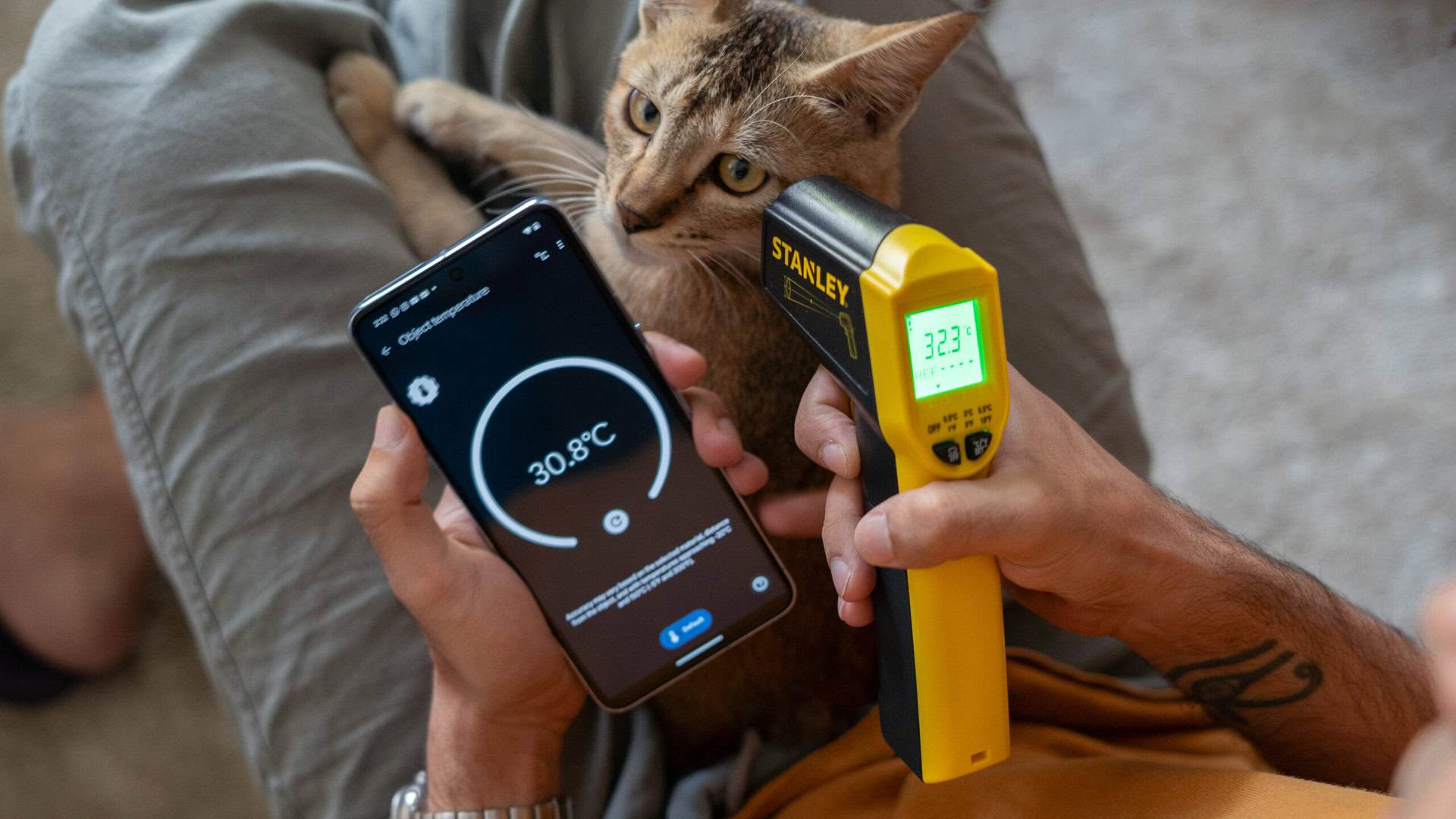
Dhruv Bhutani / Android Authority
When Google introduced an infrared thermometer on the Pixel 8 Pro, the reaction from the tech world, and me, was pretty dismissive. It felt like a strange, pandemic-era feature that arrived two years too late, squeezed into the phone for no reason other than “why not.” Now, with the Pixel 11 series, Google has quietly killed the temperature sensor, dropping it from its flagship hardware. Replacing it is Google’s new HiLight notification light, which someone might call equally gimmicky in implementation. But I digress.
It is easy to dismiss a smartphone thermometer as a useless gimmick. The space could have been better used for an IR blaster, a larger camera sensor, or even a bigger battery. But as someone who inadvertently ended up using it far more than I expected, I’m surprised to say I’m genuinely sad to see it go.
The Pixel thermometer was strange, for sure, but it was also one of the few recent phone features that solved real everyday problems in a way that software never can. As a fan of quirky hardware additions, I wish Google had kept it around.
Do you like Google’s weird Pixel hardware experiments?
112 votes
Yes, they add personality to the phone.
42%
Yes, but only if they are useful.
38%
I don’t really care.
12%
No, they add unnecesary cost to the hardware.
8%
A gimmick on paper, useful in practice
Dhruv Bhutani / Android Authority
I’ll be honest here – when the feature first arrived, Google did not exactly help its case. Early software builds required way too much user input to work. You’d have to select a material, such as plastic, metal, or fabric, to accurately calibrate the readings before taking a measurement. Moreover, human body temperature measurement simply didn’t work at launch because the feature shipped without regulatory approval.
I remember my first demo at Google’s office was quite literally checking how hot my coffee was. Cool. But I don’t need a thermometer for that. However, once Google got approval to use it for body temperature readings, the thermometer found a more practical purpose. Very specifically, I recall feeling low on energy while traveling and using the Pixel 10 Pro’s built-in thermometer to check my temperature. It wasn’t a life-and-death situation, but that one single moment convinced me that perhaps the feature wasn’t quite as gimmicky as I thought it was.
The Pixel thermometer was a weird addition, but when I needed it, having one in my pocket was incredibly useful.
The usefulness did not stop there. The thermometer became a handy tool for quick checks around the house or outdoors. I’ve used the thermometer to check just how hot the road was during the summer heat before taking the dog out for a walk, or the temperature of a frying pan. Elsewhere, I’ve used it to double-check temperature readings of electronics and appliances that I thought were misbehaving. I wasn’t the only one. When Android Authority polled users to gauge how people were using the feature, we discovered many more interesting use cases than I’d have thought of.
It wasn’t a feature that got used too often, and if I really needed to, I could have pulled out my dedicated thermometer for the task. But when you needed it, having a thermometer built into the phone already in your pocket felt incredibly useful. I’m going to miss it.
Replacing utility with visual flair
Shimul Sood / Android Authority
As I mentioned earlier, with the Pixel 11 series, Google is swapping out the temperature sensing module for a ring of ambient lights around the camera flash. HiLight acts as a visual notification system, using custom color notifications when favorite contacts call. It can also give you a glowing indicator light while you interact with Gemini hands-free. It looks neat, but in terms of usefulness, it feels like a step backward.
For one, I’d have preferred it if the notification light were on the front, or even in the volume rocker or power button. But more than that, we’ve seen notification lighting before, and other brands seem to do it better than what we have with HiLight. Nothing’s Glyph lights give you immersive notifications, while the side-mounted notification light in the upcoming Clicks Communicator is bound to be more visible. And if you really want it, you can use one of many apps on the Play Store that can give you an ambient notification directly on the phone’s OLED panel.
HiLight’s placement and software limitations make it less of a tool, and more of a visual gimmick.
All that is to say that despite being a gimmick, the switch from the thermometer sensor to a notification light highlights a bigger change in Google’s priorities. The temperature sensor, quirky as it was, was an active tool. It let your phone interact with the world around you and measure something physical. HiLight is mostly about making the phone look and feel more interesting, especially during AI interactions.
That loss in personality is what bothers me more than the lack of the feature. The thermometer is the latest in a long line of weird Pixel hardware experiments that Google eventually abandoned. We had Soli radar gestures on the Pixel 4, squeeze-for-Assistant sides on the Pixel 2, and wide-angle dual selfie cameras on the Pixel 3. Most of these features were controversial when they launched, and almost all eventually disappeared.
But those strange additions gave the Pixel lineup some personality and helped it stand out in a glut of mostly standardized hardware.
In a smartphone market filled with increasingly similar glass slabs, Google was willing to try unusual hardware and see what stuck. The temperature sensor was undeniably weird, but it showed that phones could still offer more than just better cameras and faster processors. That willingness to experiment is part of what made Pixels interesting to me in the first place. And now, that’s gone.
The loss of Pixel’s experimental DNA
Adamya Sharma / Android Authority
Let’s be real, some of Google’s experiments probably never deserved a second generation. Soli was barely supported in markets outside the US, and squeeze-for-Assistant wasn’t particularly useful. The dual selfie cameras, on the other hand, I’d have paid good money to keep around.
The point is that I would rather see Google try something strange than have every new Pixel generation focus on a slightly better camera, a faster chip, or another AI feature. By streamlining the Pixel 11 and replacing unique hardware tools with more familiar design trends, Google is making its flagship phones easier to understand for the average buyer. They are also becoming a little less interesting for tech enthusiasts who enjoy niche features.
Those weird Pixel experiments gave Google’s phones personality, even when the features themselves didn’t always work.
The Pixel thermometer was never going to be the reason someone bought a $1,000 phone. Between trying to explain the feature, delayed regulatory approvals, and most people forgetting it existed, it wasn’t a headlining feature. But it made for a cool talking point. And more importantly, for the people who actually used it, it was a surprisingly useful piece of kit. Google didn’t just replace a failed experiment with a better version of the same idea. It simply removed a tool that could do something your other devices could not.
HiLight will certainly have its fans. If you like visual notifications and clean desk setups, I can see the appeal. But it cannot measure a fever, or tell you whether your phone charger is getting dangerously hot. Collectively, it made the phone a little more useful. And in a world where phones are getting more and more commoditized, I’m going to miss this one little quirky feature that set my Pixel apart.
Thank you for being part of our community. Read our Comment Policy before posting.