


Verdict
Impressive brightness, vibrant colour and a host of image processing technologies make the Bravia 7 II an excellent Mini LED TV, but does it really live up to Sony’s True RGB hype?
-
Compelling HDR peak brightness
-
Cool PlayStation gaming functionality
-
Solid smart TV experience
-
It’s a big, bulky beast
-
Limited viewing angle
-
No HDR10+ or Dolby Vision IQ
SQUIRREL_PLAYLIST_10208749
Key Features
-
Review Price:
£1999
-
Google TV
All the apps including the UK catch-up versions
-
True RGB
Sony’s version of ‘proper’ RGB backlighting
-
My Cinema
Customise the TV’s performance based on what you watch
Introduction
The Bravia 7 II is the more affordable of Sony’s two new True RGB Mini LED TVs, and it arrives on the back of considerable hoopla. Behind the scenes, Sony has been touting its latest TV technology as the next big thing, promising greater contrast, improved colour accuracy and more precise control of blooming.
The idea behind True RGB is straightforward. Conventional Mini LED TVs use a white LED backlight combined with a Quantum Dot colour filter layer. Sony’s True RGB system instead uses independently controlled red, green and blue LEDs in the backlight.
Easy to explain, but not so easy to accomplish.
Much like Spandau Ballet, I know this much is true.
Advertisement
So just how effective is the technology, and are the results good enough to convince discerning buyers to ghost OLED in favour of something brighter?
Price
The 55-inch Sony Bravia 7 II (K-55XR75M2) tested here initially launched at £1,999 in the UK, but has quickly dropped to £1,699 (a recognition that the bullish tag was unsustainable). US and Australian pricing is set at $1,499 (down from a debut at $2,099) and AU$2,499 respectively.
The Bravia 7 II is also available in 50-, 65-, 75-, 85- and 98-inch screen sizes, the latter topping out at £6,999.
That makes the 55-incher an interesting proposition. It’s more expensive than the highly regarded LG C6 OLED (£1,599) but less pricey than Sony’s own Bravia 8 II 55-inch QD-OLED (£1,899). In the run up to its launch, Sony has consistently positioned True RGB as its premium TV offering, above OLED in its range. That seems to have flipped.
If you’re slightly confused, you’re not alone.
Advertisement
Design
- Big and weighty
- Mirage Stand
Let’s not beat about the bush – for a 55-incher, the Bravia 7 II is a substantial beast.
It weighs a grimace-inducing 18.4kg and the chassis, which measures 122.8 x 78.4 x 20.9cm with stand attached, has unapologetic depth. It’s not an easy wall mount.
I’ll assume that bulk is largely down to the novel True RGB Mini LED backlight – there’s clearly a lot of hardware packed behind the panel.
Its dress-sense is relatively restrained. A narrow black bezel surrounds the panel, with a textured plastic finish to the rear.
Image Credit (Trusted Reviews)
Advertisement
The central stand is the most interesting aspect of its design. The screen sits on what Sony describes as a Mirage Stand, so named because it uses a translucent central panel able to diffuse the visibility of whatever lies behind it.
The effect is clever. Cables are sufficiently distorted to make them difficult to identify. Sony appears to be trying to create the impression that the screen is floating above its pedestal.
It’s an intriguing piece of industrial design.
Image Credit (Trusted Reviews)
Connectivity
- HDMI 4K/120Hz support
- Hybrid optical connection
- Terrestrial and Satellite tuners
Is it possible to be impressed and disappointed at the same time?
Advertisement
The Bravia 7 II is well served to support high frame rate gaming, and boasts Variable Refresh Rate and Auto Low Latency Mode compliances, but only two of its four HDMI inputs are so equipped, and one of those has to serve as the eARC connection if you’re hooking up an external sound system.
There’s no digital optical audio output, instead we get a hybrid 3.5mm optical audio output with S-Centre speaker input, plus a couple of USB ports.
Image Credit (Trusted Reviews)
Ethernet LAN connection is provided, alongside Wi-Fi and Bluetooth 5.3.
The TV comes with two remote controls, one a button heavy standard zapper, the other a more premium pointer with fewer buttons and fast access keys for Crunchyroll, Netflix, Disney Plus, Prime Video, YouTube and Sony Pictures Core.
User Experience
Advertisement
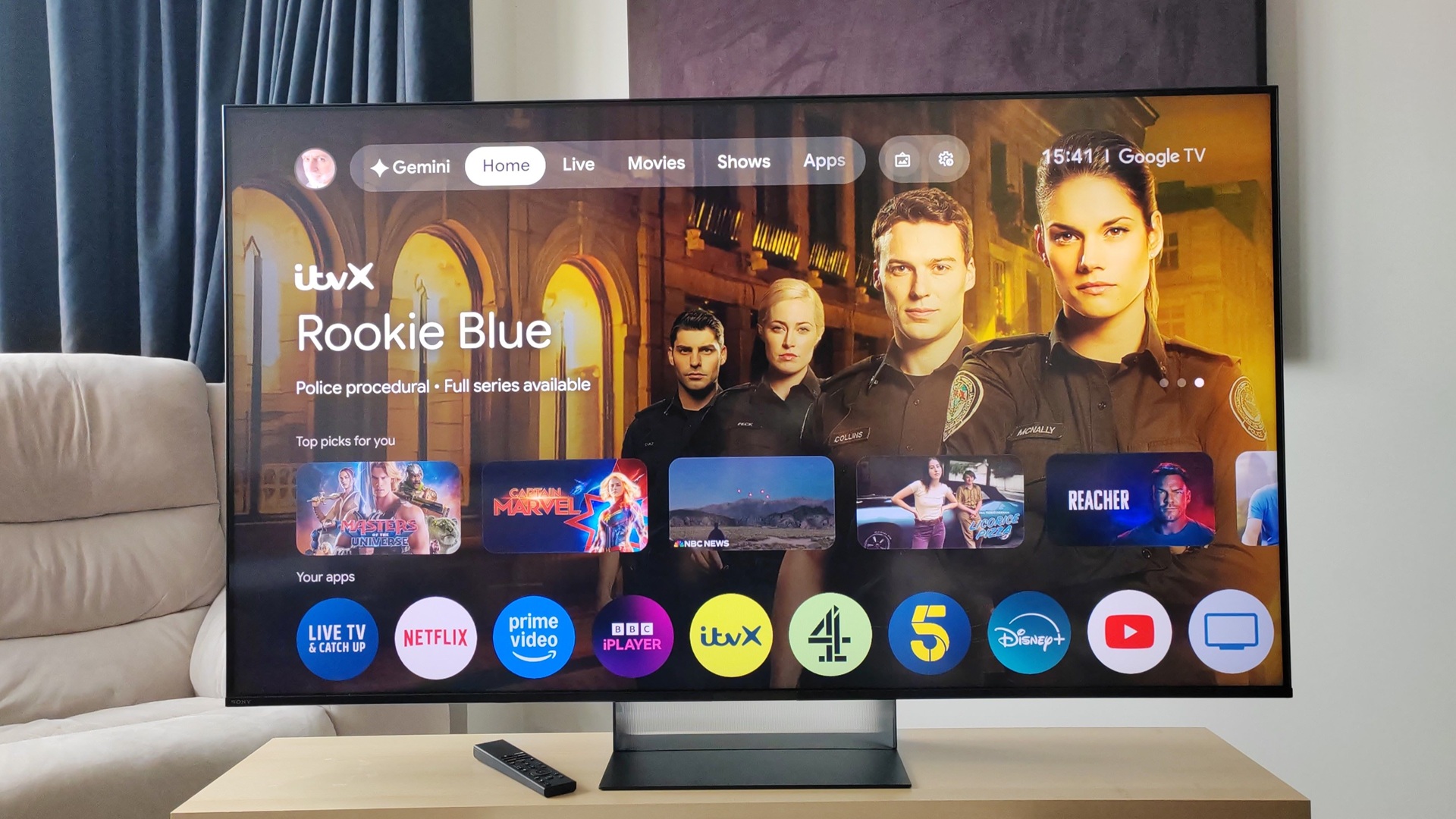
Google TV remains one of the more polished smart TV platforms available, and it provides the front end here.
What we see isn’t too dissimilar from other executions of the platform on rival screens and media players. Curated rails offer local programming, trending shows and selected movies.
Image Credit (Trusted Reviews)
App coverage is strong, with Netflix, Prime Video, BBC iPlayer, ITVX, Channel 4, Channel 5, Disney+, YouTube, BBC Sounds, Sony Pictures Core, Tubi and Crunchyroll among the available services.
The Bravia 7 II also incorporates Google’s Gemini assistant.
UK terrestrial TV is served by YouView. There’s no Freely onboard, which is a shame. The TV does, however, have both terrestrial and satellite tuners, so there’s a choice of aerials.
Advertisement
Features
- XR Clear Image AI upscaling
- My Cinema mode
Picture processing remains one of Sony’s traditional strengths, and the Bravia 7 II brings several of the company’s established technologies together.
XR Motion Clarity continues to impress. Motionflow can be left on Auto or adjusted using a pair of sliders. Movement is smooth with very few visible processing artefacts.
The television also uses XR Clear Image AI for upscaling. This analyses the quality of the source material and attempts to reconstruct lost detail and textures. It’s all very clever, and easy to take for granted.
The TV also Works with Alexa, supports Google Cast and is compatible with Apple Airplay 2 and HomeKit.
Picture Quality
- Strong HDR
- Reflective screen
Advertisement
If the Bravia 7 II was a posh meal out, you’d be worried about the bill. It’s a visual feast, with innovative ingredients.
HDR is where the True RGB system makes its strongest argument. In Professional mode, our 55-inch Bravia 7 II produced a measured peak brightness of 2,101 nits, in a 10% window.
Most obviously, this means specular highlights have appreciable impact; a small source of light in a dark scene can suddenly become intensely bright. When Jack Reacher escapes the Feds via shadowy underground subway tunnels (Reacher, S4), light sources guiding his way are appropriately intense.
Shadow performance is equally important. The Bravia 7 II retains levels of near-black detail, and blooming control is impressive.
The Bravia 7 II may not have as many dimming zones as the flagship Bravia 9 II, but uniformity is demonstrably good. The Reacher title cards appear as white lettering against a completely black background. These black areas remain impressively inky while the white lettering stays clean and bright.
The result is remarkably similar to OLED.
Advertisement
Image Credit (Trusted Reviews)
Sony has long argued that the number of dimming zones is less important than how effectively they’re controlled. The Bravia 7 II gives that argument some weight.
HDR support covers HDR10, HLG and Dolby Vision, but there’s no HDR10+ or Dolby Vision IQ though.
The inherent brightness of the panel also serves SDR well too. Everyday HD images have punch and pizazz.
Punch and Pizazz would also be great names for cats. Just saying.
Colour reproduction is another strength. The AI brain behind RGB Triluminos Max appears to have been trained on jelly beans and Smarties.
Advertisement
Reds and greens are rich and lush, yet don’t lean into the kind of lurid oversaturation that can sometimes accompany very bright displays.
It’s worth noting that the panel isn’t glare-free. Objects, windows and light sources all reflect on screen, so plan your seating accordingly.
Unfortunately, off axis viewing is poor, with significant loss of colour and contrast when viewed from the side.
Picture modes include Vivid, Standard, Cinema, Professional, Calm, Photo and IMAX Enhanced. It says much that I could happily watch at least four of these without grinding my teeth.
What’s new is a My Cinema mode – I was prompted to turn this on when starting a movie on Netflix – with Director’s Cut, Daytime and Dialogue settings. Director’s Cut is essentially Sony’s interpretation of a Filmmaker Mode (which it doesn’t offer). Director’s Cut significantly reduces brightness, hence it’s a dark viewing mode, while Daytime is a more social setting.
Sound Quality
- Dolby Atmos & DTS: X compatible
- Voice Zoom 3
- 3D Surround upscaler
Advertisement
The Bravia 7 II’s integrated audio system is definitely better than the average flatscreen. 40W of amplification drives two full-range drivers and two tweeters, producing a healthy level of slam, with enough energy to make films and games enjoyable without immediately needing a soundbar.
Dolby Atmos and DTS:X are supported, and a 3D virtualiser broadens stereo material to create a wider presentation.
Dialogue receives particular attention through Voice Zoom 3. The AI system identifies speech and can increase or reduce its level. I really didn’t find it very useful, but if you occasionally struggle to follow dialogue in dramas, it’s doubtless going to be helpful.
Bass performance is, inevitably, limited. A low frequency measurement revealed a hum at 31.5Hz (at 100 per cent volume), followed by a more confident response at 50Hz. There’s a honking character to the mid-to-lower bass, which means the system lacks the authority of a good external audio setup, but it succeeds in beefing up the mix.
A soundbar or AV system would still be my recommendation for anyone buying the Bravia 7 II, specifically for serious home cinema.
Bluetooth provides another useful option. I paired the set with Marshall Milton on-ear headphones, which was a real boon for late night private viewing.
Advertisement
Gaming
- 4K/120Hz support
- PS Remote Play
- Gaming Multi View
Clearly, in Sony World, TV owners only have one console, and it’s a PlayStation 5. So I guess the single HDMI for high frame rate gaming is all you need.
If you do indeed own a PS5, Sony guilds the lilly with Auto HDR Tone Mapping which automatically optimises HDR settings during the console’s initial setup.
To help key an eye on your gaming status, there’s Game Menu 2, a handy pop-up display that provides adjustments and assistance. This can also be used to search for YouTube videos and access Gaming Multi View.
The set’s overall gaming presentation is top notch. Sharp, colourful and contrasty, it looks great with serious shooters and colourful platformers. Motion is crisp and free from smearing.
Thankfully, you don’t need to faff around with menus to optimise all this.
The TV automatically switches into Game Mode when consoles are connected to minimise lag and maximise responsiveness. I recorded input lag at 10.9ms (1080/60). It switches out of Game Mode when you watch a movie on the console.
Advertisement
You can also connect your PlayStation remotely. The PS Remote Play app lets you control your PS5, PS5 Pro (or PS4) from another room, or location like a friend’s house. Not new but still pretty neat.
SQUIRREL_PLAYLIST_10208749
Should you buy it?
A Mini LED that’s like OLED
Go ahead and pick one up if you want a uniformly bright, well-specified Mini LED TV with impressive OLED-like black-level performance…
If you’re more of a cineaste
If cinematic OLED imagery matters more to you than extreme brightness, then Sony’s own BRAVIA 8 II QD-OLED probably makes more sense – but be wary of that high-speed HDMI limitation…
Final Thoughts
The Bravia 7 II is an impressive calling card for Sony’s nascent True RGB TV tech. It delivers a picture with genuine OLED-like qualities, and offers levels of HDR brightness that OLED still struggles to match.
So is it worth the investment? I’m not entirely sure. I really enjoyed watching shows and movies on it. A combination of high brightness, controlled blacks and convincing colour will always win me over.
Motion handling, long a Sony strength, also warrants a thumbs up.
However, movie fans need to consider the Bravia 7 II’s position within Sony’s own range. Its HDR highlights can exceed what you get from the Bravia 8 II QD-OLED, but the latter retains an advantage when it comes to an overall cinematic presentation.
For gamers, the equation becomes even more complicated. The combination of brightness, motion handling, 4K/120Hz support, VRR and Sony’s PlayStation-specific features make this a capable large-screen PS5 gaming display, but that two HDMI v2.1 limit is a potential deal breaker – unless you’re going to partner the telly with an AV receiver.
That said, for buyers looking for HDR impact, gaming and Sony’s processing expertise, the Bravia 7 II warrants very serious consideration.
How We Test
The Bravia 7 II True RGB Mini LED was both bench-measured and boxset-binged over a prolonged period. Sources included Blu-ray, Sky Stream, a PS5 and assorted media streaming gizmos.
My audition period also coincided with Reacher Season 4 landing on Prime Video and the launch of Lanterns on HBO Max, so many hours were duly spent glued to the various picture presets. I mixed it up with official Dolby test demos and oft-used movie clips.
It was also partnered with a Sony Bravia Theatre Bar 7 system, to check system interoperability.
- Tested with real world use
- Tested for several days
FAQs
Is the Sony Bravia 7 II an OLED TV?
No. The Bravia 7 II uses Sony’s new True RGB Mini LED technology. Instead of OLED pixels generating their own light, the TV uses independently controlled red, green and blue LEDs in its backlight.
Does the Sony Bravia 7 II need a soundbar?
You won’t need one for everyday viewing. Its 40W sound system produces a good overall balance and has reasonable impact. However, an external sound system will open the door to more immersive listening and better bass performance.
Advertisement
Test Data
Full Specs
Sony Bravia 7 II Review
Manufacturer
Sony
Screen Size
54.6 inches
Size (Dimensions)
x x INCHES
Size (Dimensions without stand)
784 x 1228 x 209 MM
Weight
18.4 KG
Operating System
Google TV
Release Date
2026
Model Number
K-55XR75M2
Resolution
3840 x 2160
HDR
Yes
Types of HDR
Dolby Vision, HDR10, HLG
Refresh Rate TVs
48 – 120 Hz
Ports
Two HDMI, two HDMI 2.1, 3.5mm hybrid optical audio, Ethernet, USB
HDMI (2.1)
eARC, ALLM, VRR, 4K/120Hz, SBTM
Audio (Power output)
40 W
Connectivity
Wi-Fi, Bluetooth 5.3
Display Technology
OLED
UK RRP
£1999
USA RRP
$2099