


DLSS 4.5 Ray Reconstruction was finally unveiled at Gamescom, putting the finishing touch on what could only be described as one of the most remarkable leaps in upscaling technology that is Nvidia’s second-generation transformer-based DLSS 4.5 stack. Unlike many GPU features that arrive with a new generation of hardware attached, this one comes as a free present for all GeForce RTX graphics card owners.
Ray Reconstruction combines upscaling and denoising into a single model, which means Nvidia gets to tackle two of the most pressing problems in rendering with the same technology. The new model is now available as Preset F in the Nvidia App, replacing the DLSS 4.0-era Preset D, and it works across every RTX generation from Turing onward.
Curious to see what this means for GPUs that aren’t Blackwell-class, I put Preset F and Preset D head-to-head on my humble RTX 4070 Ti Super, testing both image quality and performance at 1440p across three games to see what Team Green has promised, and what they have delivered.
The test bench for the runs detailed below comprised of a GeForce RTX 4070 Ti Super coupled with a Ryzen 5 7600X, with 32GB of DDR5-6000 memory running with EXPO enabled.
Resident Evil Requiem
DLSS 4.5 RR brings a requiem for noisy reflections
Nvidia states that the new Ray Reconstruction model should bring better lighting accuracy, stronger temporal stability, and clearer detail in ray-traced scenes all while maintaining roughly the same performance as the preceding model. With Resident Evil Requiem, there are a couple of challenges involved in showing all of that off, though. Much of the game is characterized by dimmer lighting, matte concrete, and in a specific reflective scene that I captured under both presets, the two come quite close, barring the obvious clarity and crispiness in reflections.
Which is why I’d argue the gains become easier to spot when you put Preset F in front of reflections. Wet floors in the same dimly lit areas have more convincing color and reflection, and the lighting looks brighter and better defined. Pushing the brightness too far, in my testing, however, has some reflections feeling rain-soaked, imparting a glossy sheen that feels overly enthusiastic than the scene really calls for.
When it comes to performance, it’s effectively a tie. Average FPS is within 1% of variance. Preset D is nominally 0.7 FPS ahead, which I’d chalk up to run-to-run variance, and I am quite confident stating that there is no performance penalty. Similarly, on 1% lows, the variance only came down to an imperceptible 1.47% on subsequent runs.
Metric
Preset F (DLSS 4.5 RR)
Preset D (DLSS 4.0 RR)
Variance (vs DLSS 4.0)
Average FPS
83.4
84.1
-0.8%
Average 1% low
61.4
62.3
-1.47%
Benchmark results can vary even on identical hardware due to silicon variance between GPUs and CPUs, system configuration, driver and background process variations, graphical presets, and ordinary run-to-run variance. The figures highlighted should therefore be treated as representative results from this test system rather than absolute performance figures.
Related
Path tracing is slowly becoming a non-negotiable for me, and it wouldn’t be possible without DLSS
Never thought I’d say this, but if it’s got path tracing, I want it on.
Alan Wake 2
Nvidia cracked the case for cleaner visuals with this one
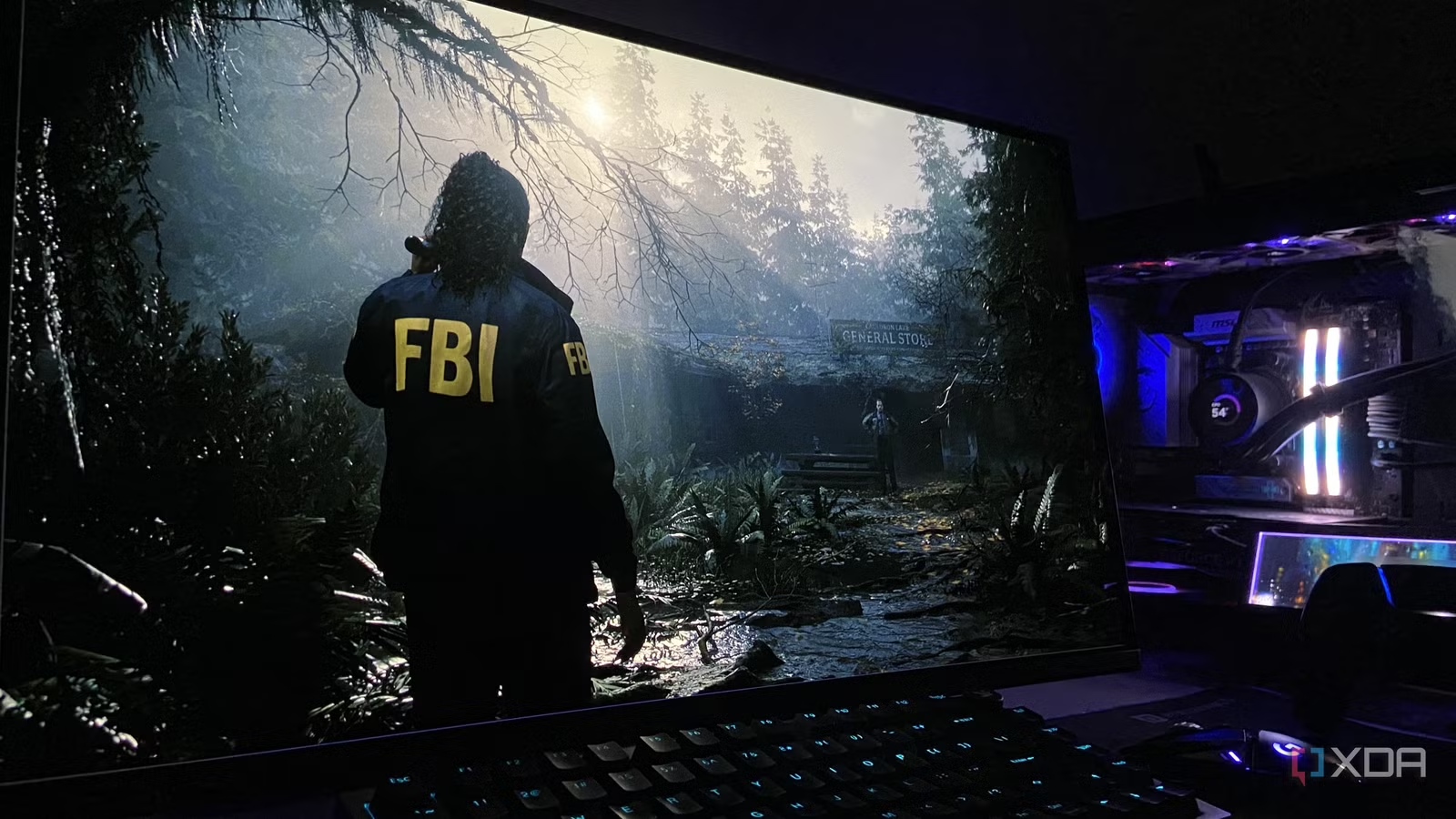
Where the new ray-reconstruction model shone brightest in my own testing was Alan Wake 2. A specific scene that I picked in the “Mind Place” may as well be the quintessential example to confirm Nvidia’s claims are not unfounded. With path tracing in the cabin, Preset F is undoubtedly more stable. The lamp clearly shows a bright emitter against a deep shadow with less shimmer and grain that are visible on Preset D around high-contrast edges. The path-traced bounce on the wooden bar top and the mounted antlers and brick behind it preserve better textures with Preset F, and the setting makes it obvious in juxtaposition.
Performance comparisons, similarly, give reasons to rejoice. In Alan Wake 2, the new Ray Reconstruction model led by 6% on average and 8% at 1% low, notably with lower PC latency too. This is consistent with the broader observations and testing around it, and reinforces that there are no concerns around performance penalties even with Ada Lovelace architecture. This was rather obvious as both Blackwell and Ada Lovelace are native FP8-capable architectures.
Metric
Preset F (DLSS 4.5 RR)
Preset D (DLSS 4.0 RR)
Variance (vs DLSS 4.0)
Average FPS
42.2
39.7
+6.3%
Average 1% low
37.2
34.5
+7.8%
Backrooms: Escape Together
Let’s just say the nightmares are a lot more vivid now
At first, I thought Backrooms: Escape Together was a rather unlikely entrant to the DLSS 4.5 Ray Reconstruction initial support list, but then I remembered that everything the game showcases is purpose-built to show off visual lighting, path tracing, and the entirety of the ray-reconstruction suite. The game makes a case for itself, needless to say, and this title shoehorned itself into the test.
That being said, it is challenging to create an apples-to-apples comparison. The game resets the level and respawns objects every time you run it, so my two captures don’t contain the same puddles, lighting, or framing. The overall behavior, however, is evident. Preset F produces brighter, more vivid, more defined, and more stable reflections across the concrete, although it does bring back the over-wet look I noticed in Requiem. That’s more justifiable in this title, though.
Performance, on the other hand, is another tie, which makes it a win for the second-gen RR. Preset F averaged 55.8 FPS against 54.8 FPS for D, while the 1% low settles at just 2.1%.
Metric
Preset F (DLSS 4.5 RR)
Preset D (DLSS 4.0 RR)
Variance (vs DLSS 4.0)
Average FPS
55.8
54.8
+1.8%
Average 1% low
24.3
23.8
+2.1%
Related
DLSS 4.5 is expensive, but it’s the best thing to happen to my aging RTX PC
The upside is remarkable, but the cost isn’t equal for all.
Perhaps the most important upgrade to ray tracing in modern history is here
DLSS 4.5 Ray Reconstruction reminds me what makes Nvidia such a formidable force in consumer graphics. Across the games, the second-gen AI denoiser delivered better reflections, cleaner visuals, and more stable path-traced imagery with no performance penalty, and in some cases, slightly better performance.
It is unreal that all of that is available to RTX owners for free now, which means this major leap in Ray Reconstruction is accessible to everyone who has purchased a GPU in the last eight years. Turns out, there absolutely is such a thing as a free lunch, and it’s out now for RTX users.