


Tushar Mehta / Android Authority
One of my favorite inclusions is Android 17’s new Digital Wellbeing feature, called Pause Point. When enabled, it forces you to deliberate whether you truly want to open a possibly distracting app. While it was announced as a core Android 17 feature, Google screwed up big time by limiting it to the Pixel 11 series.
But thanks to the beauty of Android, I discovered an app called “Stroll,” which serves a similar purpose by preventing me from using social media or other time-sinks. Unlike Pause Point, which relies heavily on one’s power of introspection, this app puts a simple, somewhat fun spin on accessing those apps: earning your time by walking. And after a few weeks of using it, I can already tell you it’s working pretty well.
Do you find Android’s built-in app timers useful?
527 votes
No, they’re not good at limiting usage
22%
Yes, I find them useful
27%
I use an app for that
3%
I don’t need/use app limits
48%
Here’s how the Stroll app works
Tushar Mehta / Android Authority
Scrolling mindlessly on social media is something we spend more time doing than we’d like to admit. And that attaches a sense of shame and guilt to it. Stroll takes a different route, making you pause and contemplate rather than shaming you for poor life choices. This way, you can feel okay about using social media apps or other apps where you might spend time disproportionately.
The idea is simple: you earn time for using distracting apps in exchange for the steps you’ve walked. The more steps you’ve walked, the more time you accumulate, which you can use later if you have any left. That way, you do the hard work first and reap its reward in the form of time twiddling on TikTok.
I can’t put it more simply: you stroll before you scroll.
It’s like that Justin Timberlake and Amanda Seyfried-starring sci-fi, In Time, where time is the literal currency. Except here, it’s not a matter of life and death, but simply the time you can spend on social media, fair and square.
The app sources information about your steps not only from the phone’s built-in step counter, but also from a connected smartwatch (so long as its app supports Health Connect). You can also use Google Health to manually enter steps, and they sync to Stroll, so all the effort of walking without the phone in your grip doesn’t go to waste.
In addition to apps, I can restrict certain URLs if I wish, and it lets me track my weekly or monthly streaks for days I meet my step goals. While all this may seem rudimentary, there are plenty of good reasons it’s more effective than Android’s standard app limits.
Why this beats Android’s built-in app timers
Tushar Mehta / Android Authority
The most vital of them all is that the app changes how I think about both exercising and the screen-time controls built into Android. Both of the experiences, in isolation, feel daunting to some degree. Stroll, however, flips that switch and makes walking feel more rewarding, which in turn softens the negative perception of passive scrolling — and its association with slothiness.
There’s simply no incentive or reward for stopping social media use.
My other concern with app timers is that they take a reactive, not a proactive, approach. When your assigned time for an app is about to run out, the warnings appear when you’re at the end of your allotted time. For instance, if you set yourself a 60-minute Instagram limit per day, the app timer wouldn’t alert you until you have 15 minutes left. You’re 45 minutes in, and likely already bewitched by funny edits of dancing cats, and you think to yourself, “What’s another 15 minutes going to do?”
Another reminder appears when there’s just five minutes left, and panic sets in about having wasted almost an hour. The problem with this approach is that these 60 (or whatever) minutes you spend with an app, which likely relies on programmatic feeds meant to keep you hooked, can be right at the beginning of your day. You would have wasted that time without any repercussion, other than a feeling of regret that influences the rest of your day. And the same compulsive habits follow the next day.
I’ve been there, and I know willpower isn’t enough to break this cycle. There’s simply no incentive or reward for stopping social media use. What needs to be changed, instead, is the cue, and that’s where Stroll really becomes useful. I wake up, and with a few steps recorded, Stroll sets me up for a challenge (walking a few steps before using the apps) and leaves me hoping I can use social media in moderation without drowning in guilt.
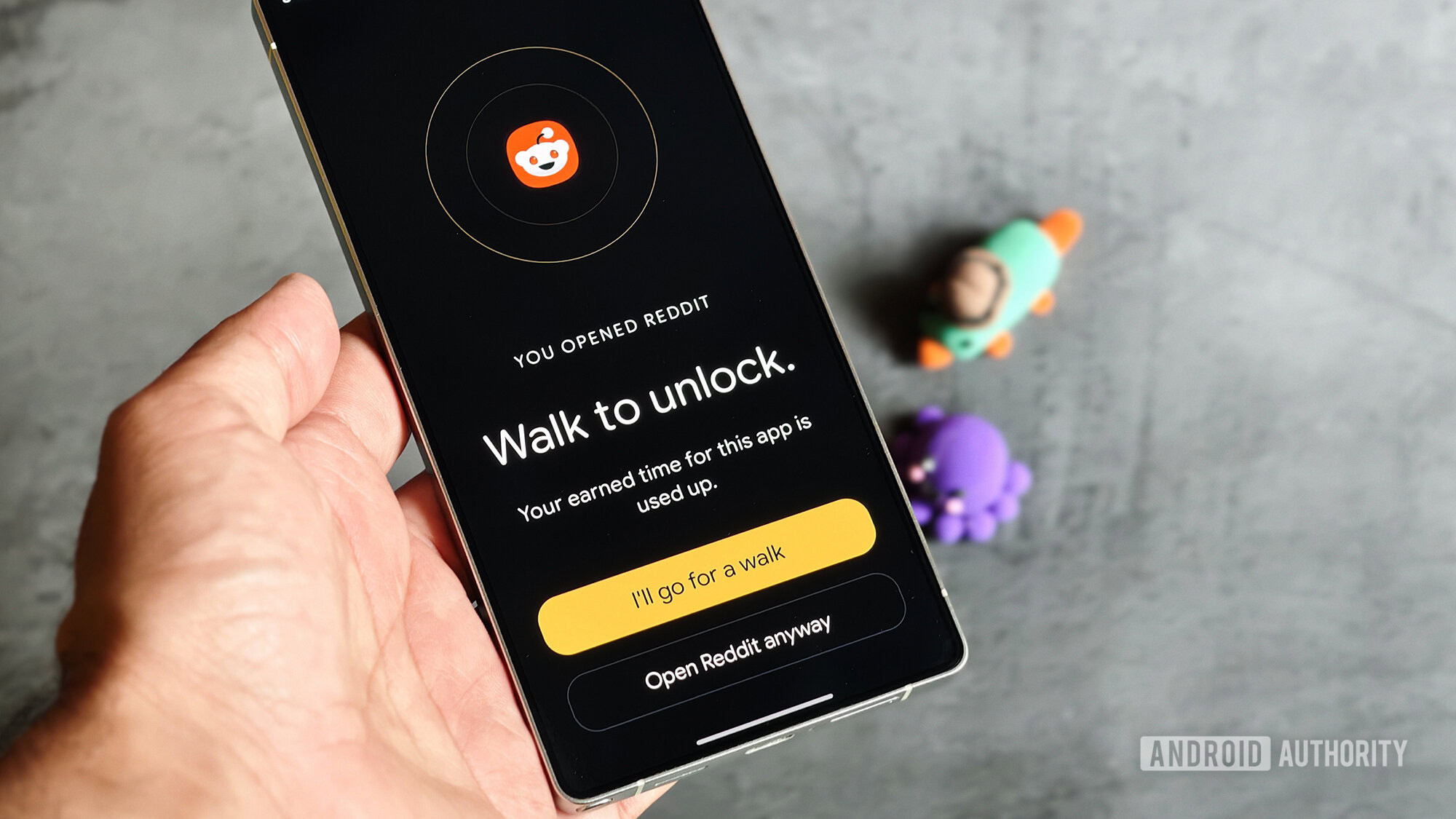
The gentle messaging here always reminds me to go for a walk, but only if I want to. The app lets me choose between a hard wall, which disables bypass without walking, and a soft one that lets me through with some friction. I choose the latter, just so I don’t uninstall Stroll in a fit of rage.
Tushar Mehta / Android Authority
Hard wall without the option to open app.
It then gives me the option to dismiss the page by tapping “Open anyway,” and choose to use the distracting app it was meant to block.
Despite the easy access to the app, that delay of a couple of seconds is often enough to blow out your reckless spree of switching apps in search of dopamine hits. That’s different from being greeted by a Short the moment I tap the YouTube icon, half-awake, letting it instantly eat through my limited attention and lock me into pulling that slot machine lever as I scroll to the next one.
In my case, Stroll is not only delaying my seeking of dopamine hits, but also letting me ignore the need entirely.
I’m not walking more because of Stroll, but it’s still working
Tushar Mehta / Android Authority
I’m not walking more, as the big bold words above also say. That would confuse you, because you’d question the app’s validity and effectiveness before you even finish the article. But would your opinion change if the app is actually helping reduce my social media usage instead?
About three to four times out of 10, when I open a social media app, I now tend not to open it. I’m conserving energy, as a wise sloth would, and happily giving away the time I’d spend squandering on social media.
While I initially started with a very low steps-to-time ratio (low difficulty), I’ve gradually increased it so I spend less time on social media per step I walk.
Tushar Mehta / Android Authority
To be honest, I’m not necessarily spending time not looking at the screen. Instead, I now spend it on apps that help me learn, such as book-reading or RSS apps. When I’m not in the mood to look at a screen, I can listen to a podcast that keeps my wandering mind still — or just rawdog it and try to make a melody out of renovation noises from next door.
It’s a new way to look at the “value” of time
Tushar Mehta / Android Authority
The best way to slow down time is to hold a plank, it’s said. (Okay, I truly don’t know whether it’s actually said; I read it at a gym once). Walking when you don’t want to probably comes second on that list. The only time I voluntarily walk — for fun — is when I’m out on a hike, distracted by beautiful mountain peaks, or when I’m exploring a new city. In my native urban jungle, I’m naturally less inclined to do it.
So, by having to trade actual steps for (some more) time on social media, I’m learning the real value of time. Can you imagine the weight in the word “value” here? All of this understanding is utterly simple. And yet I’m so surprised it took a very simple app like Stroll to bring that to me as an epiphany.
The app emphasizes time’s resourcefulness, and that it ‘must be earned.’
Another significant feature here is that Stroll lets me stack any unused time in a “time bank” that I can use on subsequent days if I want. That means any surplus, unutilized time can be hoarded for days of poor self-control. While I appreciate the option, I prefer sticking to daily limits to keep my usage in check.
I can already feel the difference
Tushar Mehta / Android Authority
As part of my job, I have to switch devices often, sometimes within the same week. While Stroll stays on my primary phone, I don’t actively use it on every phone. Despite that, I’ve noticed a shift in my patterns of compulsive social media use.
I find myself reaching for my phone less, and even when I do, I’m less inclined to open Instagram or YouTube, as I previously would. Instead, I can direct my energy toward more intentional use when I really want to use social media — or just unwind with a well-deserved break. And even when I reach for my phone, I now tend to open a reading app rather than something visually stimulating — or to engage in an activity away from my phone. Those clay sculptures you see are a result of one such activity.
Perhaps it’s just muscle memory; I can’t deduce the exact neuroscience behind the shift, but I can say it’s definitely not placebo. My time on social media apps has receded, and I credit Stroll for it. Whether it will stick or not is a different story, but for now, I feel I have a little more control over my novelty-seeking brain, and the feeling is extremely satisfying.
Thank you for being part of our community. Read our Comment Policy before posting.